Mallards ride the first cold fronts south, Canada geese stage over harvested grain fields, and the state’s waterfowl season becomes one of the best stretches on the calendar — provided you know your dates, your zone, and where you’re actually allowed to hunt.
This Montana Waterfowl Season Guide for 2026 is built to remove that guesswork. Whether you’ve hunted the same stretch of river for twenty years or you’re flying in from out of state for your first Montana duck hunt, we’ve put together this guide — from Hunting Locator — to walk through every date, license, and access point you need before the season opens.
Here’s what’s covered below:
- Confirmed 2026–27 season dates and bag limits by species and flyway
- Every license, permit, and credential you need — resident and non-resident
- Where to hunt: public lands, private-land leases, and guided options
Here’s the quick version before we get into detail.

Quick Overview: Montana Waterfowl Season 2026 at a Glance
Montana spans two flyways, and where you hunt determines your dates and limits. The western portion falls under the Pacific Flyway; the eastern portion falls under the Central Flyway, which splits further into separate zones. This is the biggest planning risk for hunters new to the state — show up on the wrong weekend in the wrong zone and you’ll find an empty marsh with no birds you can legally shoot.
Montana Fish, Wildlife & Parks (FWP) sets these flyway and zone boundaries and is the authority to check before finalizing your trip. For a zone-by-zone breakdown, see our full Montana waterfowl guide.
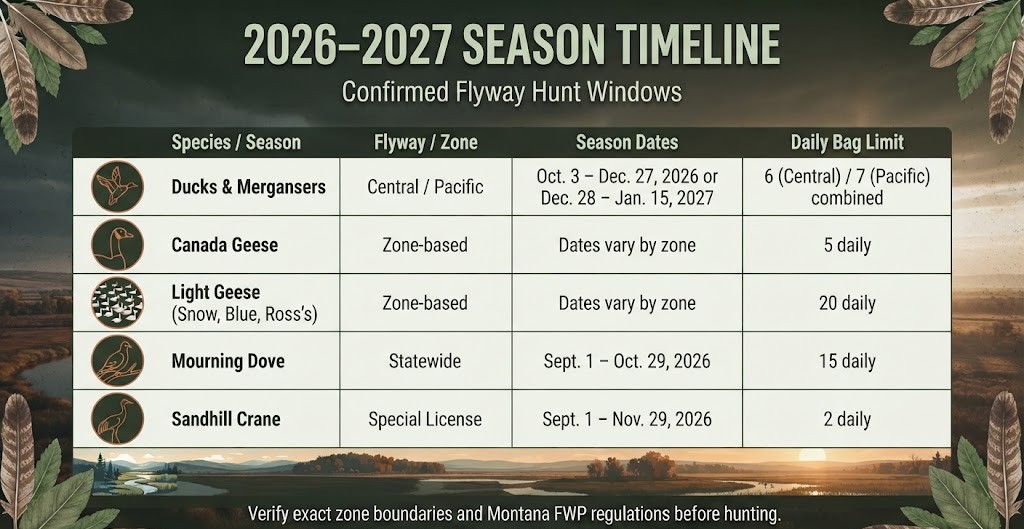
| Species | Season Dates (2026–27) | Daily Bag Limit | Notes |
|---|---|---|---|
| Ducks & Mergansers | Oct 3 – Dec 27, 2026, OR Dec 28, 2026 – Jan 15, 2027 (varies by zone/flyway) | 6 (Central Flyway) / 7 (Pacific Flyway) combined | Possession typically 3× daily |
| Canada Geese | Dates vary by zone | 5 daily | Confirm zone dates with FWP |
| Light Geese (Snow, Blue, Ross’s) | Dates vary by zone | 20 daily | High-volume migration species |
| Mourning Dove | Sep 1 – Oct 29, 2026 | 15 daily (45 possession) | Adjacent early bird season |
| Sandhill Crane | Sep 1 – Nov 29, 2026 | 2 daily | Requires specific license |
Confirm current dates and limits with Montana FWP (fwp.mt.gov) before you hunt. These details can shift annually based on population surveys and zone-specific management decisions.
Before you load the truck, every waterfowl hunter in Montana needs the right paperwork:
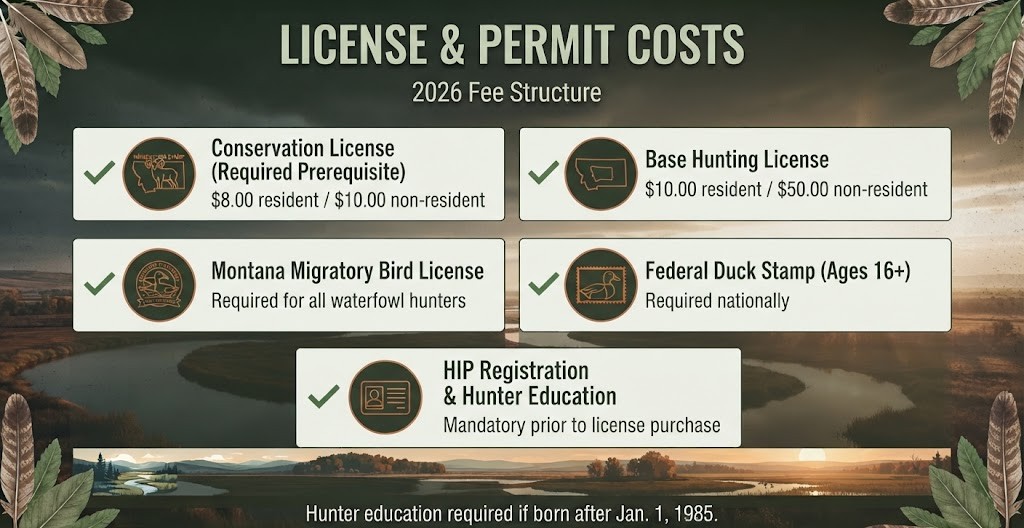
- Base Hunting License — the required foundation for all hunting in Montana
- Conservation License — a required prerequisite you’ll need before anything else
- Montana Migratory Bird License — required for all waterfowl hunters, resident or non-resident
- Federal Duck Stamp — required for hunters age 16 and older
- HIP (Harvest Information Program) registration — must be completed before purchasing your Migratory Bird License
- Hunter education — required for anyone born after January 1, 1985
Montana Waterfowl Hunting Seasons
The table above covers the basics, but dates and limits vary by flyway and zone, so it’s worth understanding how each species breaks down. Below: ducks, geese, and the two “bonus” migratory species that round out Montana’s fall bird calendar.
Duck & Merganser Season
Montana’s duck and merganser season runs on a split structure for 2026–27: Oct 3 – Dec 27, 2026, or Dec 28, 2026 – Jan 15, 2027, depending on your zone and flyway. The split gives hunters access during both the early migration push and the late-season flight, when colder weather drives bigger numbers of birds south.
Bag limits are 6 daily combined in the Central Flyway and 7 daily combined in the Pacific Flyway, with possession limits typically running 3× the daily bag. Montana’s rivers and wetlands host a strong mix of species throughout the season, including mallards, pintails, teal, gadwall, wigeon, canvasbacks, and redheads. Some species carry their own sub-limits within the daily bag, so confirm species-specific restrictions with FWP before you head out.
Goose Season (Canada & Light Geese)
Canada geese carry a daily bag limit of 5, with season dates that vary by zone. These birds are abundant statewide and often stage over harvested grain fields well before the main duck migration kicks in.
Light geese — snow, blue, and Ross’s geese — allow a much higher daily bag limit of 20, reflecting their tendency to move through in large flocks during migration. Like Canada geese, light goose dates vary by zone, so confirm your zone first here too.
Sandhill Crane & Mourning Dove
Sandhill crane season runs September 1 – November 29, 2026, with a daily bag limit of 2. Unlike ducks and geese, cranes require a specific license beyond your standard waterfowl paperwork, so plan ahead if you want to pursue them.
Mourning dove season opens earlier, running September 1 – October 29, 2026, with a daily bag limit of 15 and a possession limit of 45. Because it opens before the main waterfowl season, dove hunting is worth factoring into your early-fall planning — check our Montana game bird seasons guide for the full picture on doves and other upland birds.
One rule applies across all of it: non-toxic shot is required for all waterfowl hunting nationwide, and lead shot has been prohibited for waterfowl since 1991 due to lead poisoning risks in wild bird populations. Shotguns must also be plugged to hold no more than three shells total.
Montana Waterfowl Licenses and Permits
Licensing is the first thing to sort out. Get it right and the rest of the trip — scouting, gear, getting into the blind — goes a lot smoother.
Montana Hunting Licenses
| License | Resident Cost | Non-Resident Cost | Required For |
|---|---|---|---|
| Base Hunting License | $10 | $50 | All hunters (foundation) |
| Conservation License | $8 | $10.00 | Required prerequisite for all hunters |
| Montana Migratory Bird License | Required | Required | All waterfowl hunters |
| Federal Duck Stamp | Required (age 16+) | Required (age 16+) | Hunters 16 and older |
There’s a logical order to buying these: Conservation License first, then Base Hunting License, and only after that can you add the Montana Migratory Bird License and Federal Duck Stamp. Before purchasing the Migratory Bird License, you’ll also need to complete HIP registration. For current Migratory Bird License and Duck Stamp fees, confirm directly with Montana FWP — exact figures beyond the base license costs weren’t part of the authoritative data used for this guide.
Montana Hunting Permits & How to Buy (Non-Resident Steps)
If you’re planning your first Montana waterfowl trip from out of state, here’s the process to get legal before you hit the water:
- Complete HIP registration — provide your name, address, and date of birth before purchasing your Migratory Bird License. According to Montana’s migratory bird regulations, migratory bird hunters must complete this survey before buying the license.
- Purchase your Conservation License — the required prerequisite for every other license.
- Purchase your Base Hunting License — your foundational credential to hunt in Montana at all.
- Add your Montana Migratory Bird License — required for all waterfowl hunters.
- Buy your Federal Duck Stamp — required for hunters age 16 and older, available through USPS and FWP offices.
- Carry proof of hunter education — required if you were born after January 1, 1985; an approved course from any state or province is accepted.
Montana’s license year opens March 1, so if you’re planning a fall trip, lock in your licensing — and your land access — well ahead of the October opener. The Federal Duck Stamp is worth noting beyond the legal requirement: it directly funds wetland conservation, so the marshes and potholes you’re hunting benefit from every stamp sold.
Montana Waterfowl: Where to Hunt
Finding quality, legal access is often the hardest part of planning a hunt, especially if you’re coming from out of state and don’t know the ground. Montana offers a mix of public land, private leases, and guided options, and knowing how each fits your trip matters.
Best Public Lands
Montana has real public access for waterfowl hunters, worth building into your plan even if you end up supplementing with private ground. Common categories include:
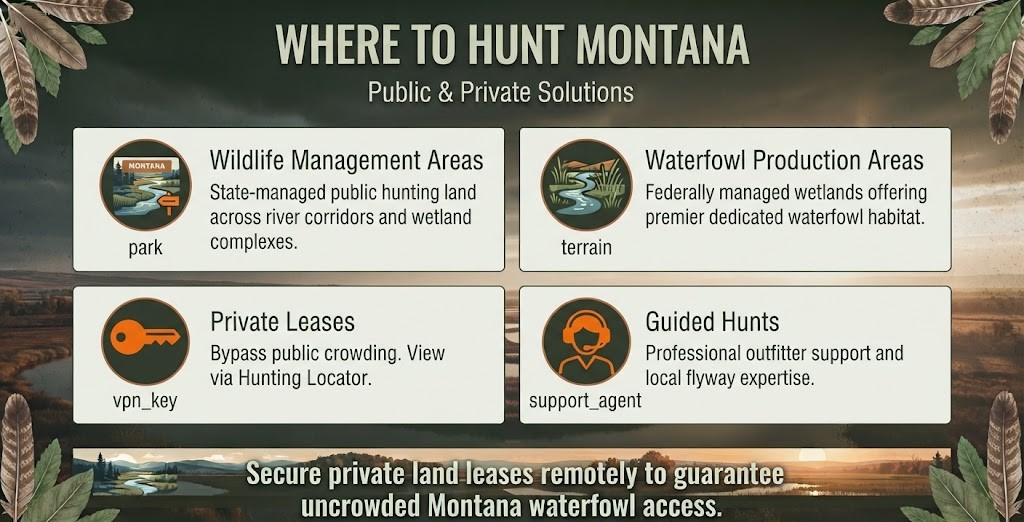
- Wildlife Management Areas (WMAs) — state-managed public hunting land scattered across Montana’s river corridors and wetland complexes
- Waterfowl Production Areas (WPAs) — federally managed wetlands under the National Wildlife Refuge and Wetland Management District system, offering some of the state’s best dedicated waterfowl habitat
- National Wildlife Refuges — several refuges across Montana permit hunting during designated seasons, providing large blocks of managed habitat
- Block Management and river-bottom access — check FWP’s public-access tools for current maps and enrolled properties along Montana’s river systems
Public land can produce birds, but it also draws a crowd near the opener, especially at well-known WPAs and refuge units. That’s one reason many hunters — resident and non-resident alike — start looking at private access to spread out and hunt less-pressured water.
Private Land Hunting with Hunting Locator
Private land offers less competition, more control over your setup, and often better bird numbers because the water and fields haven’t been pounded all season. There are two paths here: leasing access for the season, or buying land outright if you’re building toward a long-term hunting property.
Hunting Locator connects hunters directly with landowners who lease or sell hunting access, so you’re not guessing which properties are legitimate or scrambling to find a phone number for a landowner three states away. Every listing gives you a real starting point — acreage, game type, and terrain — so you can evaluate a property before you make the drive.
Browse current Montana waterfowl leases and start narrowing down the water that fits your season. Whether you’re a resident looking for a fresh spot closer to home or a non-resident who needs access locked in before you book your trip, this is the fastest way to move from “where do I hunt?” to opening day booked.
If leasing isn’t the right fit and you’re thinking longer-term, that same marketplace connects you with landowners open to selling hunting property outright — worth exploring if Montana waterfowl hunting is becoming a yearly tradition rather than a one-off trip.
Guided Hunts
A guided hunt takes the access question off the table entirely, and for many non-residents, that’s the whole point. What a guided trip typically solves:
- Local knowledge — guides know which fields are holding birds and which water is producing right now, not last season
- Gear and blinds provided — decoys, blinds, and calls are often part of the package, cutting down what you need to haul or buy
- Zero-scouting turnkey experience — you show up and hunt, instead of spending your first two days figuring out the water
- Legal-access certainty — guided hunts operate on land the outfitter already has permission to use, removing any question about where you’re allowed to be
Because guided outfitter pricing and availability change hunt to hunt, use Hunting Locator’s resources to explore access options and connect with landowners and outfitters directly rather than relying on secondhand pricing estimates.
Montana Waterfowl Hunting Tips
These are the fundamentals that turn a solid plan into a full strap. None of this requires decades of experience — just attention to a few basics that consistently separate productive hunts from slow ones.
- Scout before you shoot — Find the water and fields where birds are feeding and roosting before opening morning. Understanding migration timing and flight patterns beats luck every time.
- Match your spread — Quality decoys and a well-brushed blind bring birds into range. Set a realistic spread for the water you’re actually hunting, not the biggest one you own.
- Learn the language — Duck and goose calls, used sparingly and correctly, close the distance on wary late-season birds that have already heard every mediocre call in the county.
- Dress for Montana — Layered thermal wear, quality waders, and waterproof outerwear keep you in the marsh longer when the temperature drops and the birds start moving.
- Shoot legal, shoot clean — Use non-toxic shot (required nationwide), keep your gun plugged to three shells, and know your species and bag limits cold before you pull the trigger.
Before opening day, gear up at our store for decoys, blinds, waders, calls, and the non-toxic shot you’ll need to hunt legally and comfortably all season long. Stock your blind bag now, so the only thing you’re thinking about on opening morning is the birds working your spread.
More Resources from Hunting Locator
Montana’s hunting seasons don’t stop at waterfowl, and neither does our resource library. Here’s the toolkit for planning the rest of your season.
Waterfowl & Access:
- The Hunting Locator homepage — your hub for leases, gear, and guides across every state
- Montana hunting leases — browse current private-land access statewide
- The Hunting Locator store — gear up for the season with decoys, blinds, and apparel
- Montana waterfowl deep dive — the companion guide with additional waterfowl detail
- Montana hunting hub — the full-state pillar guide covering every season
- Montana game bird seasons — dove, pheasant, and upland bird coverage
Big Game Seasons:
- Montana deer hunting season — whitetail and mule deer dates and tips
- Montana elk hunting season — rifle and archery elk season planning
- Montana antelope hunting season — pronghorn season details
- Montana moose hunting season — permit-based moose hunting info
- Montana bighorn sheep hunting season — draw-tag sheep hunting guide
- Montana mountain goat hunting season — alpine goat hunting details
- Montana bison hunting season — bison hunting opportunities and rules
Predators & Furbearers:
- Montana black bear hunting season — spring and fall bear season info
- Montana mountain lion hunting season — quota-based lion hunting guide
- Montana wolf hunting season — wolf season rules and quotas
- Montana bobcat hunting season — furbearer season details
Turkey:
- Montana turkey hunting season — spring and fall turkey season guide
Frequently Asked Questions
When does Montana’s 2026 duck season open and close?
Ducks and mergansers run October 3 – December 27, 2026, or December 28, 2026 – January 15, 2027, depending on your zone and flyway. This split structure gives hunters access during both the early and late migration windows. Confirm your zone’s exact dates with Montana FWP before finalizing your trip.
What are the daily bag limits for ducks in Montana?
The daily bag limit is 6 combined in the Central Flyway and 7 combined in the Pacific Flyway, with possession limits typically running 3× the daily bag. Some species carry individual sub-limits within that total, so confirm species-specific restrictions with Montana FWP.
What licenses does a non-resident need to hunt waterfowl in Montana?
Non-residents need a Base Hunting License ($50), a Conservation License ($10), a Montana Migratory Bird License, and a Federal Duck Stamp (required age 16+). You’ll also need to complete HIP registration and carry proof of hunter education if you were born after January 1, 1985.
Do I need a Federal Duck Stamp to hunt ducks in Montana?
Yes. The Federal Duck Stamp is required for all waterfowl hunters age 16 and older, resident or non-resident. It’s available through USPS and FWP offices, and the funds it generates go directly toward wetland conservation.
What’s the difference between the Central and Pacific Flyway in Montana?
Montana spans both flyways — the western portion falls under the Pacific Flyway, and the eastern portion falls under the Central Flyway, which further splits into separate zones. Your flyway and zone determine your exact season dates and bag limits, so confirm both with Montana FWP before you plan your trip.
Is non-toxic shot required for waterfowl hunting in Montana?
Yes. Non-toxic shot is required for all waterfowl hunting nationwide, and lead shot has been prohibited since 1991 due to lead poisoning risks in waterfowl populations. Shotguns must also be plugged to hold no more than three shells.
Where can I find private land to hunt waterfowl in Montana?
You can browse vetted private-land leases through Hunting Locator’s Montana hunting leases marketplace, which connects you directly with landowners who lease or sell hunting access statewide. It’s built for both residents looking for fresh ground near home and non-residents securing access remotely.
The Final Shot
Planning a successful Montana waterfowl season for 2026 comes down to three things: know your flyway, zone, and dates; get your licenses in the right order; and lock in quality access before the crowds do. Get those pieces in place and the rest — scouting, gear, the actual hunting — follows.
Before opening day, confirm your current season dates and bag limits directly with Montana FWP at fwp.mt.gov, since these details can shift slightly year to year. From there, complete your HIP registration and licensing, then turn your attention to securing land and gear.
This Montana Waterfowl Season Guide for 2026 covers half the equation — the other half is having somewhere to actually hunt. Browse our current Montana waterfowl leases and work through the resource hub above to finish planning your season.


