This Montana wolf guide covers dates, costs, limits, access and gear for residents and out-of-state hunters alike.
Hunting Locator is where you can plan, find ground and gear up. Montana FWP has the final word on quotas and closures, so use this guide for planning and check with FWP before you head out.
Ahead:
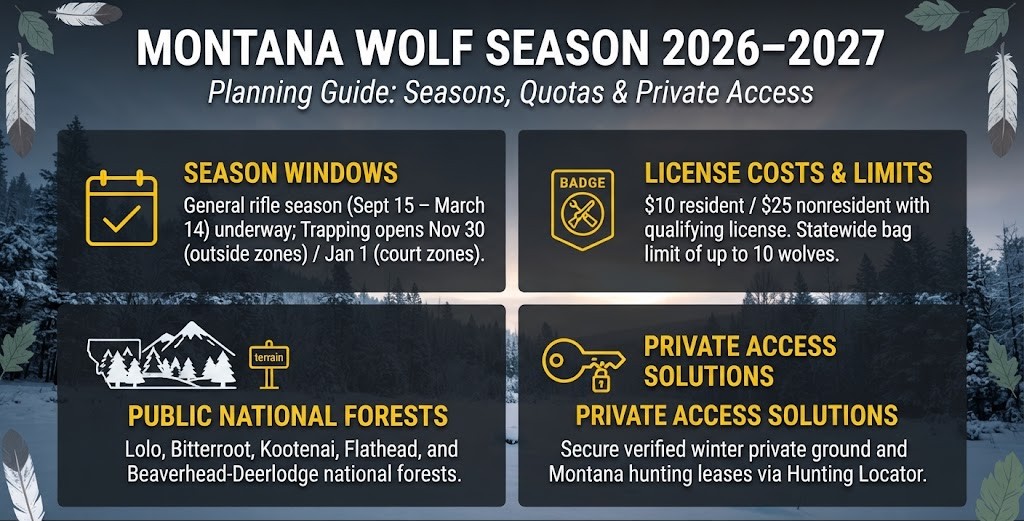
- Season dates, license costs and the 10-wolf bag limit at a glance
- Where to hunt: public land, private leases and guided options
- Tips, gear and resources for a winter hunt
Montana Wolf Season Guide for 2026: Quick Overview
The table below summarizes the seasons. For more on the species, see our Montana wolf hunting season page.
| Season / Method | Dates | Bag Limit | Key Regulations |
|---|---|---|---|
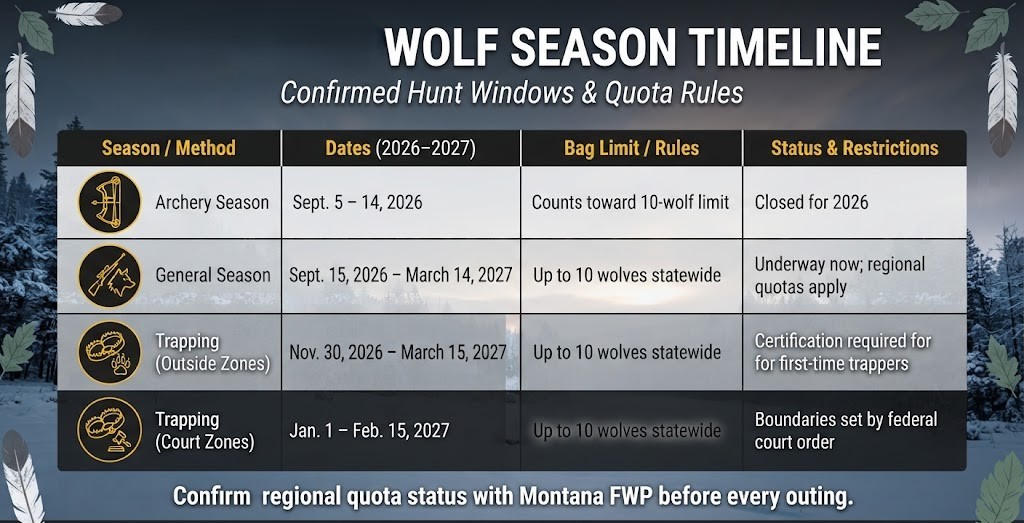
| Archery | Sept 5–14, 2026 | Counts toward the 10-wolf statewide limit | Wolf license + base license |
| General (rifle/any legal weapon) | Sept 15, 2026 – March 14, 2027 | Up to 10 licenses / 10 wolves statewide | Regional quotas can close areas early |
| Trapping, outside court-ordered zones | Nov 30, 2026 – March 15, 2027 | Up to 10 wolves statewide (regional exceptions) | Wolf trapping certification required for first-time trappers; wolf trapping license |
| Trapping, inside court-ordered zones | Jan 1 – Feb 15, 2027 | Same as above | Boundaries set by federal court order; check FWP maps |
Wolf license cost: $10 resident / $25 nonresident with a Sportsman’s or Combination License.
Licensing runs in a fixed order: base license, then wolf license, then certification if you plan to trap, then a quota check before each outing. The requirements are:
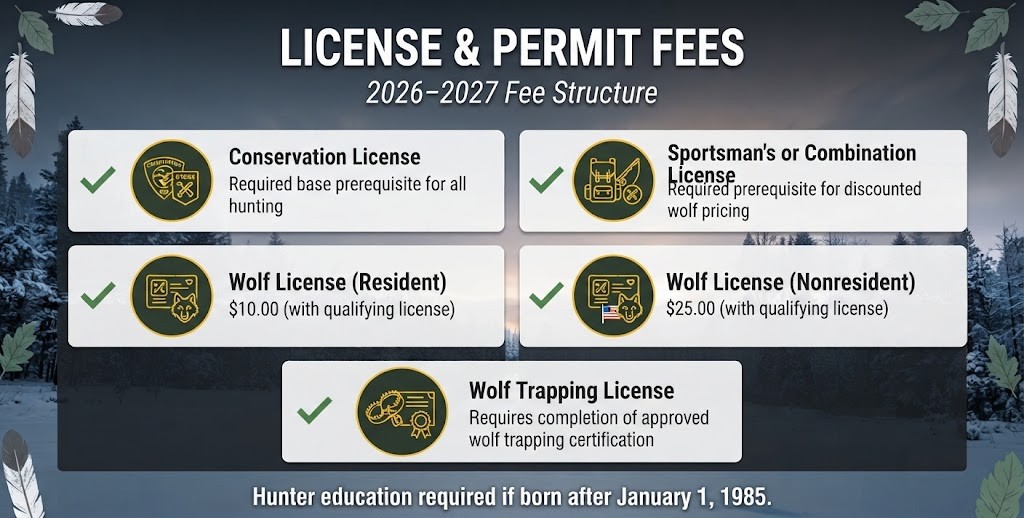
- Conservation License: Required as the base for all hunting licenses.
- Sportsman’s or Combination License: Qualifies you for the $10 (resident) / $25 (nonresident) wolf license pricing.
- Hunter education: Required if you were born after January 1, 1985. A Montana course or another state or province’s approved course both count.
- Trapping certification: First-time wolf trappers must complete a Montana or Idaho wolf trapping certification course before setting a trap.
- Quota check: Confirm regional quota status with Montana FWP before every outing.
If you want private ground this winter, browse Montana hunting leases to see what’s open.
Montana Wolf Hunting Seasons
Montana divides wolf opportunity by method. Archery has ended, the general season is running, and trapping opens next.
Archery Season
Archery runs September 5–14, 2026. It overlaps fall bear country, so bowhunters often pair the two. For that kind of trip, start with the Montana black bear hunting season guide.
General Season
The general season runs September 15, 2026, through March 14, 2027. Confirm final dates with Montana FWP before your hunt.
The wolf tag is inexpensive: $10 for residents and $25 for nonresidents with a Sportsman’s or Combination License. That makes it easy to add a wolf tag to your elk hunt or pair it with the Montana deer hunting season.
Regional quotas work like a shared pool. When a region’s quota fills, that region can close before March. Region 3 has closed early in past seasons, so check status before every outing instead of assuming your unit is open. Late-season snow also helps with tracking, covered in the tips section.
Trapping Season: Inside vs. Outside Court-Ordered Zones
Trapping has the most moving parts. A federal court order sets a shorter trapping window in defined areas, including parts of Regions 1–5. Check FWP maps for exact boundaries before you set a trap.
| Zone | Dates | What to Know |
|---|---|---|
| Outside court-ordered zones | Nov 30, 2026 – March 15, 2027 | Opens first; certification required for first-time wolf trappers |
| Inside court-ordered zones | Jan 1 – Feb 15, 2027 | Shorter window; verify boundaries on FWP maps |
Trapper rules to know before you head out:
- Foothold trap inside jaw spread may not exceed 9 inches.
- Two swivels, including a center swivel, are required on ground-set foothold traps.
- Report any incidental capture of a non-target animal, including domestic animals, to FWP within 24 hours.
- Present harvested pelts to FWP for tagging and registration.
The official FWP wolf regulations are the place to verify every rule, including zone boundaries and certification requirements.
Check traps as often as the regulations and ethical practice require. If you also run a winter line for furbearers, the Montana bobcat season guide may be useful.
Montana Wolf Licenses and Permits
This section lays out each license and the steps to get legal. For statewide license context, see our Montana hunting overview.
Montana Hunting Licenses
| License | Resident | Nonresident | Requirement / Notes |
|---|---|---|---|
| Conservation License | $8 | $10 | Required base for all hunting licenses |
| Wolf License (with Sportsman’s or Combination) | $12 | $50.00 | Up to 10 licenses / 10 wolves per hunter statewide |
| Wolf Trapping License | $250 | $250 | Certification course required for first-time wolf trappers |
Fees differ without a Sportsman’s or Combination License, so check FWP before you buy. Regional exceptions and reduced limits may apply near protected boundaries and in portions of Region 3. If you were born after January 1, 1985, you’ll need proof of hunter education before purchasing a hunting license.
Montana Hunting Permits
Montana has no draw or limited-entry permit for wolves, so there is no application process and no lottery. The steps are:
- Buy your base license. Start with the Conservation License and a Sportsman’s or Combination License.
- Add your wolf license. Purchase it through FWP online or an FWP license provider before you hunt, and confirm purchase deadlines with FWP.
- Complete certification (trappers). First-time wolf trappers need a Montana or Idaho wolf trapping certification course.
- Check the quota before each outing. Regional closures can happen mid-season.
After a successful hunt, present the pelt to a designated FWP employee for tagging and registration.
Where to Hunt Wolves in Montana
Most of the activity is in western Montana. Region 1 in Northwest Montana has historically led wolf harvest, while Regions 6 and 7 see little to none. Your options are public land, private ground and guided hunts.
Best Public Lands
Montana’s public ground is extensive and open to scouting. Respect closures, and check quotas before you commit to a drainage.
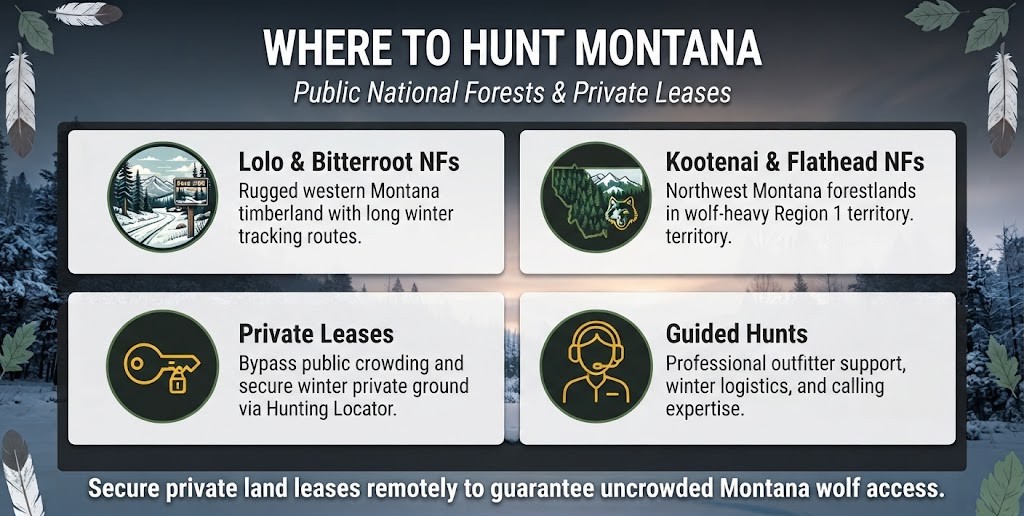
- Lolo National Forest: Big western Montana country with room to roam.
- Bitterroot National Forest: Rugged terrain and long winter tracking opportunities.
- Kootenai National Forest: Northwest Montana forestland in wolf-heavy Region 1 territory.
- Flathead National Forest: Another strong option in Northwest Montana.
- Beaverhead-Deerlodge National Forest: Southwest Montana access across large public acreage.
- BLM ground: Open country that complements the forests.
- Block Management: Free public access to enrolled private land through FWP.
Private Land Hunting with Hunting Locator
Montana law requires landowner permission on all private land, whether it’s posted or not. Private ground tends to have lower hunting pressure and more predictable access through the winter, which matters when quotas can close public-land units on short notice.
A lease usually means seasonal or annual access with defined species and rules, and it’s best to get permission in writing so expectations are clear. Quotas and season rules still apply on leased land; a lease doesn’t change what FWP allows. Buying gives clubs and families lasting access and the freedom to manage ground over many seasons, while leasing offers flexibility without the long-term commitment. Hunting Locator also connects buyers with landowners who are selling land.
Hunting Locator is a SaaS platform that connects you directly with landowners who lease or sell hunting land, so you spend less time searching. Search by state, species or acreage and reach out to landowners yourself. Browse Montana hunting leases and connect directly with landowners.
Guided Hunts
A guide can simplify logistics for nonresidents who are short on time or unfamiliar with winter terrain.
Before you book an outfitter, ask:
- Are you properly licensed in Montana?
- Which areas do you hunt, and how do you handle quota closures?
- What methods do you use, such as calling or tracking?
- What do lodging and winter travel look like?
- What’s included in the price?
- Do you help with pelt handling and FWP registration?
- Do you offer combo hunt options?
Many hunters pair a wolf tag with a winter predator hunt for the Montana mountain lion season. To talk with outfitters, connect through Hunting Locator.
Wolf Hunting Tips
Good gear makes a cold winter hunt more comfortable and more productive, and you can find it at the Hunting Locator store. The tips that matter most:
- Check quotas before every outing. Regional quotas are a shared pool that can empty fast. A quick FWP check is cheaper than driving hours to a closed unit.
- Call with patience. Howls and distress sounds both work, and e-callers are a popular option. Confirm electronic caller rules with FWP before you buy or use one.
- Glass big country. Wolves cover a lot of ground, and quality optics let you spot them at long range before they spot you.
- Track fresh snow. Late-season snow reveals travel routes and gives you a starting point.
- Choose a flat-shooting, adequate caliber. Consider distance, cold-weather reliability and your own comfort with the rifle.
- Dress for severe cold. Layer for sitting still in sub-zero conditions, because you’ll spend more time stationary than you expect.
- Handle the pelt properly. Keep it clean and cool, and present it to FWP for tagging.
- Hunt ethically. Get landowner permission and positively identify your target every time.
- Gear up before you go. E-callers, optics and cold-weather layers all earn their keep in winter, so shop hunting gear at the Hunting Locator store before the season gets away from you.
More Resources from Hunting Locator
Everything below is on Hunting Locator, so you can plan your whole Montana season in one place.
Montana Wolf & Access
- Montana wolf hunting season: The companion species page with season details.
- Montana hunting overview: Statewide hunting information and license context.
- Montana hunting leases: Browse private land access with direct landowner contact.
- Hunting Locator store: Gear for your winter hunt.
Pair With Your Wolf Tag
- Montana elk hunting season: Add a wolf tag to your elk trip.
- Montana deer hunting season: Another natural pairing.
- Montana black bear hunting season: Plan ahead for next fall’s archery overlap.
- Montana mountain lion hunting season: A winter predator companion hunt.
- Montana bobcat hunting season: For trappers running winter lines.
Other Montana Big Game
- Montana antelope hunting season
- Montana bighorn sheep hunting season
- Montana bison hunting season
- Montana moose hunting season
- Montana mountain goat hunting season
Birds & Waterfowl
FAQ
How much is a nonresident wolf license in Montana?
A nonresident wolf license costs $25 with a Sportsman’s or Combination License, while residents pay $10. A Conservation License is the required base. Fees differ without a Sportsman’s or Combination License, so check Montana FWP before purchasing.
When does wolf trapping start in Montana in 2026?
Trapping opens November 30, 2026, outside federal court-ordered zones and runs through March 15, 2027. Inside the court-ordered zones, trapping runs January 1 – February 15, 2027. Check FWP maps to confirm which side of the boundary your trapline falls on.
How many wolves can you kill in Montana?
You can hold up to 10 wolf licenses and take up to 10 wolves per hunter statewide. Regional exceptions apply, and quotas can close areas early. Confirm your region’s status with Montana FWP before heading out.
Do I need a trapping certification to trap wolves in Montana?
Yes, for first-time wolf trappers. You must complete a Montana or Idaho wolf trapping certification course before setting a trap. You’ll also need to report any incidental capture of a non-target animal, including domestic animals, to FWP within 24 hours.
Do I need hunter education?
Yes, if you were born after January 1, 1985. You’ll need proof of completing a Montana hunter education course or an approved course from another state or province before you can buy a hunting license.
Can I hunt wolves on private land in Montana?
Yes, with landowner permission, which is required whether the land is posted or not. Block Management offers free access to enrolled private land, and you can also browse Montana hunting leases for private ground with direct landowner contact.
Do quotas close regions early?
Yes. Regional quotas work like a shared pool, and when one fills, that region can close before the season ends. Region 3 has closed early in past seasons. Check Montana FWP before each outing.
Can I add a wolf tag to my elk hunt?
Yes. The general season runs through March 14, 2027, and a wolf license costs $10 for residents and $25 for nonresidents with a qualifying license. Many hunters add it as an inexpensive companion tag.
What do I do after harvesting a wolf?
Present the pelt to a designated Montana FWP employee for tagging and registration. Keep the hide clean and cool until you can get it there, and confirm any additional reporting steps with FWP.
What gear do I need for winter wolf hunting?
Plan for a caller, quality optics, cold-weather layers and a rifle you shoot well in your chosen caliber. You can find hunting gear at the Hunting Locator store, and confirm electronic caller rules with FWP first.
The Final Shot
The general season runs through March 14, 2027, and trapping opens November 30 or January 1, depending on the zone. A $10 or $25 wolf license, a 10-wolf limit and a quota check with Montana FWP are the basics for hunting wolves in Montana this winter.
To plan your season, find private ground and pick up gear, start with Hunting Locator.


