Those odds shouldn’t stop you from chasing what many consider the West’s most coveted elk tags.
Nevada’s elk herds produce some genuinely incredible bulls, and this guide breaks down everything you need to know for 2026. We’re covering the real costs (spoiler: it’s expensive), actual season dates, and where you can realistically hunt—including some alternatives to the decades-long wait for public land tags.
What you’ll find here:
- Exact 2026 season dates for every hunt type
- The full financial picture for residents and non-residents
- Honest talk about where to hunt, including private land options when you’re tired of playing the lottery
Let’s dive into what actually matters for your 2026 Nevada elk plans.
Quick Overview: 2026 Nevada Elk Season at a Glance
Here’s the official breakdown straight from NDOW’s 2026-2027 regulations. No fluff, just the dates and details you need.
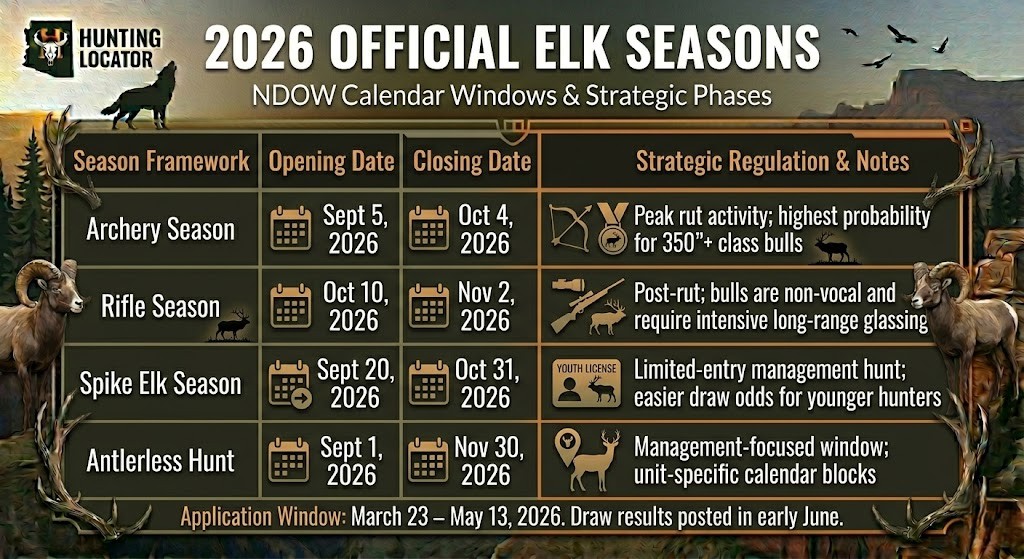
| Season Type | Start Date | End Date | Bag Limit | Key Notes |
|---|---|---|---|---|
| Archery | September 5, 2026 | October 4, 2026 | 1 per tag | Peak rut timing; best trophy odds |
| Any Bull Rifle | October 10, 2026 | November 2, 2026 | 1 per tag | Post-rut; tougher hunting conditions |
| Spike Elk (Various Units) | September 20, 2026 | October 31, 2026 | 1 spike | Max 2 points per antler |
| Antlerless (Various Units) | September 1, 2026 | November 30, 2026 | 1 per tag | Management hunts; unit-specific |
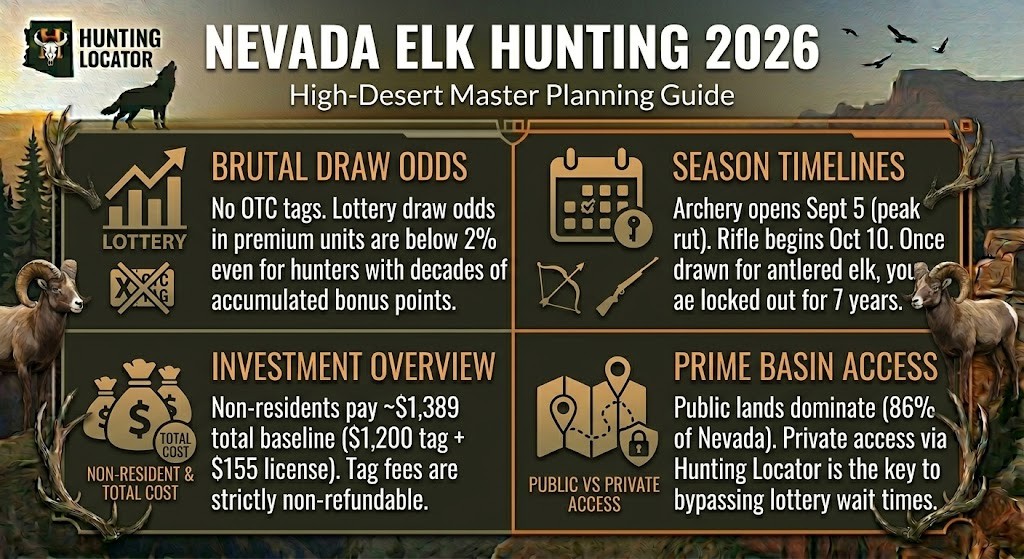
Every Nevada elk hunt requires winning the lottery draw—no over-the-counter tags exist. Nevada’s squared bonus point system gives everyone a mathematical chance, even first-time applicants. Your 5 points become 25 entries, 10 points become 100. But here’s the catch: no guaranteed tags for high point holders means you could apply for 30 years and still get beat by someone’s first application.
What You Need Before You Hunt:
- Valid Nevada hunting license (required before applying)
- Hunter education certificate (mandatory if born after January 1, 1960)
- Elk tag from the draw (application window: March 23 – May 13, 2026)
- Habitat Conservation Stamp (certain public lands)
- Application fee (non-refundable: $12 residents, $19 non-residents)
Nevada Elk Hunting Seasons
Your season choice isn’t just about dates—it’s about strategy. Each season offers completely different hunting experiences, trophy potential, and draw odds.
Archery Elk Season
September 5 – October 4, 2026 is when magic happens. This is hands down the best time to tag a giant bull, and virtually every Nevada unit can produce a 350-inch bull during archery season.
Why archery works so well here: Nevada’s elk rut earlier than most western states. September archery perfectly aligns with peak rut madness. Bulls are vocal, responsive to calls, and making mistakes. Bugles echo across basins, cow calls work like magic, and even mediocre calling can produce results.
The downside? Archery odds in top units still sit below 2%, though a handful of units can hit 8-9% odds if you’re strategic about unit selection.
Any Bull Rifle Season
October 10 – November 2, 2026 presents a totally different challenge. Most mature bulls have separated from cows by October 22nd and become incredibly difficult to locate. They’re not moving much, not calling, basically ghosts.
Rifle hunts are physically brutal because bulls aren’t in easy spots anymore. Previous elk and deer seasons have pushed them high and deep into nasty country. You’re looking at serious spot-and-stalk hunting with lots of long-range glassing across Nevada’s massive basins.
One exception: Unit 061 opens October 5th and still has some rut activity remaining, making it unique among rifle hunts.
Spike Elk Season
September 20 – October 31, 2026 across various units. Legal spikes are defined as any elk with no more than 2 antler points on either side.
Spike hunts serve as a management tool for bull ratios while creating additional hunting opportunities. Draw odds are typically better than antlered bull tags, making spike hunts a potential entry point for Nevada elk hunting.
Nevada Elk Licenses and Permits
Nevada requires both a hunting license AND a drawn tag. The costs add up fast, especially for non-residents.
Nevada Hunting Licenses
You must buy the license before applying for tags. It’s separate from the tag itself and required whether you draw or not.
| License Type | Resident Cost | Non-Resident Cost | Notes |
|---|---|---|---|
| Annual Hunting License | $38 | $155 | Required before tag application |
| Combination Hunt/Fish | $62 | $182 | Better value for multi-species hunters |
| Junior License (12-17) | $15 | $15 | Age restrictions apply |
That $156 non-resident license fee is gone forever if you want bonus points—you pay whether you draw or not. Hunter education is mandatory for anyone born after January 1, 1960.
Nevada Elk Permits and Tags
Tags come exclusively through Nevada’s computerized draw. Main application period runs mid-March to mid-May, with results in late May or early June. You can submit up to 5 hunt choices per application through NDOW’s online portal.
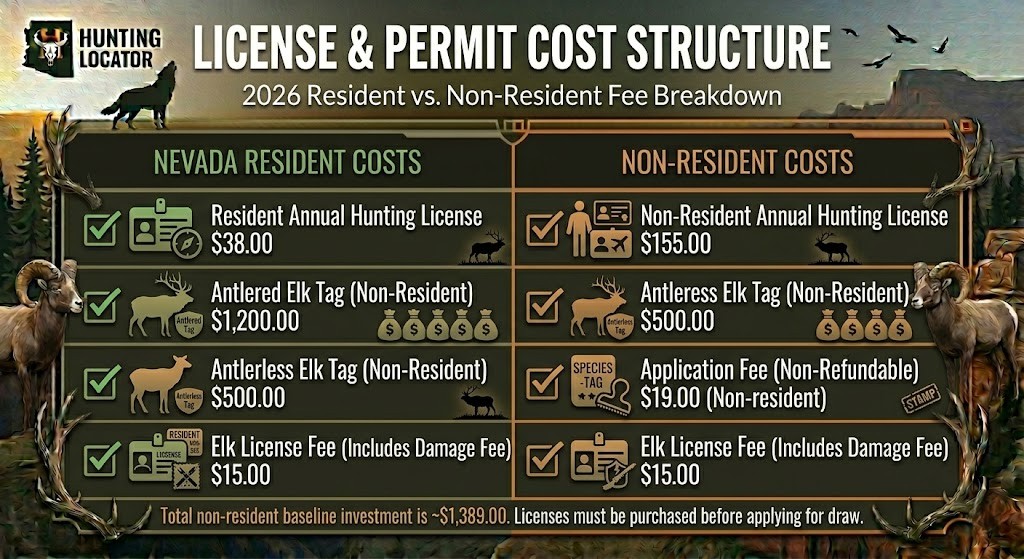
| Tag Type | Resident Cost | Non-Resident Cost |
|---|---|---|
| Antlered Elk Tag | $120 | $1,200 |
| Antlerless Elk Tag | — | $500 |
| Application Fee | $12 | $19 |
| Elk License Fee | $15 (includes $5 elk damage fee) | $15 |
Non-Resident Reality Check: $1,200 tag + $155 license + $19 application + $15 elk license = $1,389 minimum before you even book a flight to Nevada.
Let’s be honest about the odds. Even with maximum points—33 years of applications—the best units hover under 2% for most weapon types. Nevada squares every bonus point, so 5 points becomes 25 entries, 10 points becomes 100. But you’re competing against people with 20+ years of accumulated points. Most non-resident hunters will draw one Nevada elk tag in their lifetime, if they’re lucky.
Critical Rule: Draw an antlered elk tag and you’re locked out for seven years, regardless of whether you fill it. This makes every drawn tag a genuine once-in-a-decade opportunity.
Where to Hunt Nevada Elk
Nevada’s elk live primarily in the eastern and central regions. The northeastern corner holds the highest elk populations. Good news: access is mostly public. BLM data shows 48 million acres of public land in Nevada—86% of the entire state is federally owned.
Best Public Lands for Nevada Elk
Nevada’s massive public land holdings provide incredible hunting access, though units can be huge and remote, making e-scouting absolutely essential.
Top Public Land Areas:
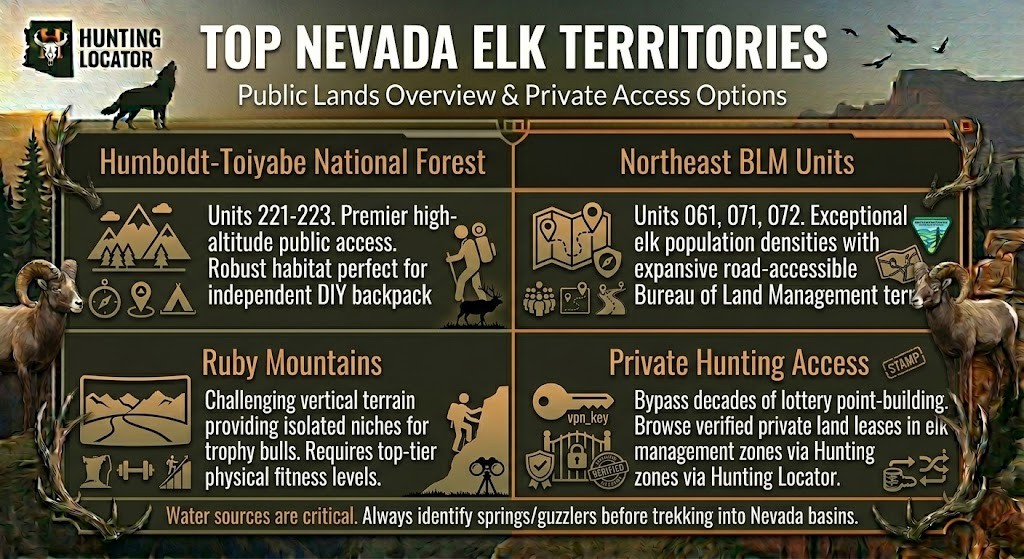
- Humboldt-Toiyabe National Forest: Straddling the Utah-Nevada border, units 221, 222, 223 offer excellent public access. Perfect for DIY hunters with capable 4WD vehicles and provides serious backcountry opportunities.
- BLM Lands (Eastern Nevada): Units 061, 071, 072 in the northeast pack high elk numbers with extensive BLM access. Decent road access for hunters with proper vehicles.
- Grafton Wilderness (Unit 222): Southern White Pine County with low hunting pressure because motorized vehicles are banned. Requires packing in but means fewer hunters.
- Ruby Mountains: Premium elk habitat with challenging terrain. Demands physical fitness and proper preparation for high-elevation hunting.
In Nevada’s dry climate, water isn’t just important—it’s absolutely critical. Plan to pack water or camp near reliable springs and guzzlers.
Trophy Unit Breakdown:
Top-tier units are 111, 112, 113, 114, 115, 221, 222, 223 for maximum trophy potential. However, units 62, 64, 66, and 67 offer significantly better draw odds while still producing 350-inch bulls—smart choices for hunters balancing trophy potential against realistic draw chances.
Guided Hunts and Outfitters
Going with an outfitter makes sense if you lack time and/or hunting partners for a successful self-guided hunt. Many Huntin’ Fool Endorsed Outfitters average over 350 inches on all their hunts in better units.
Outfitter costs significantly increase your already substantial investment, but for a potentially once-in-a-lifetime tag, professional guidance might be worth it.
DIY vs. Guided Decision Points:
- Go DIY if: You have scouting time, hunting partners to help, western elk experience, and physical fitness for demanding terrain
- Go Guided if: This is your first western elk hunt, you have limited scouting time, or you want to maximize success on a potentially once-in-a-lifetime tag
Private Land Elk Hunting with Hunting Locator
Private land hunting offers an escape route from the decades-long wait for draw tags. While Nevada is predominantly public, strategic private holdings exist with elk hunting opportunities.
Leasing Private Land:
Private land leases provide guaranteed access without draw system uncertainty. Lease agreements typically run annually and may include exclusive or shared access depending on the property.
Buying Private Land:
For serious elk hunters with long-term vision, purchasing private land in elk habitat provides permanent access and potential income through leasing to other hunters. Requires significant capital but eliminates draw dependency entirely.
Hunting Locator: Your Private Land Connection
Hunting Locator connects hunters with landowners offering hunting leases and sales. Our database includes verified Nevada properties with elk populations, detailed acreage information, and direct landowner contacts. Instead of waiting decades for public land tags, secure private land access and hunt Nevada elk on your timeline. Browse Nevada hunting leases to find your next elk hunting opportunity.
Nevada Elk Hunting Tips
Success in Nevada’s challenging country requires specific strategies adapted to the state’s unique terrain and conditions. Nevada’s elk country allows long-range spotting unlike thick-timbered states.
Essential Nevada Elk Strategies:
- Master Long-Range Glassing: Nevada’s open basins allow spotting elk from miles away. Invest in quality optics and learn systematic glassing from high vantage points.
- Focus on Water Sources: In Nevada’s dry climate, water isn’t just important—it’s critical. Identify springs, guzzlers, and water tanks on maps before hunting.
- Plan for Extreme Weather: Nights can drop to freezing while days push triple digits. Pack layered clothing and quality shelter systems.
- Hunt Early and Late: Focus on early morning and late afternoon when elk are most active, especially during rut periods.
- Learn Multiple Calling Techniques: Master various elk calls including bugles, cow calls, and grunts for effective rut communication.
- Prepare for Physical Demands: Rifle hunts are physically demanding since bulls aren’t in easy spots. Build cardiovascular fitness and leg strength before hunting.
More Resources from Hunting Locator
Expand your Nevada hunting knowledge with these guides:
- Nevada Hunting Season Guide – Complete Nevada hunting overview
- Nevada Mule Deer Season – Premier mule deer opportunities
- Nevada Pronghorn Season – Antelope hunting guide
- Nevada Bighorn Sheep Season – Once-in-a-lifetime sheep hunting
- Nevada Black Bear Season – Bear hunting strategies
- Nevada Mountain Lion Season – Predator hunting opportunities
- Nevada Turkey Season – Spring and fall turkey hunting
FAQ
When is the Nevada elk application deadline for 2026?
Nevada’s deadline is May 13th at 11pm Pacific time. Applications open March 23, 2026, giving you nearly two months to submit choices.
How much does a Nevada elk tag cost for non-residents?
Non-resident antlered elk tags cost $1,200, antlerless tags cost $500. Add the $155 hunting license, $19 application fee, and $15 elk license for a total minimum of $1,389 if you draw an antlered tag.
What are Nevada elk draw odds for non-residents?
Non-resident elk draw odds in Nevada are among the worst in the country, with odds below 0.1% at zero points for most top-tier units. Even with maximum points—33 years of applications—the best units hover under 2% for most weapon types.
Can I hunt Nevada elk without winning the draw?
Yes, through private land hunting opportunities. While public land requires winning the draw, private landowners can provide elk hunting access outside the state system. Browse Nevada hunting leases to explore private land options.
What happens if I draw a Nevada elk tag but can’t hunt?
You can return your tag to NDOW, but drawing an antlered elk tag means waiting seven years to apply again regardless of hunt success. This makes the application decision very strategic.
Which Nevada elk season offers the best trophy potential?
Archery season is typically the best time to tag a giant bull, with nearly every Nevada unit capable of producing a 350-inch bull during archery hunts. September timing coincides with peak rut activity.
The Final Shot
Nevada elk hunting represents the ultimate western big game challenge—incredible trophy potential wrapped in brutal draw odds and serious financial commitment. Whether you’re building points for that once-in-a-lifetime public land tag or exploring private land alternatives through Hunting Locator, success demands strategic planning, physical preparation, and realistic expectations.
The 2026 season offers the same incredible opportunities that made Nevada famous for producing 380-400 inch bulls, but with draw odds that keep most hunters waiting decades. For those unwilling to wait, private land access provides an alternative pathway to experience Nevada’s world-class elk hunting without draw system uncertainty.
Ready to secure your Nevada elk hunting opportunity? Explore private land hunting leases and take control of your hunting future today.


