This creates some of the most flexible mountain lion hunting in the West. You can time your hunt around fresh snow, work schedules, or whenever conditions look perfect. But don’t mistake “accessible” for “easy”—these cats remain some of the most challenging animals to hunt successfully.
This Nevada mountain lion season guide covers current season dates and bag limits, complete licensing costs, proven hunting locations, and practical tips from experienced guides. We’ve consolidated the latest Nevada Department of Wildlife (NDOW) regulations with insights from successful hunters to save you time and help you plan effectively. Before you head into Nevada’s rugged terrain, make sure you have the right gear.
Here’s what you’ll discover in this guide:
- Season dates, bag limits, and Nevada’s unique year-round hunting structure
- Complete license and tag costs for residents and non-residents
- Where to hunt and whether you need a guide for success
Let’s start with the essentials every Nevada mountain lion hunter needs to know.
Quick Overview: Nevada Mountain Lion Hunting at a Glance
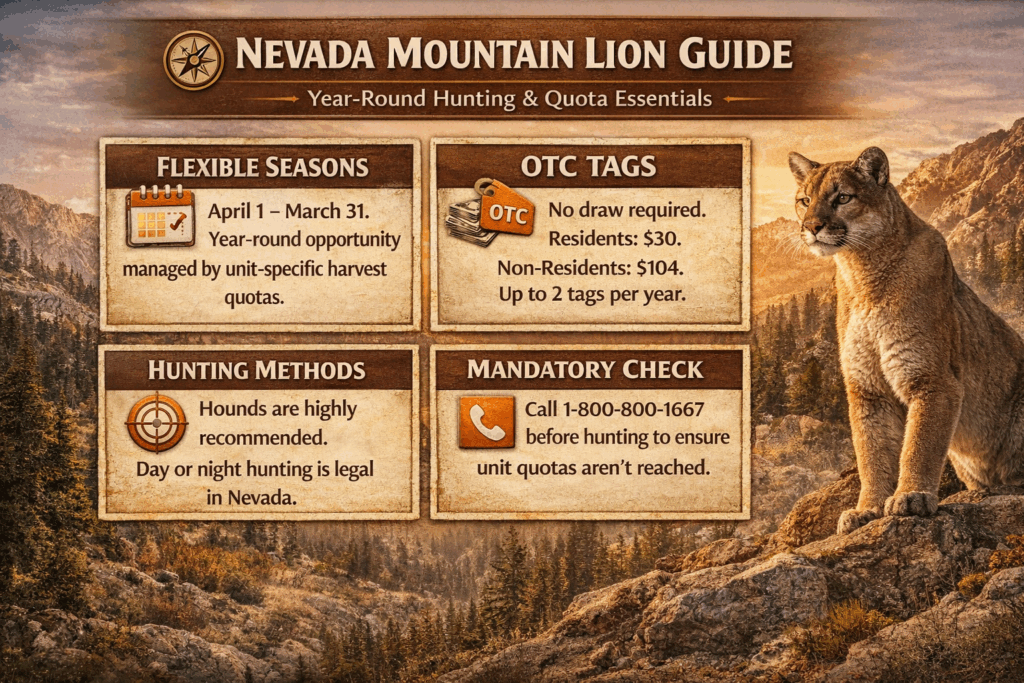
Nevada’s approach to mountain lion management stands out among western states. While neighbors like Utah and Colorado run complex draw systems with limited tags, Nevada keeps things simple: buy a tag when you want to hunt, then go hunting. This system works because Nevada manages harvest through quotas rather than restricting opportunity upfront.
| Element | Details |
|---|---|
| Season Dates | Year-round: April 1 – March 31 (or until quota reached) |
| Bag Limit | 1 lion per tag, maximum 2 tags per person per season |
| Tag Type | Over-the-counter (no draw required) |
| Resident Tag Cost | $30 per tag |
| Non-Resident Tag Cost | $104 per tag |
| Non-Resident License | $155 |
| Hunting Hours | Day or night (Nevada allows both) |
| Hunting Methods | Hounds, calling, spot-and-stalk |
The catch? Seasons close when harvest quotas are met. Nevada targets around 250 lions annually, and once that number’s reached, hunting stops until the next season year. This means checking unit status before you hunt isn’t optional—it’s essential. Call NDOW at 1-800-800-1667 to verify your target area is still open.
What you need to hunt legally:
- Valid Nevada hunting license (resident or non-resident)
- Mountain lion tag(s) purchased through NDOW
- Proof of hunter education
- For non-residents: tags available online at ndowlicensing.com (plan for 2-week shipping)
Nevada Mountain Lion Hunting Season Structure
Most states force mountain lion hunters into narrow windows—hunt in January and February, or don’t hunt at all. Nevada flips this approach completely. Their April-to-March season gives you 12 months to plan around weather, work, and optimal conditions.
Year-Round Season Explained
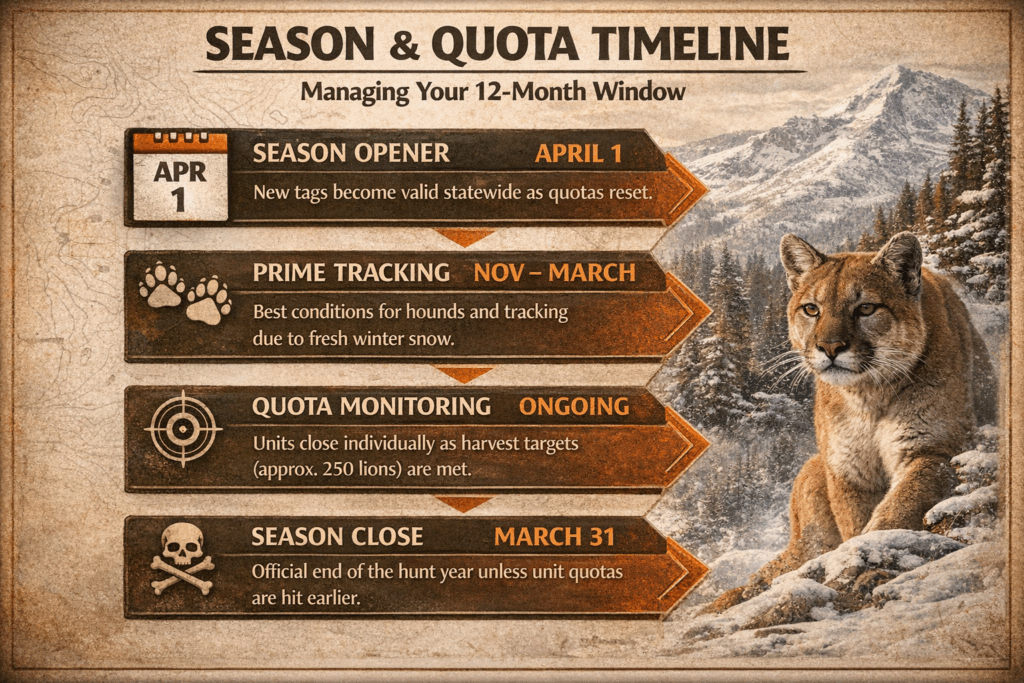
This continuous season doesn’t mean unlimited harvest. Think of it as a 12-month opportunity window with a statewide harvest ceiling. When Nevada hits approximately 250 lions harvested, specific units start closing based on their individual quotas.
The flexibility is huge for hunters. Bad weather during your planned hunt? Reschedule for next month. Work conflict in December? Try February instead. Experienced outfitters point out that “the best time to hunt lions is right after a storm when you have fresh snow. Because of this the best time to go is November through April.” With year-round seasons, you can capitalize on these perfect tracking conditions whenever they happen.
Quota System and Unit Closures
Nevada sets annual harvest targets around 247-250 mountain lions statewide. This isn’t a hard cap that shuts down all hunting—it’s distributed across hunting units based on local populations and management objectives. When Unit A reaches its quota, Unit A closes while Units B, C, and D might stay open for months.
This system requires active monitoring from hunters. You can’t assume your chosen area will be open just because the statewide season is active. Call NDOW at 1-800-800-1667 before every hunt to check current unit status.
For guided hunts, reputable outfitters track this constantly and adjust hunting locations as needed. DIY hunters need to stay on top of closures themselves, especially during peak months (December through March) when harvest rates typically spike.
Nevada Mountain Lion Licenses and Permits
Nevada keeps licensing straightforward compared to draw-heavy western states. No complicated point systems, no application deadlines to miss, no years of building preference points. Nevada’s system confirms that “Mountain lion hunting tags are available for both residents and nonresidents to purchase—up to two per year” whenever you’re ready to buy them.
Nevada Hunting Licenses
Every mountain lion hunter needs a valid Nevada hunting license before purchasing tags. The process is streamlined with multiple buying options, though costs vary significantly between residents and non-residents.
| License Type | Cost | Notes |
|---|---|---|
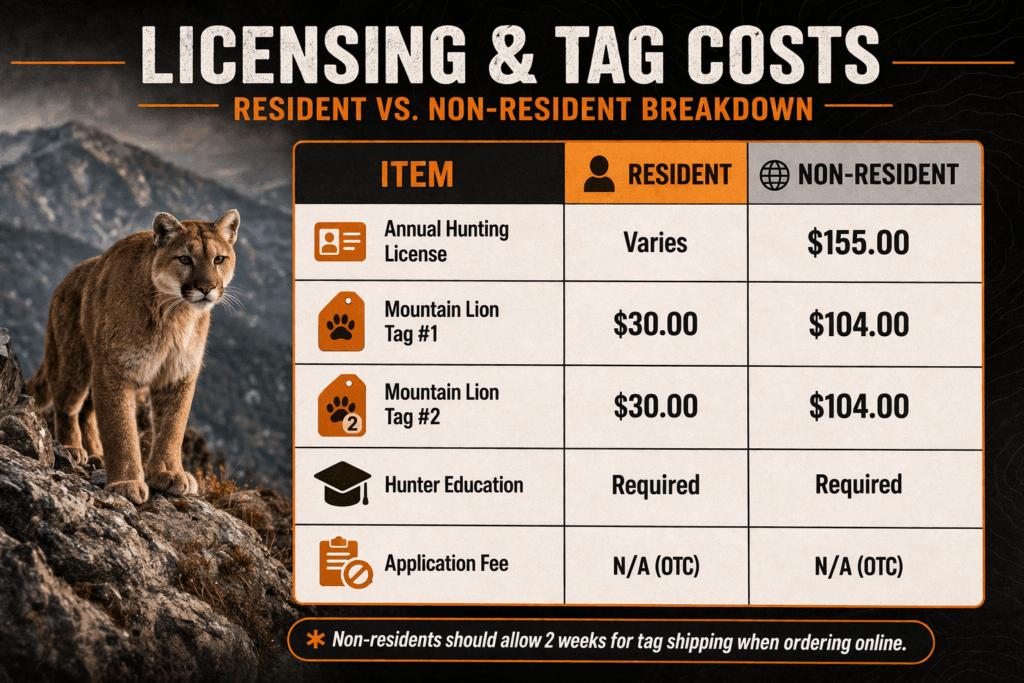
| Nevada Resident Hunting License | $75 | Check NDOW for current rates |
| Non-Resident Hunting License | $155.00 | Required for all non-resident hunters |
You can buy licenses through NDOW offices, authorized dealers, or online at ndowlicensing.com. Hunter education proof is mandatory for everyone—no exceptions. For broader context on Nevada’s hunting license structure across all species, check our Nevada Hunting Season Guide.
Nevada Mountain Lion Tags
Here’s where Nevada really shines for hunters frustrated with draw systems elsewhere. Current tag pricing:
- Resident: $30 per tag
- Non-Resident: $104 per tag
You can buy up to 2 tags annually, giving you multiple chances or the flexibility to hunt different areas throughout the season. Tags work statewide, though you still need to verify specific unit quotas before hunting.
Non-residents ordering online should plan ahead. Outfitters report that “shipping approximately takes two weeks to receive your tags through the mail.” If you’re booking a guided hunt, get your tags ordered well before your hunt dates.
The beauty of this system? No application deadlines, no draw odds to calculate, no waiting for results. Buy tags when you’re ready to hunt, not months or years in advance.
Where to Hunt Mountain Lions in Nevada
Nevada’s landscape offers everything mountain lions need: rugged terrain, abundant prey, and minimal human disturbance across vast areas. The state’s terrain features “rocky mountain ranges, thick juniper forests, and sagebrush valleys that are tailor-made for lions to roam.” But finding huntable populations requires understanding where these cats concentrate and how to access quality habitat.
Best Public Lands for Mountain Lion Hunting
Nevada is roughly 85% public land, creating enormous opportunities for hunters willing to work remote country. However, success on public ground demands serious effort, local knowledge, and usually specialized skills like hound handling or expert calling ability.
Top public land areas for mountain lions:
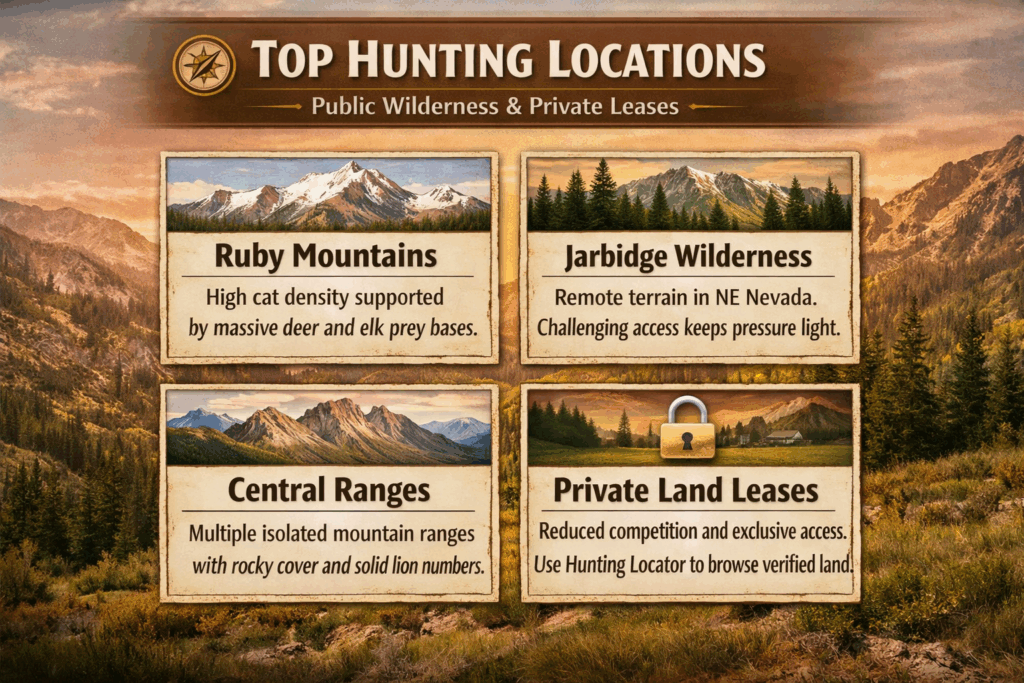
- Ruby Mountains – Strong lion populations supported by healthy deer and elk herds that provide the prey base these cats need
- Jarbidge Wilderness – Remote northeastern Nevada wilderness with excellent habitat but challenging access that keeps hunting pressure light
- Central Mountain Ranges – Multiple ranges throughout central Nevada offering good lion numbers with less competition from other hunters
- High Desert Plateaus and Juniper Forests – Classic Nevada lion country with rocky cover, natural travel routes, and good prey availability
Local research confirms that “areas like the Ruby Mountains, Jarbidge Wilderness, and the central mountain ranges hold solid lion populations and are ideal for tracking lions because they also support deer and elk herds, which are a main food source.”
Reality check for DIY hunters: mountain lion hunting without hounds is brutally difficult. Experienced hunters admit that “mountain lions are one of the most elusive species in North America, and without the use of dogs, many hunters go their entire life without seeing one.”
Guided Mountain Lion Hunts
For most hunters—especially first-timers and non-residents—professional guides dramatically improve your odds while providing expertise that takes years to develop independently. Guides understand that “using dogs is the only way to selectively hunt” mountain lions effectively.
What professional guides bring to your hunt:
- Trained hound packs with GPS collars for tracking and treeing lions
- Local knowledge of lion populations, travel patterns, and productive hunting areas
- Full logistics support including lodging, meals, and transportation in remote terrain
- Expertise in track reading and animal evaluation before harvest decisions
Typical guided hunt schedules are demanding: “The day typically starts by waking up at 4:00 am and we are leaving camp or town by 5:00 am.” Each client works with dedicated guides using 10-12 seasoned hounds, horses or mules, and specialized vehicles with communication equipment.
Timing matters enormously for success. Multiple outfitters focus hunts “typically from December through March when there is fresh snow on the ground,” with peak conditions “from the end of November through early March.”
Success rates on guided hunts far exceed DIY attempts. Some outfitters achieve “100% opportunity success rate on mostly mature toms,” though results vary with weather and hunter participation.
Booking considerations: Selective outfitters “only take two to three hunters a year” and recommend hunters “get in touch early to reserve a spot.” Top guides book quickly, especially for prime winter dates.
Private Land Hunting
Private land provides several advantages for mountain lion hunting: reduced competition, landowners who often know recent lion activity, and better road access for efficient tracking when following hounds.
Benefits of private land access:
- Less hunting pressure compared to popular public areas
- Landowner knowledge of recent lion activity and livestock interactions
- Better maintained roads for tracking and hound transportation
- Potential for exclusive hunting rights during your visit
The traditional challenge has been finding willing landowners and negotiating reasonable access terms. This typically meant cold-calling ranchers, networking through local contacts, or relying on personal connections many hunters simply don’t have.
Hunting Locator eliminates the guesswork in finding private land access. Our platform connects hunters directly with Nevada landowners ready to lease or sell hunting opportunities. Whether you need a single-season lease or long-term hunting property, you can browse verified Nevada hunting opportunities and connect with landowners who understand what hunters need.
Mountain Lion Hunting Tips
Mountain lion hunting demands different skills than traditional big game hunting. These cats are secretive, cover enormous territories, and leave minimal sign except under ideal conditions. Success requires adapting your approach to their behavior and Nevada’s challenging terrain.
Proven strategies from successful mountain lion hunters:
- Hunt After Fresh Snow – Experienced guides emphasize that “the best time to hunt lions is right after a storm when you have fresh snow.” Fresh snow reveals tracks clearly and helps determine track age and travel direction.
- Learn Track Identification – Mountain lion tracks are distinctive: “roundish track with no claw marks, four toes and a distinctive heel pad that is bi-lobed at the front and tri-lobed at the rear.” Adult tracks measure 3-4 inches across.
- Consider Hound Hunting – Expert hunters confirm that “using dogs is the only way to selectively hunt” mountain lions effectively. Hounds let you tree cats and evaluate animals before making harvest decisions.
- Prepare Physically – Expect demanding conditions where “most chases for mountain lions are between 100 yards and 3 miles in 6 inches to 2 feet of snow.” Get in good shape and dress in light layers you can shed easily.
- Use Nevada’s Night Hunting – Nevada allows mountain lion hunting “any time of the day or night.” If hounds get on a track late in the day, you can continue the chase after dark.
- Focus on Prey Areas – Lions follow food sources. Areas supporting deer and elk typically hold more mountain lions due to abundant prey.
- Try Calling as Alternative – For hunters without hound access, predator calls can work using distress sounds and lion vocalizations. Success rates are much lower than hound hunting.
- Always Check Unit Status – Call NDOW at 1-800-800-1667 to confirm your target unit hasn’t reached quota before hunting.
More Resources from Hunting Locator
Nevada hunting often involves planning multi-species trips to maximize your time and investment. These resources help with broader trip planning and understanding Nevada’s diverse hunting opportunities.
Additional Nevada hunting resources:
- Nevada Hunting Season Guide – Complete overview of all Nevada hunting seasons, regulations, and planning resources
- Nevada Hunting Land Leases – Browse available private land hunting opportunities for exclusive access
- Nevada Mule Deer Season – Mule deer are primary mountain lion prey; understanding deer patterns helps locate cats
- Nevada Elk Hunting Season – Elk represent another key prey species, especially in northern Nevada ranges
- Nevada Black Bear Season – Combine predator hunting opportunities for comprehensive Nevada hunting
- Nevada Bighorn Sheep Season – Explore Nevada’s premier big game opportunities in similar mountain terrain
FAQ
How much does it cost to hunt mountain lions in Nevada as a non-resident?
Non-resident hunters need a $155 hunting license plus $104 per mountain lion tag. You can buy up to two tags annually, so total licensing costs range from $259 (license + one tag) to $363 (license + two tags). These costs don’t include guided hunt fees, travel, lodging, or equipment.
Can I hunt mountain lions in Nevada without a guide?
Yes, Nevada allows DIY mountain lion hunting on public lands. However, experts acknowledge that “mountain lions are one of the most elusive species in North America, and without the use of dogs, many hunters go their entire life without seeing one.” Success rates are dramatically higher with professional guides using trained hounds.
When is the best time to hunt mountain lions in Nevada?
Most hunters target “the cooler months from November to March when tracking conditions are best.” Experienced guides recommend hunting “right after a storm when you have fresh snow” for optimal tracking.
Do I need to use dogs to hunt mountain lions in Nevada?
While not legally required, hunting experts confirm that “using dogs is the only way to selectively hunt” mountain lions effectively. Hounds allow hunters to tree cats and evaluate animals before harvest. Alternative methods like calling have much lower success rates.
How do I know if a hunting unit is still open in Nevada?
Call NDOW at 1-800-800-1667 to verify current unit status before hunting. Nevada’s harvest quota system closes units when approximately 250 lions are harvested statewide, making status checks essential for hunt planning.
What happens to harvested mountain lions in Nevada?
Nevada regulations require that “all harvested mountain lions must be personally presented to a representative of the Department within five days, with the skull unfrozen, the jaw propped open and the unfrozen pelt in its entirety.” This mandatory check-in helps NDOW monitor harvest and maintain population data.
The Final Shot
Nevada’s year-round mountain lion season and over-the-counter tags create some of the most accessible cougar hunting opportunities in the West. No draws to enter, no years of waiting, no complex point systems to navigate. Just buy your tags when you’re ready and hunt when conditions are right.
But don’t mistake “accessible” for “easy.” Mountain lions remain among the most challenging animals to hunt successfully, demanding specialized skills, excellent physical conditioning, and often professional guidance to achieve consistent results. The cats are secretive, the terrain is demanding, and success requires adapting to conditions that change rapidly in Nevada’s high desert mountains.
The key to Nevada mountain lion success lies in realistic expectations and thorough preparation. Whether you choose guided hunts with experienced hound handlers or tackle the challenge independently, respect both the animal and the rugged landscape they call home.
Ready to turn your Nevada mountain lion plans into reality? Browse quality Nevada hunting land opportunities and connect with landowners who can provide the private access that often makes the difference between a good hunt and an exceptional one.


