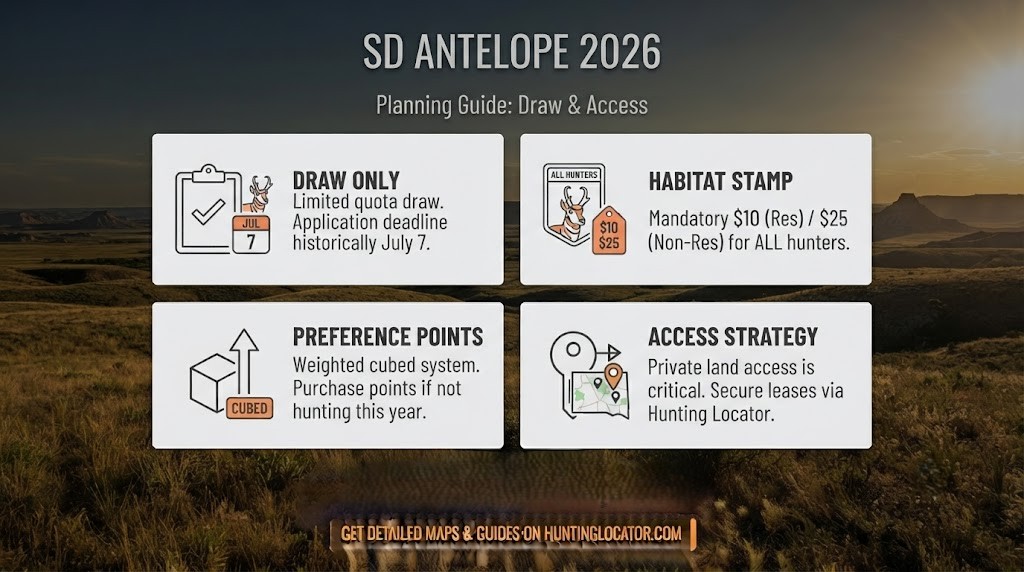
Tags are limited, the draw has a hard deadline, archery access rules are stricter than most hunters expect, and private land fills up months before opening day. This guide covers the confirmed 2026 season dates, license costs, draw mechanics, and land access options for both residents and non-residents. For broader species background, see our complete South Dakota antelope hunting overview.
Here’s what’s covered:
- Confirmed 2026 season dates, bag limits, and habitat stamp requirements
- What residents and non-residents pay, and how licenses, permits, and tags work
- Where to hunt: public land, private leases, and guided options, plus field-tested tactics and gear
Quick Overview: South Dakota Antelope Season at a Glance
Regulations shift year to year — confirm final details directly with South Dakota Game, Fish & Parks (GFP) before you apply.
| Season / Method | 2026 Dates | Bag Limit | Notes |
|---|---|---|---|
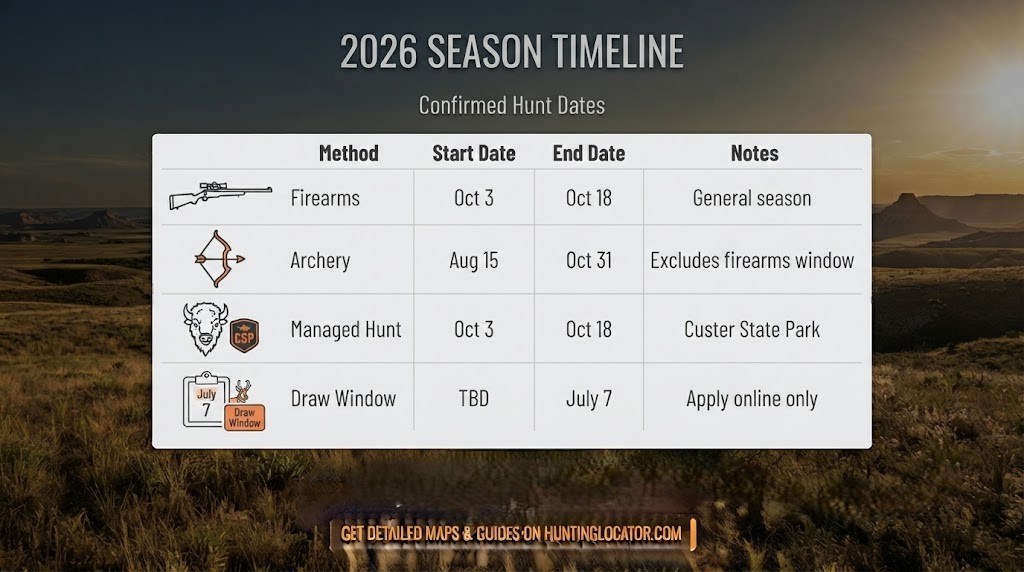
| Firearms | Oct. 3 – Oct. 18, 2026 | 1 antelope per valid tag | Either-sex or buck-only, depending on drawn tag |
| Archery | Aug. 15 – Oct. 31, 2026 | 1 antelope per valid tag | Closes during the firearms season |
| Custer State Park | Oct. 3 – Oct. 18, 2026 | 1 antelope per valid tag | Special managed hunt |
Every legal South Dakota antelope hunter needs the following before heading afield:
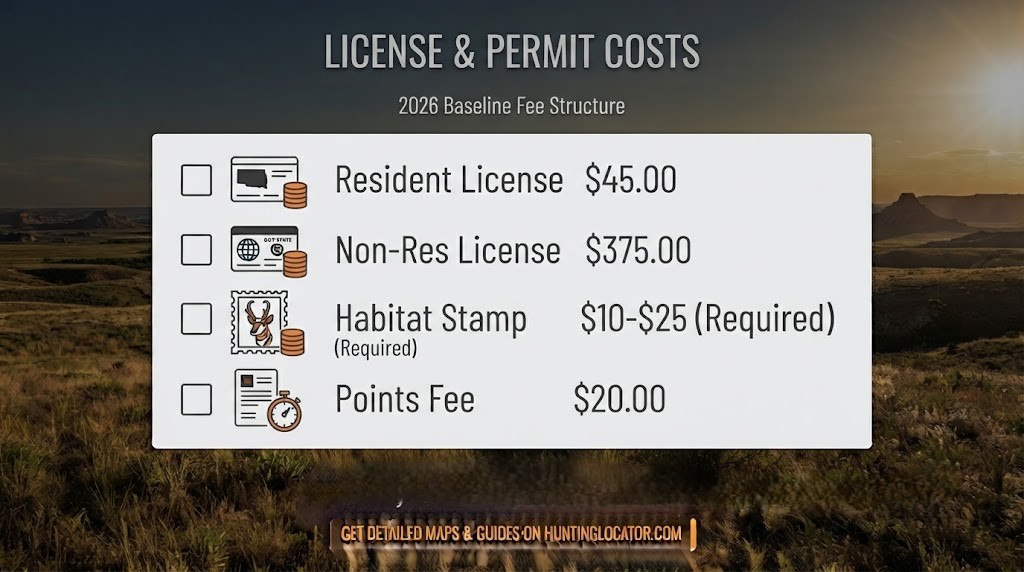
- A valid hunting license (resident $45 / non-resident $375)
- A drawn antelope tag (via the SD GFP draw — either-sex or buck-only depending on your issued tag)
- A South Dakota habitat stamp ($10 resident / $25 non-resident) — required for all hunters regardless of age or residency
- Hunter education certification — all hunters 16 and younger must complete a course including an in-person HuntSAFE field day before purchasing a license
South Dakota Antelope Hunting Seasons
South Dakota offers two primary methods for hunting pronghorn — firearms and archery — plus a special managed hunt inside Custer State Park. Each has its own dates, access rules, and practical considerations.
Firearms Season
The firearms season runs October 3–18, 2026 and is the most popular window of the year. Draw licenses are valid on public land, found primarily in the western half of the state. The tag you draw — either-sex or buck-only — determines what you can legally harvest. Most hunters focus on western South Dakota’s open rangeland during this 16-day window, so securing land access well before October is important.
Archery Season
The archery season runs August 15 – October 31, 2026, closing during the firearms season. The longer window means more time afield and considerably less competition than firearms season.
One access distinction matters here: OTC archery antelope licenses are valid on private land only, excluding all public lands and private lands enrolled in Walk-In Areas, CREP, and CHAP programs. Hunting public land with a bow requires a limited draw archery license instead.
Archery also demands a different skill set. Getting within bow range of an animal with nearly 300-degree vision requires patience and terrain awareness — many stalks won’t pan out. For new hunters, firearms season is a more accessible starting point, though archery rewards the preparation it requires.
Custer State Park Hunt
The Custer State Park antelope hunt runs October 3–18, 2026, coinciding with the general firearms season. This is a special managed hunt with its own permit structure and limited access. Custer State Park is closed to all archery hunting, so applicants for this unit will be applying for a firearms tag. Contact SD GFP directly for permit availability and application details, as managed-hunt specifics can change between seasons.
South Dakota Antelope Licenses and Permits
Three things are required before you hunt: a license, a tag, and a habitat stamp — and they are not interchangeable. The license grants general hunting privileges in South Dakota. The drawn tag authorizes you to harvest an antelope. The habitat stamp is a mandatory conservation purchase every hunter must make separately. Getting all three in the right order is how you hunt legally.
One eligibility note for out-of-state hunters: non-residents may only apply for bison, deer, and antelope in South Dakota’s draw system — not bighorn sheep, mountain goat, or elk.
Always confirm current details with South Dakota Game, Fish & Parks before you apply.
South Dakota Hunting Licenses
| License / Add-On | Resident | Non-Resident |
|---|---|---|
| Antelope License | $45 | $375.00 |
| Habitat Stamp (required) | $10 | $25 |
The habitat stamp funds wildlife habitat conservation programs across the state and is required for every hunter regardless of residency. Verify all fee and eligibility details with SD GFP before submitting your application.
South Dakota Hunting Permits and the Draw Process
South Dakota antelope tags are allocated through a limited-quota draw. South Dakota sets aside specific tag numbers for non-residents, who do not compete against residents in the draw — your application goes into a separate pool.
Applications are submitted online only through the SD GFP portal — no paper applications are accepted. For the firearm antelope draw, the application deadline has historically fallen around July 7, though this shifts annually. Confirm the exact 2026 deadline with SD GFP well in advance.
Preference Points: South Dakota uses a weighted preference point system. The state applies a cubed point system — four preference points become 4 × 4 × 4 + 1 = 65 weighted entries. Points can be purchased during a set window (typically September 15–December 15) and remain valid across years unless the applicant goes dormant for five consecutive years. If you’re not hunting this year, purchasing preference points is worth doing to build odds for a future season. Youth applicants under 16 are not charged the $20 preference point fee and may begin purchasing points starting at age 10.
Buck-Only vs. Either-Sex Tags: The limited draw license allows hunters to harvest any buck antelope and is valid in all units with an open firearm antelope season, covering most of the western half of the state. Some tags issued through the draw are either-sex, depending on the unit and available harvest allocations.
Here’s the step-by-step process to get legally afield:
- Complete hunter education — required for all hunters 16 or younger before a license can be purchased; includes an in-person HuntSAFE field day
- Purchase your hunting license — resident ($45) or non-resident ($375) through the SD GFP online portal
- Apply for your antelope tag during the draw window — online only, no paper applications accepted
- Purchase your habitat stamp — $10 resident / $25 non-resident; required for all hunters
- Confirm all details with SD GFP before the season opens, especially if regulations or dates have been updated
One note for hunters considering a guided hunt: outfitters and guides are not permitted to guide antelope hunts on public, walk-in access, or state lands — only on private lands. Hunters who want a guided private-land experience should apply for a license through the special buck draw or regular draw with that access structure in mind.
South Dakota Antelope: Where to Hunt
The biggest hurdle for most antelope hunters is obtaining access to private land. Draw licenses are valid on public land, but if you’re targeting private ground, access needs to be secured before you ever apply. Here’s a breakdown of your options.
Best Public Lands for South Dakota Antelope Hunting
Pronghorn populations are greatest in the western rangelands of South Dakota, with herds in most counties west of the Missouri River and some counties directly east of it. Public land hunting is centered in this western region, where rolling terrain and a mix of grass, forb, and shrub forage support pronghorn year-round.
Key public land options include:
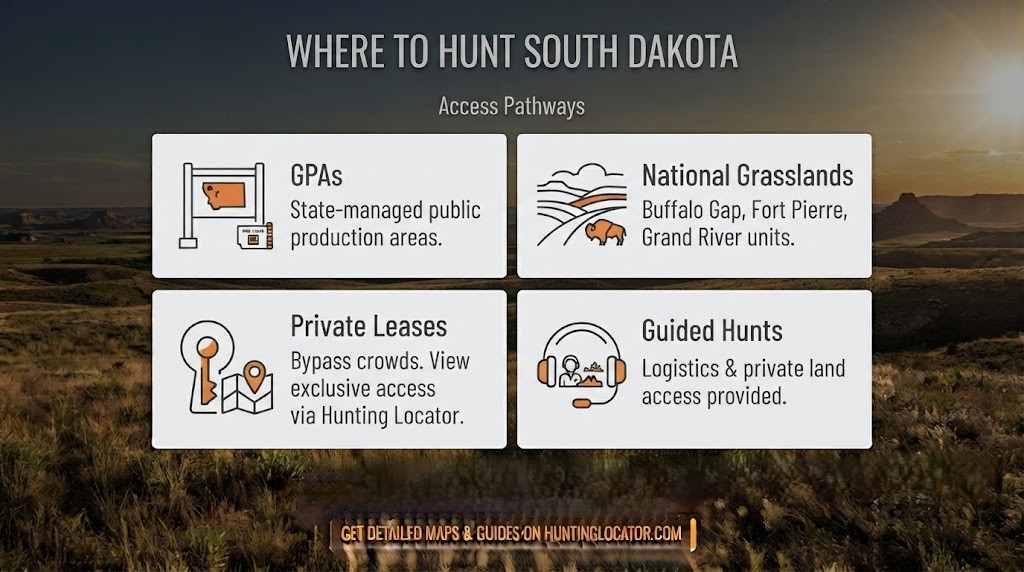
- Game Production Areas (GPAs) — Publicly accessible parcels managed by SD GFP across western South Dakota; no landowner permission required for licensed hunters
- Walk-In Areas (WIAs) — Private lands enrolled in a public access program; hunters can access these without contacting the landowner, though OTC archery licenses are excluded from WIA parcels
- CREP and CHAP parcels — Conservation program lands open to public hunting under specific conditions; OTC archery licenses are not valid on these areas
- National Grasslands — The Buffalo Gap, Fort Pierre, and Grand River National Grasslands in western South Dakota offer expansive public pronghorn habitat with minimal access barriers
- Western Unit Focus — Most of the archery harvest concentrates in unit 35A, with strong trophy production from Meade County (unit 49) and Perkins County (unit 53)
Check the SD GFP website and updated WIA maps each season, as enrolled parcels change annually.
Private Land Hunting with Hunting Locator
Public land gives you access, but private land typically means fewer hunters, better-managed habitat, and the ability to pattern specific animals without competing pressure. For out-of-state hunters without local contacts, finding that access is the harder problem.
Hunting Locator is a platform that connects hunters with South Dakota landowners who are actively looking to lease or sell their property for hunting use. You can browse available properties, filter by location, acreage, game type, and season, and contact landowners directly — whether you need a 500-acre lease for archery season or want to explore purchasing private hunting ground outright.
Explore available South Dakota hunting leases on Hunting Locator and secure your 2026 access before the best ground is taken.
Guided Antelope Hunts in South Dakota
For hunters who want land access, local knowledge, and logistical support built in, a guided hunt is worth considering — particularly for non-residents making the trip for the first time. South Dakota has an active outfitter community built around private-land pronghorn hunting.
Key planning notes for guided hunts:
- Book early — Outfitters are booking one to two years in advance; contact them well ahead of the season
- Understand the license requirement — Even with a guide, you still need to draw your own license through SD GFP; your outfitter can advise on which draw aligns with their operation
- Confirm guide eligibility — Guides may only operate on private land for antelope hunts, not on public, walk-in, or state lands
Hunting Locator also connects hunters with outfitters and guide services. Browse available options through the platform to find the right fit for your 2026 hunt.
Antelope Hunting Tips for South Dakota Success
The pronghorn is considered one of the best big-game animals for first-time Western hunters, but that doesn’t mean it’s easy. These tips apply whether you’re hunting public rangeland on your own or working private ground with a guide. For gear suited to open-country hunting, visit the Hunting Locator store.
- Master the spot-and-stalk approach — The typical method for pursuing antelope is spot and stalk, and it demands terrain awareness. Use coulees, hillsides, and sagebrush to stay below the skyline as you close distance. Most guided hunters kill their antelope within 200 yards — the stalk matters more than raw range.
- Invest in quality optics — A pronghorn can spot movement up to 4 miles away, so your glassing setup needs to be dialed in before you move. Let your optics do the walking — a spotting scope paired with quality binoculars lets you identify animals and plan your approach without burning a stalk. Rangefinder-integrated optics are especially useful where distance is deceptive. Find optics at the Hunting Locator store.
- Choose a flat-shooting rifle caliber — Any flat-shooting caliber is appropriate for pronghorn, from a .243 to a .375. What matters most is your familiarity with the rifle and your ability to make a clean shot at distance. Browse rifle options at the Hunting Locator store.
- Time your morning right — Pronghorn don’t move early like deer. Be in position and glassing early, but expect animals to start moving later in the morning.
- Be ready to walk — Hiking a few miles from the truck is normal, and productive days can push 10+ miles. Wear comfortable, durable boots and layer for October temperature swings in western South Dakota.
- Don’t rush the shot — If you bust a stalk, the animal is gone. Take your time getting into position and settle before you squeeze the trigger. A missed shot at 150 yards costs more than a passed shot at 300.
- Audit your gear before you leave home — The three biggest equipment mistakes hunters make are inadequate scopes, poor-quality ammunition, and a poorly fitted sling. Check all three before opening day. The Hunting Locator store is a good starting point for optics upgrades and open-country hunting gear.
More Resources from Hunting Locator
- South Dakota Hunting Seasons Overview — All South Dakota hunting seasons in one place; useful if you’re planning multiple species in the same trip
- South Dakota Antelope Hunting Season — Additional species-specific guidance to supplement this guide
- South Dakota Deer Hunting Season — Whitetail and mule deer seasons covered side by side; relevant for hunters holding both tags
- South Dakota Elk Hunting Season — Worth reviewing for overlap planning on a western SD trip
- South Dakota Turkey Hunting Season — Spring and fall turkey opportunities for hunters looking to extend their season
- South Dakota Upland Game Hunting Season — Pheasant, grouse, and sharptail seasons that often overlap with the antelope firearms window
- South Dakota Waterfowl Hunting Season — Duck and goose season planning for western SD trips that combine species
- South Dakota Small Game Hunting Season — Additional species coverage for hunters building a full South Dakota season calendar
- South Dakota Buffalo Hunting Season — Worth reviewing if you’re interested in South Dakota’s specialty hunts
- South Dakota Mountain Lion Hunting Season — Season structure and licensing for mountain lion hunting in the Black Hills region
- South Dakota Bighorn Sheep Hunting Season — One of the state’s most limited draws; resident-only, but worth understanding for complete season planning
- South Dakota Hunting Leases on Hunting Locator — Browse available private land leases by location, acreage, and game type
FAQ
Do I need a habitat stamp to hunt antelope in South Dakota?
Yes — every hunter, resident or non-resident, must purchase a South Dakota habitat stamp in addition to their hunting license. The stamp costs $10 for residents and $25 for non-residents. It funds wildlife habitat conservation programs across the state and is required regardless of where or how you hunt.
Can non-residents apply for a South Dakota antelope tag?
Yes. Non-residents are eligible to apply for South Dakota’s antelope draw. South Dakota sets aside specific tag allocations for non-residents, who do not compete against residents in the draw — out-of-state hunters draw from a defined separate pool. Non-residents are not eligible for elk, bighorn sheep, or mountain goat tags.
When does the antelope tag application window close?
The firearm antelope application deadline has historically fallen around July 7, with applications submitted online only through SD GFP — no paper applications accepted. Confirm the exact 2026 deadline directly with SD GFP. South Dakota typically releases current-year regulations at the end of May, so check the GFP website as that window approaches.
What’s the difference between a buck-only and an either-sex tag?
The limited draw license allows hunters to harvest any buck antelope and is valid in all units with an open firearm antelope season, covering most of western South Dakota. Some tags issued through the draw are either-sex, meaning a doe can also be legally harvested. The type of tag you receive depends on the unit you draw and available harvest allocations for that season.
What are preference points, and should I buy them if I’m not applying this year?
South Dakota uses a cubed preference point system to weight draw odds — four points translate to 65 weighted entries (4 × 4 × 4 + 1). If you’re not hunting this year but plan to in the future, purchasing preference points is worth doing to build your odds. Points can be purchased from September 15–December 15 and remain valid across years unless you go dormant for five consecutive years.
Where do most South Dakota antelope live, and what habitat should I focus on?
Pronghorn populations are greatest in the western rangelands of South Dakota, with herds in most counties west of the Missouri River. Key habitat features include rolling terrain with good visibility and a mix of grass, forb, and shrub forage. They also use agricultural land — particularly wheat and alfalfa — when it’s adjacent to grassland. Most record-book bucks come from Meade County (unit 49) and Perkins County (unit 53), making these western units worth targeting if trophy class matters to you.
Wrapping Up
South Dakota’s 2026 pronghorn season gives both residents and non-residents a well-defined window to hunt one of the more demanding animals in North America’s open country. The mechanics are manageable — but tags are limited, the draw deadline comes in early July, and private land books up well before October. Sort out your license, access, and gear early, and you’ll be in a much better position when the season opens.
If you’re still looking for the right place to hunt, browse South Dakota hunting leases on Hunting Locator and connect directly with landowners who have ground available for the 2026 season.


