This South Dakota bighorn sheep guide covers what you need whether you’re a resident who just drew the tag or you’re trying to figure out if there’s any path in as a non-resident (there isn’t, but more on that below). It lays out the dates, fees, and eligibility rules so you can spend your planning time on the hunt rather than paperwork. It’s part of South Dakota’s wider big game hunting calendar, narrowed down to the one tag most hunters only get to dream about.
Here’s what’s covered:
- Season dates, bag limit, and the once-in-a-lifetime eligibility rule that decides who can apply
- How to apply — fees, timeline, and how South Dakota’s draw system works
- Where to hunt — the best public units, private-land leasing options, and gear to bring
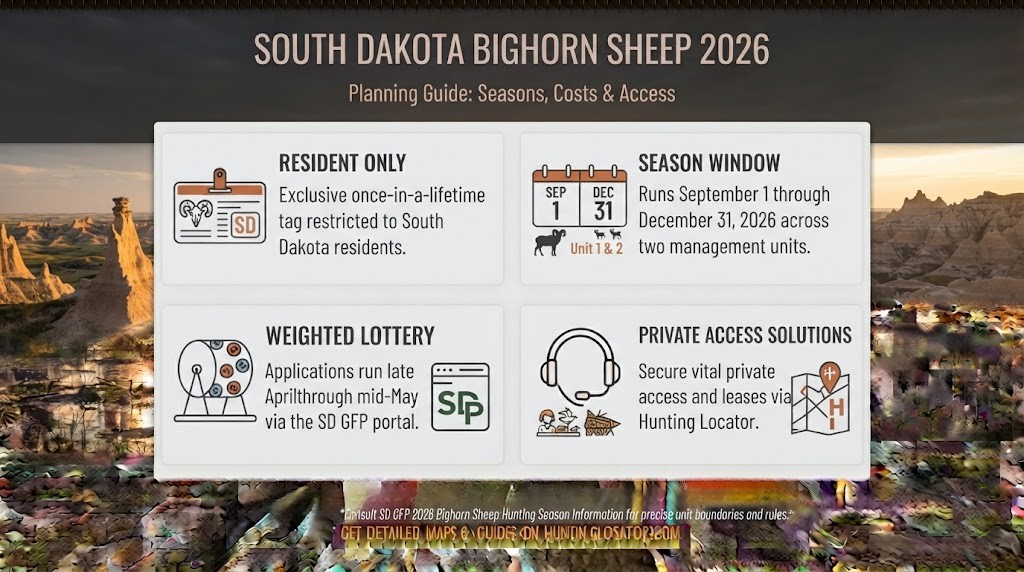
Quick Overview: South Dakota Bighorn Sheep at a Glance
Here’s what South Dakota Game, Fish and Parks has published for the 2026 season, in one table.
| Detail | 2026 Information |
|---|---|
| Season Dates (Custer State Park / Black Hills) | September 1 – December 31, 2026 |
| Bag Limit | 1 ram, once-in-a-lifetime per hunter |
| Eligibility | South Dakota residents only who have never held a bighorn sheep license |
| Application Period | Typically late April–mid-May (e.g., April 22 – May 19, 2026) via the SD GFP portal |
| Application Fee | $10 (non-refundable, per season applied for) |
| License Fee | $294–$300 (includes legislative surcharges) |
| Draw System | Weighted lottery draw using points |
| Hunting Units | BHS-BH2 (Custer County), BHS-BH3 (Badlands) |
Application windows shift slightly from year to year, so confirm the exact 2026 dates through the official GFP application details before submitting anything.
Non-residents are not eligible to apply for a South Dakota bighorn sheep license. This is a resident-only, once-in-a-lifetime tag. For more detail, our South Dakota bighorn sheep season guide covers the same ground in more depth.
A few other requirements matter as much as the dates:
- Resident status required — you must be a South Dakota resident who has never previously been issued a bighorn sheep license.
- Two separate fees — a $10 non-refundable application fee, plus a $294–$300 license fee if you’re drawn.
- Online-only applications — there’s no paper option; everything runs through the SD GFP portal.
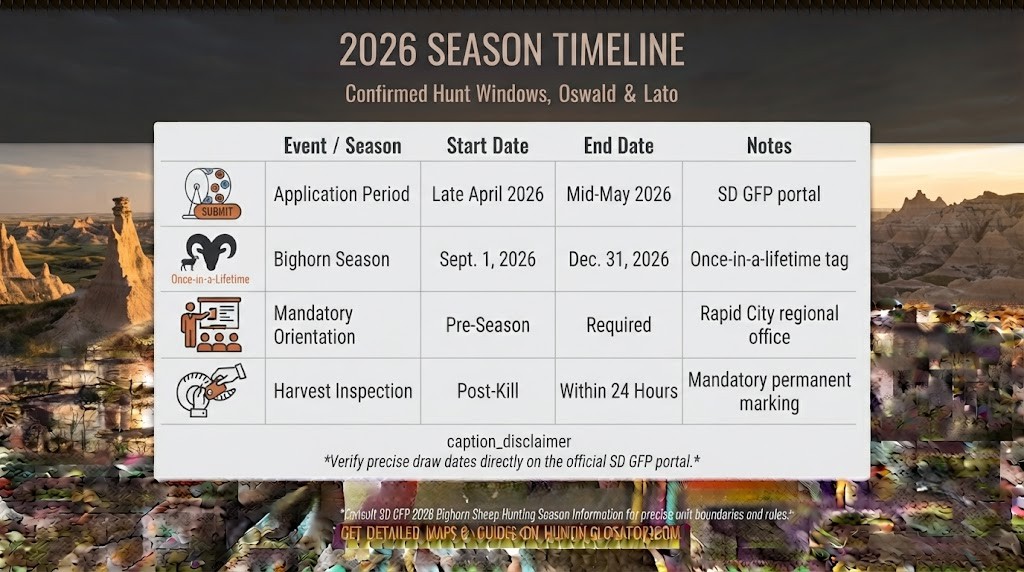
- Mandatory orientation meeting — required at the GFP regional office in Rapid City before your first day afield.
- 24-hour inspection window — successful hunters must present the sheep for inspection and permanent marking within 24 hours of the kill.
Three terms come up throughout this guide: the once-in-a-lifetime hunting tag rule, the bighorn sheep bag limit, and the South Dakota bighorn sheep license requirements that govern eligibility.
Bighorn Sheep Hunting Seasons
Unlike deer or waterfowl, South Dakota doesn’t split bighorn sheep into archery, muzzleloader, and rifle seasons. Tag holders get one long season window instead — simpler than most big game seasons in the state, though it still rewards planning around it.
The 2026 Season Window
Per South Dakota GFP, the 2026 bighorn sheep season runs September 1 through December 31, 2026 — four full months, which is a fair amount of runway for a once-in-a-lifetime tag.
That window matters tactically. Early September brings warm, dry conditions with rams still holding summer patterns. The stretch into November and December pushes into rut behavior and heavier weather in the Black Hills. There’s no single best time to hunt bighorn sheep here — it depends on how much time you have, how the season’s weather shakes out, and how quickly you find rams once you’re in the unit.
Hunting Units: BHS-BH2 and BHS-BH3
South Dakota manages bighorn sheep hunting through two designated units, laid out in the GFP bighorn management plan: BHS-BH2 (Custer County) and BHS-BH3 (Badlands).
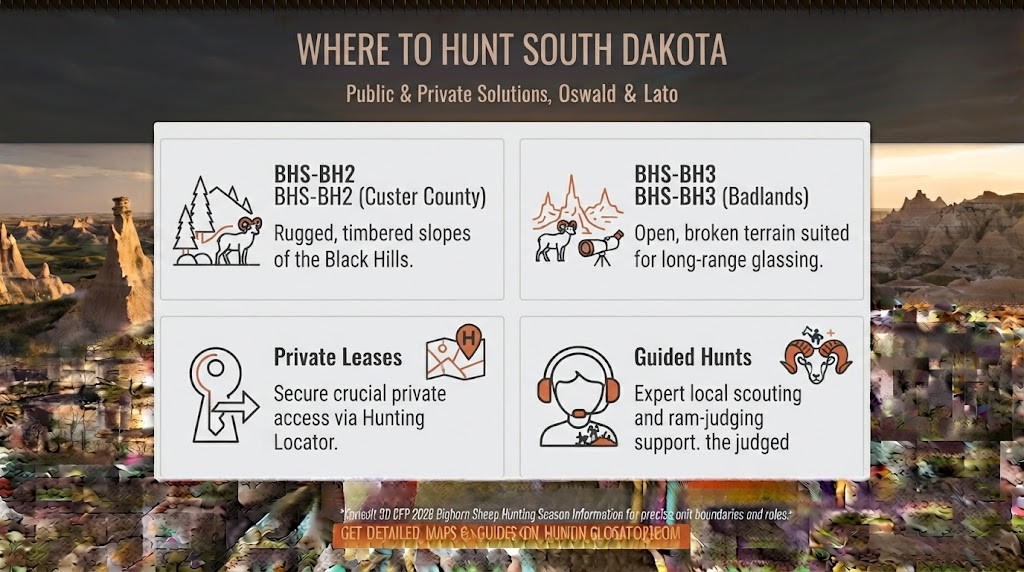
BHS-BH2 sits in the heart of Custer County and the Black Hills — steep, timbered slopes and rocky outcrops typical of Black Hills bighorn sheep hunting, along with Custer State Park ground that carries real historical weight for the species in this state. BHS-BH3 covers the Badlands, a more open, broken landscape suited to long-range glassing rather than close-quarters stalking. The two units call for different tactics, so knowing which one your tag covers should shape your game plan from the start.
For exact boundaries, don’t rely on secondhand maps. Pull up the official GFP unit maps before you scout, and confirm your unit lines match what’s on your license.
South Dakota Bighorn Sheep Licenses and Permits
This is the section that turns “I hope to draw someday” into an actual plan. Two rules govern everything here: the tag is once-in-a-lifetime, and it’s restricted to South Dakota residents. Get comfortable with both before spending a dime on an application.
South Dakota Hunting Licenses
The cost structure is straightforward, but the two fees serve different purposes.
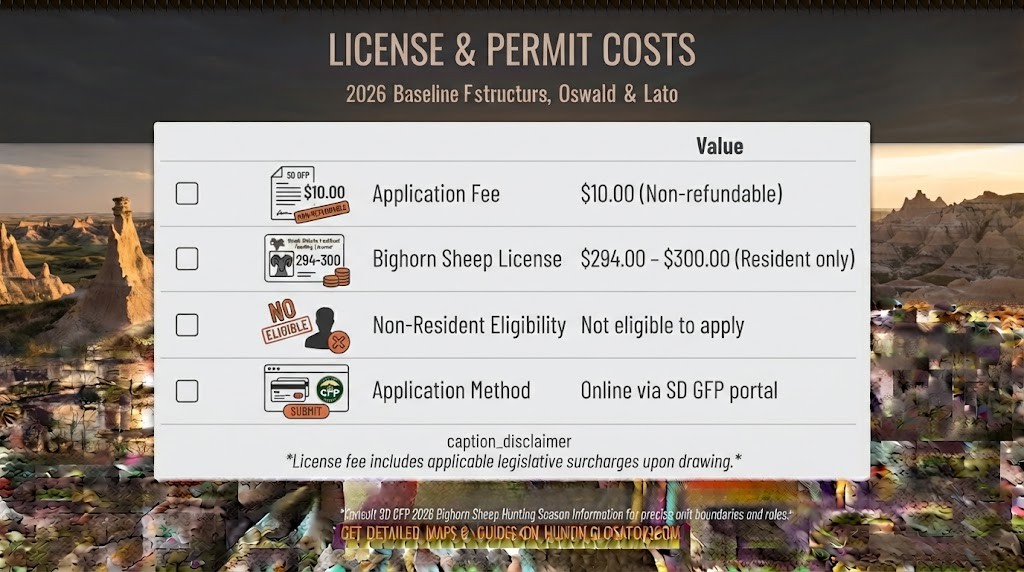
| Item | Cost | Notes |
|---|---|---|
| Application Fee | $10.00 | Non-refundable, per season applied for |
| Bighorn Sheep License | $294–$300 | Includes legislative surcharges; residents only |
| Eligibility | — | Must be an SD resident who has never held a bighorn license |
The $10 application fee gets you into the drawing. It doesn’t guarantee a license, and it’s gone whether you draw or not. Non-residents can’t buy their way into eligibility at any price — residency is a hard requirement, not a fee tier. When you apply, be ready to provide the last four digits of your Social Security number, which GFP requires from all U.S. residents before an application can be processed.
South Dakota Hunting Permits and the Application Process
South Dakota GFP is explicit on this point: all bighorn sheep seasons and units are a once-in-a-lifetime opportunity, and only residents who have never received a South Dakota bighorn sheep license are eligible to apply. The steps below assume you meet that bar.
- Confirm eligibility — you must be a South Dakota resident who has never previously been issued a bighorn license.
- Apply online — applications are submitted online only, through the SD GFP portal, per the official GFP application details.
- Pay the $10 non-refundable application fee — required for each season you apply.
- Apply within the window — typically late April through mid-May; confirm the exact 2026 dates on the GFP portal before submitting.
- Check your results — draw results are posted online, historically by early June.
- If drawn, pay the license fee — $294–$300, depending on legislative surcharges for the year.
- Attend the mandatory orientation meeting — held at the GFP regional office in Rapid City, required before your first day of hunting.
Tags are distributed through a weighted lottery draw system that factors in points, and only a small handful of tags are issued each season. It’s not a draw you can count on in any given year — building points through consistent applications is the realistic path.
If you’re drawn, two compliance items follow you into the field: the 24-hour inspection requirement for your harvested ram, and the mandatory orientation before you step into the unit. Missing either one puts the tag you waited years for at risk.
South Dakota Bighorn Sheep: Where to Hunt
Once you’ve drawn the tag, the next step is figuring out where the rams actually are. This section covers public ground, private access, and guided options.
Best Public Lands
South Dakota’s bighorn sheep hunting centers on a few well-defined public areas, each tied to one of the two management units.
- Black Hills (BHS-BH2, Custer County) — rugged, forested terrain in the heart of bighorn country. Per South Dakota GFP, the most recent translocation effort brought bighorns from Alberta into the Deadwood area, adding to the herd’s range in this unit.
- Badlands (BHS-BH3) — open, broken terrain that rewards hunters who can glass long distances and cover ground methodically rather than still-hunt through cover.
- Custer State Park — historically significant ground for the species; bighorns were first released here in 1922, and the park remains tied to the Black Hills unit’s identity today.
Before you scout, pull up the interactive unit maps through GFP’s official mapping tool to confirm exact boundaries for BHS-BH2 and BHS-BH3. Don’t rely on memory or old maps once you’re out there.
Private Land Hunting with Hunting Locator
A good portion of the access corridors and prime ground near these units runs through private land, and locking down permission early isn’t optional. South Dakota GFP advises hunters to secure landowner permission before applying, since it may not be obtainable once the season is underway. For a tag you may only get once, that’s not a risk worth taking.
Whether you’re looking to lease access for this season or considering buying hunting land outright for years of future access, the goal is the same: certainty before the season opens. A boundary line you can’t cross will derail a once-in-a-lifetime hunt faster than almost anything else.
Hunting Locator connects hunters directly with landowners across South Dakota who are ready to lease or sell their ground — no cold calls, no scrambling in August to find a spot for a September opener. Search by acreage, location, and terrain type, and connect directly with the people who control the land.
If you want to see what’s currently available, browse South Dakota hunting leases and start lining up access now — for this season’s tag or to build a relationship with a property ahead of a future application.
Guided Hunts: What to Look For
A guided hunt can meaningfully raise your odds on rugged sheep terrain, and for a tag you’ll only carry once, that edge is worth considering.
A quality guided bighorn sheep hunt typically brings scouting intel built up over multiple seasons, ram-judging expertise so you don’t burn your tag on an immature animal, established access into the toughest terrain, and support getting your ram packed out once it’s down. When vetting an outfitter, ask for references, confirm proper licensing, and make sure they have current experience in BHS-BH2 or BHS-BH3 specifically — general western sheep experience doesn’t always translate to South Dakota’s terrain and regulations.
If you’d rather run your own hunt from start to finish, or want a backup plan alongside a guided package, private-land access is your best lever — browse South Dakota hunting leases to see what’s on the table.
Bighorn Sheep Hunting Tips
These are the fundamentals that turn preparation into a filled tag.
- Glass More, Walk Less: Bighorns get spotted long before they get stalked. A quality spotting scope is arguably the single most important piece of gear you’ll carry into sheep country.
- Choose a Capable Rifle: Sheep terrain demands a flat-shooting rifle you can carry for miles and still shoot confidently at variable, often long ranges.
- Learn Ram Identification: Study horn curl and age indicators before opening day so you can judge a legal, mature ram quickly and ethically in the field.
- Train for the Terrain: The Black Hills and the Badlands are unforgiving on unprepared legs and lungs. Start conditioning and break in your boots well before September.
- Scout Early and Often: Time spent in your unit before the season opens pays off — bighorns hold to fairly predictable patterns once you learn the ground.
- Plan Your Inspection: Don’t wait until you’ve got a ram down to figure out logistics. Know where the GFP representative is located so you can meet the 24-hour inspection and marking requirement without scrambling.
Once you know what you need, gear up at the Hunting Locator store for optics, boots, and rifle accessories built for terrain like this. Getting outfitted before the season starts is one less thing to worry about once you’re glassing a distant slope.
More Resources from Hunting Locator
A bighorn tag is rare, but it’s rarely the only hunting you’ll do in South Dakota this year. Here’s where to go next for the rest of your season planning.
- South Dakota Hunting Seasons hub — the master calendar covering every species and season in the state.
- South Dakota Bighorn Sheep Season — a companion deep-dive if you want more detail on this exact tag.
- South Dakota Elk Hunting Season — another premier, hard-to-draw big game tag in the state.
- South Dakota Deer Hunting Season — the state’s most popular and accessible big game pursuit.
- South Dakota Antelope Hunting Season — fast-paced hunting across open prairie country.
- South Dakota Buffalo Hunting Season — another rare, high-demand South Dakota tag.
- South Dakota Mountain Lion Hunting Season — Black Hills predator hunting for a different kind of challenge.
- South Dakota Turkey Hunting Season — spring and fall gobbler action across the state.
- South Dakota Upland Game Hunting Season — home to the state’s famous pheasant tradition and more.
- South Dakota Small Game Hunting Season — accessible, year-round action for hunters of any experience level.
- South Dakota Waterfowl Hunting Season — prairie potholes and flyway hunting each fall.
- Hunting Locator homepage — search leases nationwide by state, species, and acreage.
- South Dakota hunting leases — current private-land access listings across the state.
- Hunting Locator store — optics, boots, and gear built for your next hunt.
Frequently Asked Questions
Can non-residents hunt bighorn sheep in South Dakota?
No. South Dakota bighorn sheep licenses are restricted to residents who have never previously held one, per South Dakota GFP. Non-residents can look into South Dakota’s elk or antelope seasons instead — both are open to non-resident hunters. States like Wyoming, Montana, Utah, and Nevada do allow non-resident sheep applications, so those are worth researching if bighorns are the goal.
When do you apply for a South Dakota bighorn sheep tag?
The application window typically runs from late April to mid-May — for example, April 22 through May 19, 2026 — through the SD GFP portal. Applications are online-only and require a $10 non-refundable fee. Confirm the exact 2026 dates directly on the GFP portal, since windows can shift slightly from year to year.
What is the bag limit for bighorn sheep in South Dakota?
One ram, once-in-a-lifetime per hunter, according to South Dakota GFP. Once you’ve been issued a South Dakota bighorn sheep license, you’re permanently ineligible to apply again. This once-in-a-lifetime rule is the most important eligibility fact to understand before applying.
How are South Dakota bighorn sheep tags awarded?
Tags are distributed through a weighted lottery draw system that factors in points. Only a small handful of tags are issued each season, making the odds long for any individual applicant. Applying consistently over multiple years is the best way to build points and improve long-term chances.
What does a bighorn sheep license cost in South Dakota?
Expect a $10 non-refundable application fee, plus a $294–$300 license fee if you’re drawn, which includes legislative surcharges. The application fee is separate from the license fee and doesn’t guarantee a tag. Non-residents cannot apply at any price — eligibility is based on residency, not cost.
What happens after I harvest a bighorn sheep?
You must submit the sheep for inspection and permanent marking within 24 hours of the kill, per South Dakota GFP. You’ll also need to have already completed the mandatory orientation meeting at the Rapid City regional office, which is required before your first day of hunting.
The Final Shot
A South Dakota bighorn sheep tag comes down to three things: strict once-in-a-lifetime, resident-only eligibility; a September 1 – December 31, 2026 season once you’re drawn; and a narrow late April–mid-May application window worth marking on your calendar now. If you’re still applying, confirm that window on the GFP portal and get your application in on time. If you’ve already drawn the tag, focus on locking in access and getting your gear squared away before the season opens.
For the exact dates, fees, and rules that govern your season, South Dakota GFP remains the definitive source — confirm the details there before you make a move. Hunting Locator can help with the access side, so you can spend your time in the field rather than chasing down permission.
When you’re ready to line up ground for this season or start planning ahead for South Dakota’s future seasons, explore South Dakota hunting leases and take the next step toward this bighorn sheep season.


