This South Dakota Deer Season Guide for 2026 pulls the state’s fragmented deer regulations into one reference. Everything here reflects the 2026–2027 season as set by the South Dakota Game, Fish & Parks Department (SDGFP), the state’s governing authority on hunting regulations.
Below you’ll find quick-reference date and fee tables, a full non-resident cost breakdown, and plain-language explanations of tag types and terminology — whether you’re a resident confirming dates, a non-resident budgeting a trip, or a first-timer sorting out how licenses work. For the bigger picture, see all South Dakota hunting seasons, or go deeper on whitetail and mule deer specifics in our South Dakota deer hunting guide.
Jump to a section:
- Always Verify With SDGFP Before You Buy
- 2026–2027 Season Dates at a Glance
- Bag Limits & Shooting Hours
- Fees & Licenses: Resident and Non-Resident
- Non-Resident Trip Planner: Draws, Quotas & Deadlines
- Deer Hunting Units Explained
- Finding Access: Public vs. Private Land
- Gear Up for Your Hunt
- New to South Dakota Deer Hunting? Start Here
- Explore More South Dakota Hunting Seasons
- Frequently Asked Questions
⚠️ Always Verify With SDGFP Before You Buy
The firearm, special buck, and muzzleloader dates in this guide reflect the 2026–2027 season brief, but some third-party aggregators still display 2025–26 dates. South Dakota typically releases regulations each spring, usually by late May, so check the official SDGFP source before you apply or purchase a tag.
Tag purchases are final, so give the official dates a quick check first. SDGFP is the primary authority here; this guide is meant to help you make sense of it quickly, not replace it.
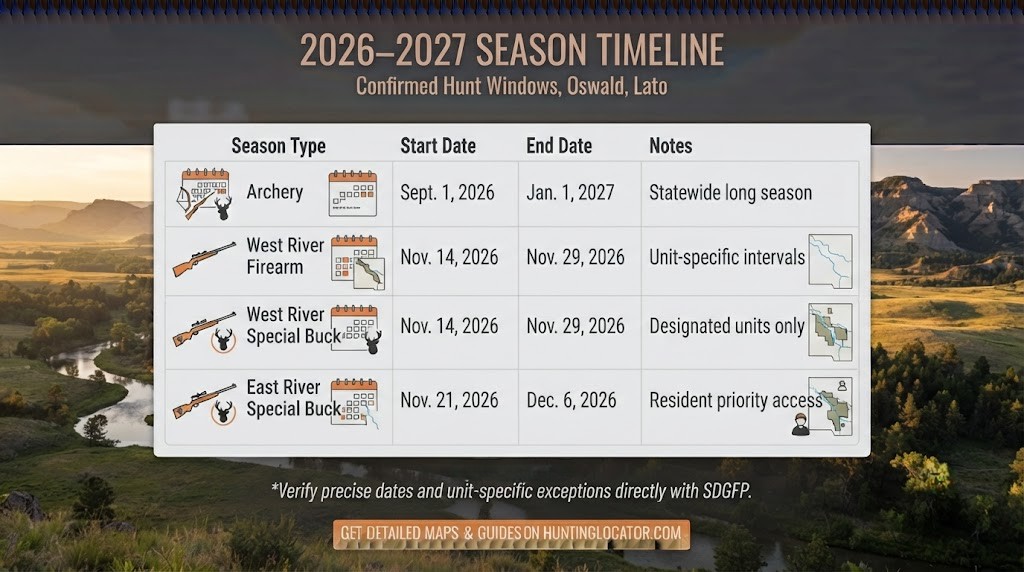
2026–2027 Season Dates at a Glance
| Season | Dates | Notes |
|---|---|---|
| Archery | September 1, 2026 – January 1, 2027 | Non-resident public/private land options may vary |
| West River Firearm | November 14 – November 29, 2026 | Unit-specific intervals and antlerless extensions apply |
| West River Special Buck | November 14 – November 29, 2026 | Premium tag, designated units only |
| East River Special Buck | November 21 – December 6, 2026 | Residents get priority access before leftover tags open to non-residents |
| Muzzleloader / Refuge | Mid-to-late December 2026 | Refuge-specific windows vary by location |
Archery season runs September 1, 2026 through January 1, 2027, the longest deer season window in the state and a common choice for hunters who want flexibility. This matches the confirmed 2026 archery dates tracked by industry sources.
West River firearm dates carry unit-specific exceptions — Gregory County has historically run on a different interval — so check your specific unit against SDGFP before finalizing plans.
Bag Limits & Shooting Hours
South Dakota’s baseline rules are simple, though unit-specific details add nuance.
- General bag limit: One deer per valid tag or license.
- Restrictions vary by unit and license type: You might hold an “Any Deer,” “Any Buck,” or “Antlerless Whitetail Only” tag, each with different harvest rules.
- Multiple tags are possible for residents: For example, residents may hold up to two muzzleloader licenses, but only one can be an antlerless whitetail tag.
- Shooting hours: One-half hour before sunrise to one-half hour after sunset — the official big-game shooting hours apply to both archery and firearm seasons.
If terms like “Any Deer” or “Antlerless Whitetail” are new to you, they’re explained in the beginner section below.
Fees & Licenses: Resident and Non-Resident
Here’s what a tag actually costs, broken out by residency status.
Resident License Fees
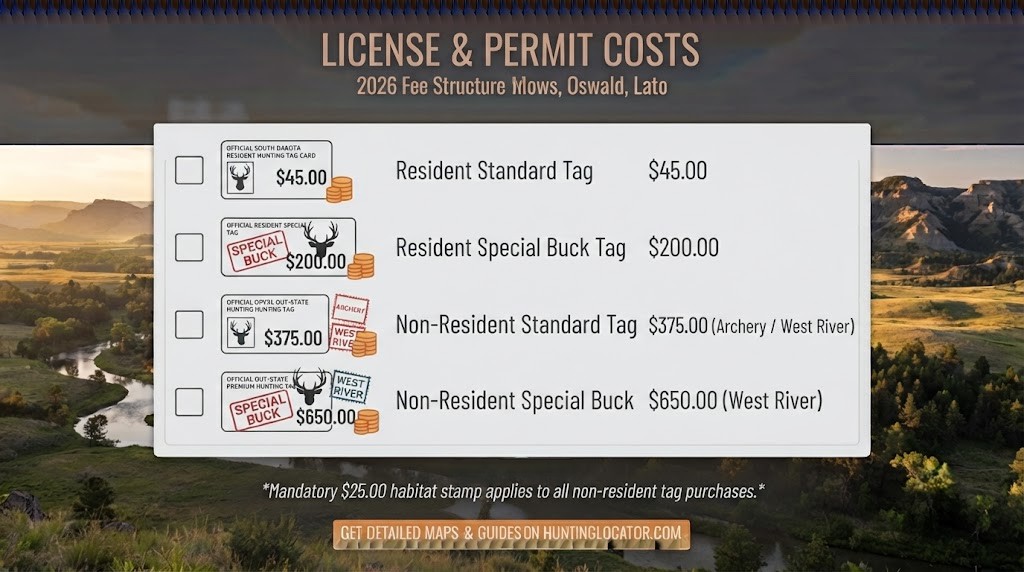
| License Type | Fee |
|---|---|
| Resident Deer Tag (Standard) | $45.00 |
| Resident Special Buck Tag | $200.00 |
The $45 figure matches SDGFP resident license pricing for standard Any Buck and Any Whitetail tags. The $200 special buck tag buys access to designated special-buck seasons and units unavailable under a standard license.
Non-Resident License Fees
| License Type | Fee |
|---|---|
| Habitat Stamp (Mandatory) | $25.00 |
| Non-Resident Deer Tag (West River, Black Hills, Archery) | $375.00 |
| Non-Resident West River Special Buck Tag | $650 |
| Non-Resident Antlerless Whitetail Muzzleloader/Refuge Tag | $100.00 |
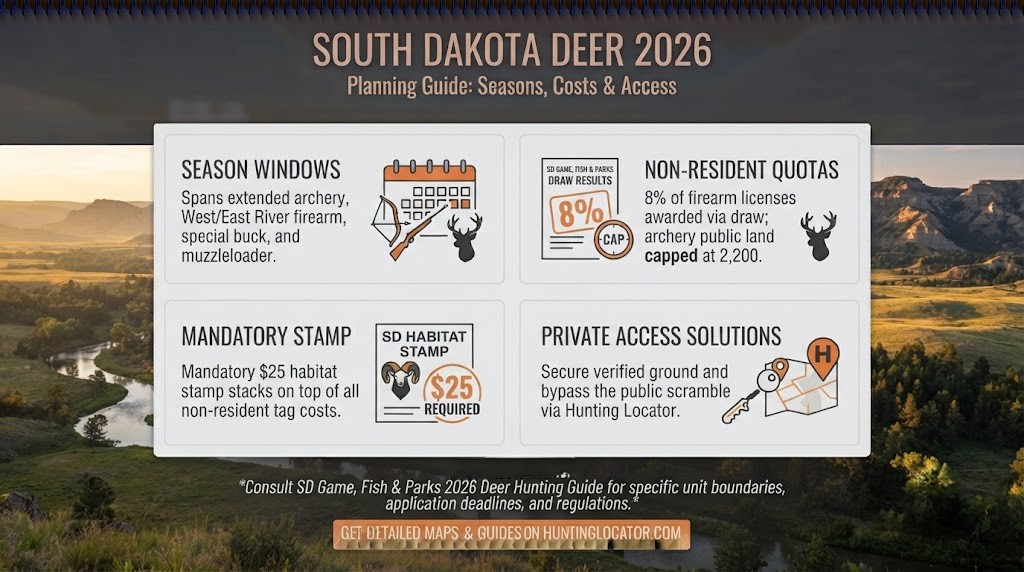
The $25 habitat stamp is mandatory and stacks on top of whichever tag you buy, so a standard $375 tag runs $400 out the door, and the $650 special buck tag runs $675. Confirm exact pricing with SDGFP before you purchase.
Non-Resident Trip Planner: Draws, Quotas & Deadlines
Planning a South Dakota trip from out of state takes more legwork than a same-state hunt.
South Dakota makes 8% of firearm deer licenses available to non-residents, awarded through three separate drawings before any leftover licenses become available. On the archery side, non-resident public-land tags are capped at 2,200, while private-land-only archery tags remain unlimited — a meaningful distinction if your trip depends on access. The deer application deadline is June 23, 2026. These figures reflect the confirmed 2026 archery dates and application windows tracked by industry sources.
A few practical realities worth knowing before you commit to a trip:
- Trophy deer skew private-land: Trophy bucks are typically taken by guided hunters on private land or by residents with private access, while public and walk-in areas offer a fun hunt with a reasonable shot at a nice buck.
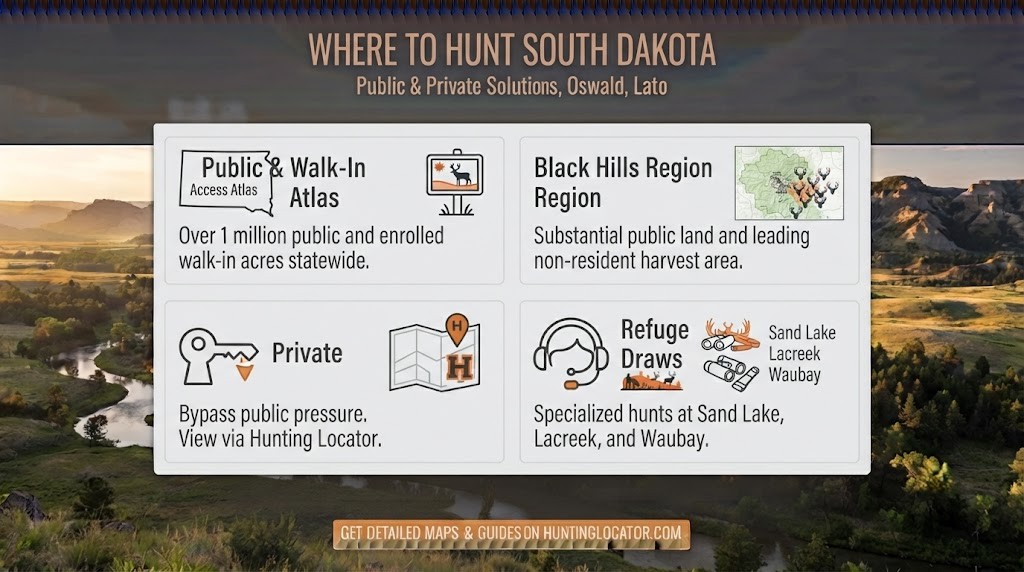
- Black Hills leads non-resident harvests: The majority of non-resident archery harvests come from the Black Hills region, making it a strong starting point for choosing where to focus.
- Refunds protect your preference point: If you return your tag before the season starts, the tag fee is refunded and you keep your preference point, though license and application fees are non-refundable. Confirm current policy specifics with SDGFP.
Cross-check dates and caps against SDGFP before locking in flights or lodging.
Deer Hunting Units Explained: West River, East River, Black Hills & Refuge
Once you know your season dates and fees, the next decision is where to hunt. South Dakota splits deer hunting into distinct regions, each with its own rules.
| Unit | Season Window | Residency Notes | Deer Type |
|---|---|---|---|
| West River | Firearm & Special Buck: Nov 14–29, 2026 | Unit-specific intervals and antlerless extensions apply | Primarily mule deer, historically strong country |
| East River | Special Buck: Nov 21–Dec 6, 2026 | 46 units from the Missouri River eastward; residents get first priority, leftovers go to non-residents | Primarily whitetail, some mule deer near the river |
| Black Hills | Tied to $375 non-resident tag | Mixed public/private land access | Mixed whitetail and mule deer |
| Refuge (Sand Lake, Lacreek, Waubay) | Mid-to-late December 2026 | Open via state draw to residents and non-residents | Type 01 “Any Deer” licenses for 2026 |
A few unit-specific notes worth knowing:
- East River residency priority matters for non-residents hoping to hunt this region — licenses go to residents first throughout all draw periods, and non-residents can only purchase leftover tags after the final draw, per East River residency and access details.
- Black Hills carries substantial public land, making it a popular choice for both residents and traveling hunters.
- Refuge hunts at Sand Lake, Lacreek, and Waubay run through a state draw open to both residents and non-residents. The Sand Lake refuge season dates for 2026 include a muzzleloader-only window from November 14–18 and a rifle window from November 19–23, alongside the broader statewide muzzleloader timeframe.
Finding Access: Public vs. Private Land
One of the biggest challenges in South Dakota, regardless of the license you draw, is finding somewhere legal and good to hunt.
Public and walk-in areas offer real opportunity, and resources like the interactive hunting atlas can help you scout boundaries ahead of time. Private land access, though, consistently produces better trophy odds, especially in West River units and the Black Hills. If you’d rather skip months of cold-calling landowners, browse South Dakota hunting leases to line up a spot before the season crunch hits.
Securing access ahead of time means you’re scouting instead of scrambling once the season opens.
Gear Up for Your Hunt
West River and the Black Hills bring cold, variable conditions by the time firearm season opens in mid-November, so layering matters as much as marksmanship. Firearm big-game hunters are also required to wear at least one exterior article of fluorescent orange or pink clothing, whether that’s a hat, vest, or jacket. It’s a safety rule, but it’s also a gear decision worth making before you’re standing in a parking lot on opening morning.
Cold-weather layers, blaze orange, and reliable optics make a real difference on a late-season hunt. Get the right gear here before you head out.
New to South Dakota Deer Hunting? Start Here
If this is your first South Dakota deer season, the terminology alone can be confusing. Here’s the plain-language breakdown.
Tag types you’ll encounter:
- “Any Deer” — A flexible tag valid for either whitetail or mule deer, giving you the most options in the field.
- “Antlerless” / “Antlerless Whitetail Only” — Restricts your harvest to does or antlerless deer; some of these tags are private-land-only, so check your specific license before heading out.
- “Special Buck” — A premium tag with a higher fee that allows buck harvest in designated seasons and units, typically offering better trophy potential than a standard tag.
Shooting hours, explained simply: You can legally hunt from 30 minutes before sunrise to 30 minutes after sunset. Sunrise and sunset shift throughout the season and vary slightly by location, so check a sunrise/sunset table for your specific unit and hunting date rather than assuming a fixed time.
Blaze orange: If you’re hunting with a firearm during big-game season, South Dakota requires at least one exterior article of fluorescent orange or pink clothing — a simple safety rule that keeps hunters visible to each other in the field.
Licensing basics: Applications go through SDGFP online; there’s no walk-in paper process anymore. If you’re 16 or younger, you’ll need to pass a hunter education course, which includes an in-person field day, before you can get a license. For exact steps and current deadlines, SDGFP’s site is the best source to confirm against.
Hunting in South Dakota isn’t reserved for veterans or big spenders. Whether you’re hunting public walk-in land with a basic tag or saving up for a special buck license down the road, the season is open to you the same as anyone else.
Explore More South Dakota Hunting Seasons
Planning to chase more than whitetails this trip? Here are our companion guides to South Dakota’s other seasons:
- South Dakota mountain lion season
- South Dakota turkey season
- South Dakota buffalo hunting
- South Dakota antelope season
- South Dakota elk season
- South Dakota bighorn sheep season
- South Dakota small game season
- South Dakota waterfowl season
- South Dakota upland game season
Frequently Asked Questions
When does deer season start in South Dakota in 2026?
Archery season opens September 1, 2026 and runs through January 1, 2027, the earliest and longest deer season in the state. Firearm and special buck seasons follow in mid-to-late November. Verify exact firearm dates against SDGFP before finalizing plans, since unit-specific exceptions can apply.
What are the legal shooting hours for deer hunting in South Dakota?
Legal shooting hours run one-half hour before sunrise to one-half hour after sunset, for both firearm and archery big-game hunting. It’s a fixed rule statewide, though actual sunrise and sunset times shift throughout the season.
How much is a non-resident South Dakota deer tag in 2026?
A standard non-resident deer tag runs $375, while the West River special buck tag costs $650. Both require the mandatory $25 habitat stamp on top, bringing the real cost to $400 or $675 respectively. Confirm current pricing with SDGFP before purchasing.
What’s the difference between an “Any Deer” and an “Antlerless” tag?
An “Any Deer” tag lets you harvest either a whitetail or mule deer. An “Antlerless” tag restricts your harvest to does or antlerless deer only, and some antlerless tags are valid on private land exclusively.
What is the habitat stamp and is it required?
The habitat stamp is a mandatory $25 add-on for non-resident hunters that helps fund wildlife habitat conservation across the state. It stacks on top of your tag price regardless of which deer tag type you purchase. Check SDGFP for current pricing.
Are non-resident deer tags awarded through a draw?
Yes. South Dakota allocates 8% of firearm deer licenses to non-residents through a series of three drawings before leftover licenses become available. Non-resident archery public-land tags are additionally capped at 2,200, though private-land-only archery tags remain unlimited.
Conclusion
Three things anchor this season: archery opens September 1, 2026; your tag type and unit determine what you can legally harvest; and non-residents need to budget the tag price plus the mandatory $25 habitat stamp before booking a trip.
Next steps:
- Confirm your unit and season window using the tables above as your starting point.
- Verify dates and fees with SDGFP before you apply or purchase anything — regulations can shift, and tag purchases are final.
- Secure your access early rather than scrambling the week before opening day.
- Gear up for the conditions your unit and season demand.
This guide pulls South Dakota’s 2026–2027 deer regulations together in one place, but SDGFP always has the final word on dates and fees. Double-check your dates with SDGFP, find your South Dakota hunting spot, and get set for opening day.


