This South Dakota Small Game Season Guide for 2026 pulls together the season dates, bag limits, license costs, and land-access options for residents and nonresidents alike. “South Dakota small game” covers pheasant, grouse, partridge, quail, dove, cottontail rabbit, and squirrel.
This guide covers:
- Complete 2026–2027 season dates and bag limits by species and hunting method
- Resident vs. nonresident licenses, permits, and habitat stamp costs
- Where to hunt: public walk-in land, private-land leases, and guided options

Quick Overview: South Dakota Small Game Seasons at a Glance
The table below covers the dates, limits, and requirements you’ll need over the course of the season. Regulations shift from year to year, so confirm final details against the official South Dakota GFP Hunting and Trapping Handbook before you head afield.
| Species | Season Type | Dates | Bag Limit | Notes |
|---|---|---|---|---|
| Pheasant | Youth-Only | Sept 26 – Oct 4, 2026 | 3 roosters daily | For qualifying youth hunters |
| Pheasant | Resident-Only | Oct 10 – Oct 12, 2026 | 3 roosters daily / 9 possession | Public lands only; SD residents |
| Pheasant | Traditional/General | Oct 17, 2026 – Jan 31, 2027 | 3 roosters daily / up to 15 possession | Statewide opener, third Saturday in October |
| Pheasant | Preserve | Sept 1, 2026 – Mar 31, 2027 | Per preserve rules | Licensed private preserves |
| Grouse (Prairie & Ruffed) | General | Sept 20 – Jan 31 | Varies — check GFP | |
| Partridge | General | Sept 20 – Jan 31 | Varies — check GFP | |
| Dove | General | Sept 1 – Nov 9 | Varies — check GFP | Early-season opener |
| Quail | General | Late October – Jan 31 | Varies — check GFP | |
| Cottontail Rabbit & Tree Squirrel | General | Sept 1 – Mar 31 | Varies — check GFP | Long-season small game |
| Snipe | General | Sept 1 – Oct 31 | Varies — check GFP |
Daily and possession limits for non-pheasant species vary by regulation — confirm exact per-species breakdowns with South Dakota Game, Fish & Parks before you plan your bag.
A few licensing basics worth knowing up front:
- Everyone needs a valid Small Game License, resident or nonresident
- Hunters 18 and older must add a Habitat Stamp (resident $10 / nonresident $25)
- Hunters born after a certain date or under 16 generally need hunter education (HuntSAFE) unless hunting under the mentored program
- Dove hunters also need migratory bird certification (more in the licenses section)
For a deeper species-by-species breakdown, see our South Dakota small game breakdown. If you’re planning a season around more than small game, the full South Dakota season calendar covers everything from deer to waterfowl.
South Dakota Small Game Hunting Seasons
Small game in South Dakota covers upland birds like pheasant, grouse, partridge, and quail, plus dove, cottontail rabbit, tree squirrel, and snipe. Pheasant is the flagship species and the reason South Dakota is nationally recognized as the Pheasant Capital of the World, but the state’s season calendar runs long enough to keep you hunting well past opening weekend. For a closer look at the upland side specifically, our upland game hunting guide covers pheasant, grouse, partridge, and quail in more detail.

Pheasant Season (The Flagship)
South Dakota runs pheasant season in four distinct windows, each aimed at a different type of hunter.
The Youth-Only Season runs September 26 – October 4, 2026, giving qualifying young hunters a head start before the crowds arrive. Shooting hours follow the standard 10 a.m. Central to sunset convention used throughout the pheasant season.
The Resident-Only Season runs October 10 – October 12, 2026, on public lands only, and is limited to South Dakota residents — three days to hunt birds that haven’t yet felt any pressure. Verify these dates against the current GFP listing before you lock in plans.
The Traditional (General) Season is the one most hunters ask about. It opens October 17, 2026 — the third Saturday in October, as always — and runs through January 31, 2027. It’s open to residents and nonresidents alike, with a daily bag limit of 3 roosters and a possession limit of up to 15.
The Preserve Season runs September 1, 2026 – March 31, 2027 on licensed private preserves, extending well beyond the traditional dates. More on preserves in the guided-hunts section below.
Bag limits at a glance:
- Traditional/Youth season: 3 roosters daily, up to 15 in possession
- Resident-only season: 3 roosters daily, up to 9 in possession
- Preserve season: limits set by individual preserve rules
Grouse, Partridge & Quail Seasons
Prairie and ruffed grouse, along with partridge, share a season running September 20 through January 31, which overlaps with pheasant season if you want to mix species on a single trip. Quail season opens later, starting in late October and running through January 31.
Exact daily and possession limits for these species vary by regulation, so check the current South Dakota GFP handbook for specific numbers before you head out. The season length rewards hunters willing to work cover types beyond the classic pheasant field.
Dove, Rabbit, Squirrel & Snipe Seasons
Dove season runs September 1 through November 9, making it one of the earliest small game opportunities on the South Dakota calendar and a good way to get back in the field before pheasant opener. Snipe season runs the same September 1 through October 31 window.
Cottontail rabbit and tree squirrel hunters get the longest runway of all: September 1 through March 31, roughly seven months of opportunity for resident hunters looking to stay in the field long after pheasant season wraps up.
South Dakota Small Game Licenses and Permits
Licensing in South Dakota is more straightforward than it looks once you know the structure. Licenses are sold over the counter, first-come, first-served, with no draw or lottery system to navigate.
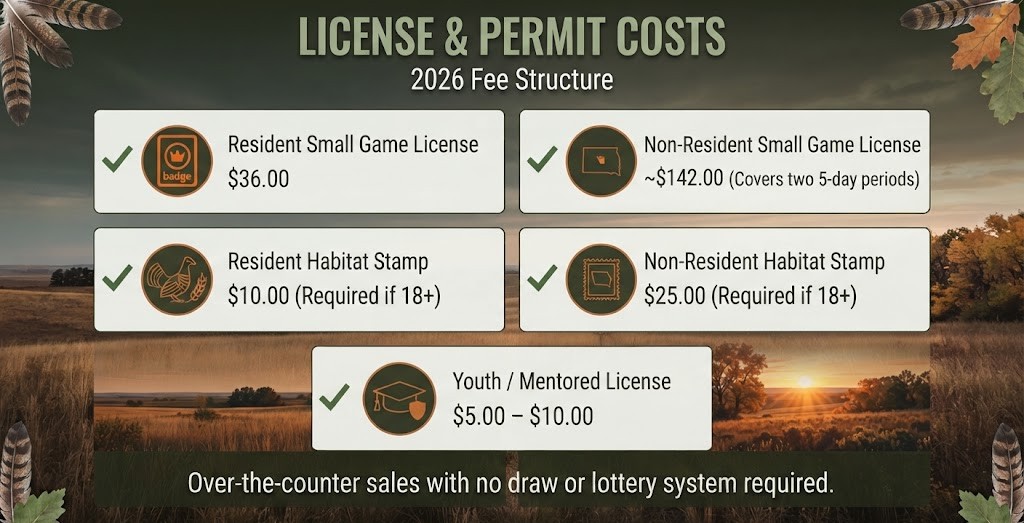
South Dakota Hunting Licenses
The core costs break down as follows:
| License Type | Cost | Habitat Stamp | Validity/Notes |
|---|---|---|---|
| Resident Small Game License | $36 | $10 (required if 18+) | Full resident season |
| Nonresident Small Game License | ~$142 | $25 (required if 18+) | 10 days total, split into two separate 5-day periods |
| Youth / Mentored License | $5–$10 | Habitat Stamp if 18+ | Reduced-rate entry point |
The nonresident structure trips up a lot of first-time travelers: a nonresident small game license doesn’t give you 10 straight days. It covers two separate 5-day hunting periods, and you choose your start dates when you buy the license. A common approach is using the first period during opener week, when pressure is highest, then returning for a second period in November or December, when crowds thin out and birds settle into heavier cover.
Licenses remain available over the counter throughout the season, and youth licenses may carry a small additional surcharge, so check current pricing on the South Dakota GFP site before you buy.
South Dakota Hunting Permits
Beyond the base license, a few add-ons come into play depending on what and how you’re hunting:
- Habitat Stamp — required for every hunter 18 and older, $10 for residents and $25 for nonresidents, funding habitat work and public access statewide. This is the official habitat stamp requirement from South Dakota GFP.
- Migratory Bird Certification — required specifically for dove hunters, in addition to your small game license.
- Preserve licenses — nonresident shooting preserve licenses exist for hunters who only plan to hunt licensed private preserves rather than the general season.
Buying your license is a simple sequence:
- Choose your license type — resident, nonresident, youth, or mentored small game
- Purchase it through the GFP website, the GFP mobile app, or an approved retailer
- Add the Habitat Stamp if you’re 18 or older
- Carry your license, stamps, and any required certification with you in the field
Hunter education matters most for younger and newer hunters. Generally, hunters under 16 need HuntSAFE certification to hunt independently, but South Dakota’s mentored program offers a workaround: a hunter under 16 can hunt without HuntSAFE as long as they’re accompanied by a qualified, unarmed adult mentor who carries their own HuntSAFE card. South Dakota GFP’s youth and mentored hunting rules page has the full breakdown.
South Dakota Small Game: Where to Hunt
There are three real paths to hunting ground in South Dakota: free public access, private land you lease or buy, and guided or preserve hunts. Finding quality land, especially from out of state, is often the hardest part of planning a trip, and it’s the problem Hunting Locator was built to solve.
Best Public Lands & Walk-In Areas
South Dakota offers millions of acres of free public hunting access, and its Walk-In Area program is one of the best deals in American upland hunting. Walk-In Areas are private lands enrolled with GFP specifically to provide free public hunting during the season, open to residents and nonresidents on exactly the same terms — no extra fee, no door-knocking required.
- Walk-In Areas (WIAs) — enrolled private land offering free public access, with identical rules for residents and nonresidents
- Game Production Areas & public lands — millions of acres statewide, best located using the GFP Public Hunting Atlas or Public Hunting Areas map
- Central & north-central South Dakota — the James River valley and Missouri River counties are traditionally among the strongest pheasant regions in the state
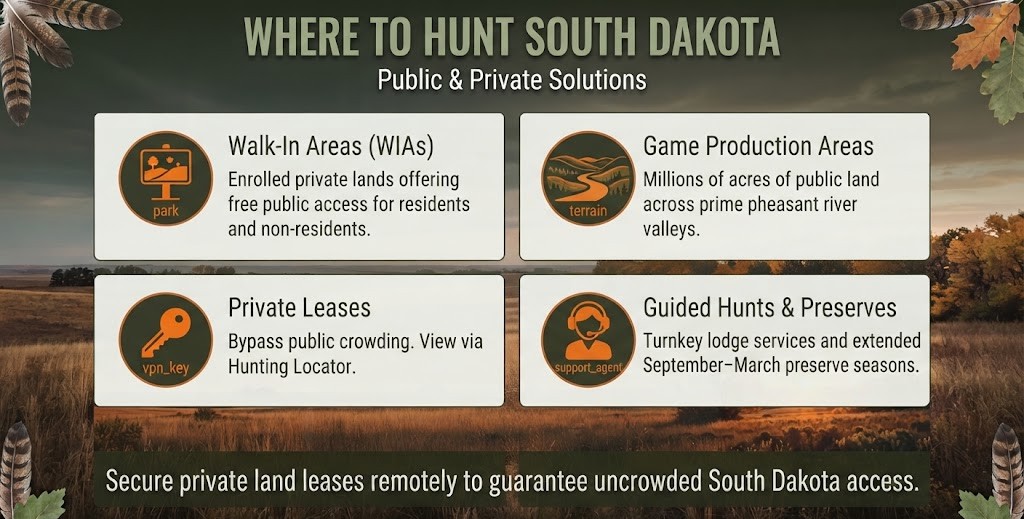
Private Land Hunting with Hunting Locator
Public land access in South Dakota is genuinely good, but pressure builds fast, especially on opening weekend, when trucks line up at well-known access points by daybreak. Securing private ground, through a lease or an outright purchase, is the way to get quieter fields, more predictable birds, and a hunt on your own terms.
Leasing gives you exclusive access for a season without the long-term commitment of ownership. Buying land is more of a long-term investment, for hunters who want a permanent home base for years of seasons to come. Hunting Locator connects you directly with South Dakota landowners open to either arrangement: browse a consolidated list of hunting land in one place, connect directly with landowners, and secure your access remotely, before you have to make the drive.
You can browse South Dakota hunting leases now and start narrowing down options for the 2026 season.
Guided Hunts & Preserves
If you’d rather have someone else handle the scouting, the access, and the logistics, a guided hunt or licensed preserve is worth considering, particularly for first-timers, out-of-state groups, or anyone short on time to plan.
Guided hunts typically trade a higher price tag for convenience: birds, land, and often lodging are handled for you, so you can focus on shooting. Preserves add another dimension, offering the extended September-through-March season mentioned earlier, which helps if your schedule doesn’t line up with the traditional dates. Hunting a preserve generally requires either a preserve-specific license or a standard Small Game License, depending on the operation.
If you’d rather run your own hunt on your own schedule instead of booking a guide, that’s what a private lease is for — worth keeping Hunting Locator’s South Dakota listings bookmarked as you plan.
Small Game Hunting Tips
A little preparation goes a long way toward a productive South Dakota season. A few fundamentals that matter most:
- Match Your Shotgun to the Bird: A 12-gauge is the workhorse for pheasant hunting, though 20-gauge and 16-gauge shotguns are popular, lighter alternatives if you’re covering a lot of ground on foot.
- Hunt the Late Season Smart: By November and December, birds bunch into heavier cover as pressure and weather push them there. Slow your pace and work thick draws and cattail sloughs instead of open fields.
- Know Your Shooting Hours: Pheasant hunting runs 10 a.m. Central to sunset, so plan your mornings for scouting, breakfast, or hunting other species before the pheasant clock starts.
- Work the Edges: Field edges, shelterbelts, and cover transitions concentrate birds — hunt these methodically rather than rushing through open ground.
- Gear Up Before You Go: Blaze orange, quality boots, a vest with a game pouch, and the right loads separate a good day afield from a long, frustrating one.
You can shop hunting gear and essentials to get ready before the season opens.
More Resources from Hunting Locator
Planning to hunt more than small game this season? Explore our other South Dakota guides for a full picture of what the state offers:
- South Dakota hunting seasons overview — the full statewide season calendar across all species
- South Dakota small game deep-dive — a companion breakdown of small game specifics
- Upland game season guide — focused coverage of upland birds
- South Dakota waterfowl seasons — a natural next step for dove hunters and early-fall trips
- South Dakota turkey hunting — spring and fall turkey planning
- South Dakota deer seasons — for hunters adding big game to their trip
- South Dakota antelope hunting — western South Dakota pronghorn planning
- South Dakota elk seasons — limited-draw elk information
- South Dakota mountain lion season — Black Hills predator hunting
- South Dakota buffalo hunting — unique bison hunt opportunities
- South Dakota bighorn sheep hunting — once-in-a-lifetime sheep tags
Frequently Asked Questions
When does pheasant season open in South Dakota in 2026?
The traditional pheasant season opens October 17, 2026, and runs through January 31, 2027. Before that, a youth-only season runs September 26 – October 4, and a resident-only public-lands season runs October 10–12. Shooting hours are 10 a.m. Central to sunset throughout.
How much does a South Dakota small game hunting license cost in 2026?
A Resident Small Game License costs $36 plus a $10 Habitat Stamp. A Nonresident Small Game License runs about $142 plus a $25 Habitat Stamp. Youth and mentored licenses cost between $5 and $10. Licenses are sold over the counter, with no draw or lottery.
How does the nonresident two 5-day period license work?
One nonresident license covers two separate 5-day hunting periods, and you choose your start dates when you purchase it. A common strategy is hunting opener week for the first period, then returning in November or December for the second, when pressure eases and birds settle into heavier cover.
Do I need a habitat stamp to hunt small game in South Dakota?
Yes. Hunters 18 and older must purchase a Habitat Stamp along with their license: $10 for residents and $25 for nonresidents. The stamp funds habitat improvement and public hunting access across the state.
What are the youth and mentored hunting rules in South Dakota?
South Dakota’s youth-only pheasant season runs September 26 – October 4, 2026, with reduced youth license rates of $5–$10. Under the mentored program, hunters under 16 can hunt without HuntSAFE certification as long as they’re accompanied by a qualified, unarmed adult mentor who carries their own HuntSAFE card.
Where can nonresidents find land to hunt pheasant in South Dakota?
Start with free public Walk-In Areas, which are open to nonresidents on the same terms as residents, and use the GFP Public Hunting Atlas to locate them. For lower-pressure, secured access, browse South Dakota hunting leases through Hunting Locator to connect directly with landowners before your trip.
The Final Shot
This guide covers the three pillars of a well-planned South Dakota trip: the 2026 season dates for every small game species, resident and nonresident license and habitat stamp costs, and the three paths to land access — public, private, and guided. From here, confirm your dates against the official GFP handbook, buy your license and habitat stamp, and lock in your hunting ground early, especially if you’re chasing opener weekend.
Regulations and dates can shift from year to year, so verify final details with the official South Dakota GFP Hunting and Trapping Handbook before you head into the field. When you’re ready to find your own piece of South Dakota, find your South Dakota hunting ground and use this guide as the starting point for planning your season.


