Here’s the thing about alligator hunting in Texas: the regulations are complex, the seasons are split, and one paperwork mistake can ruin your entire hunt. We’ve spent countless hours digging through TPWD regulations and talking to successful hunters to create this complete roadmap for your 2026 alligator season.
Planning multiple hunts this year? Our complete Texas hunting seasons guide helps you coordinate everything. And when you’re ready to gear up, Hunting Locator’s store has the heavy-duty equipment you’ll need for Texas alligator hunting.
Here’s what we’re covering:
- Season timing (because core vs. non-core counties have completely different dates)
- Licensing maze (residents pay $46 total, non-residents can hit $474+)
- Access options (from $3 public draws to $8,000+ guided experiences)
Let’s jump into the essential details first.
Quick Overview: 2026 Texas Alligator Season at a Glance
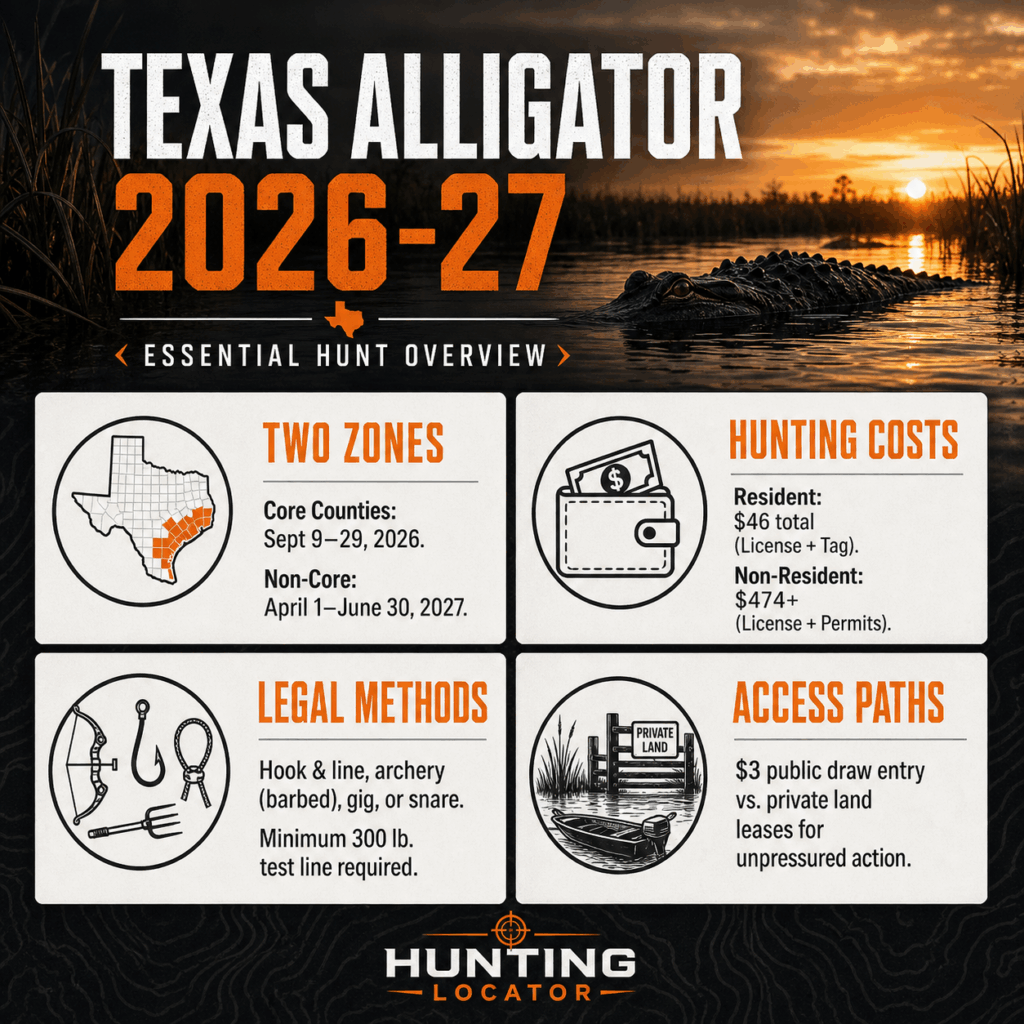
The Texas Parks and Wildlife Department (TPWD) splits Texas into two hunting zones with totally different rules and seasons.
| Element | Core Counties (22 counties) | Non-Core Counties (All other) |
|---|---|---|
| Season Dates | September 9, 2026 – September 29, 2026 | April 1, 2027 – June 30, 2027 |
| Bag Limit | 1 alligator per person | 1 alligator per person per license year |
| CITES Tag Required | Yes – must possess before hunting | Yes – affix WRD immediately, then obtain CITES tag within 72 hours |
| Hide Tag Fee | $21 | $21.00 |
| Hunting Hours | Half hour before sunrise to sunset | Half hour before sunrise to sunset |
| Legal Methods | Hook and line, archery (barbed arrow), gig, hand-held snare | Hook and line, archery (barbed arrow), gig, hand-held snare |
Your licensing checklist before heading out:
- Valid Texas hunting license (resident or non-resident)
- CITES hide tag ($21 fee)
- Hunter education certification (if born on or after September 2, 1971)
- For public land: Annual Public Hunting Permit ($48) plus drawn hunt permit
- For core counties: Must have CITES tag IN HAND before hunting
Texas Alligator Hunting Seasons
Texas runs two completely separate alligator seasons, and enforcement is strict about keeping hunters in their designated zones and timeframes. The split exists because alligator populations vary dramatically across the state.
Core Counties Season (September 2026)
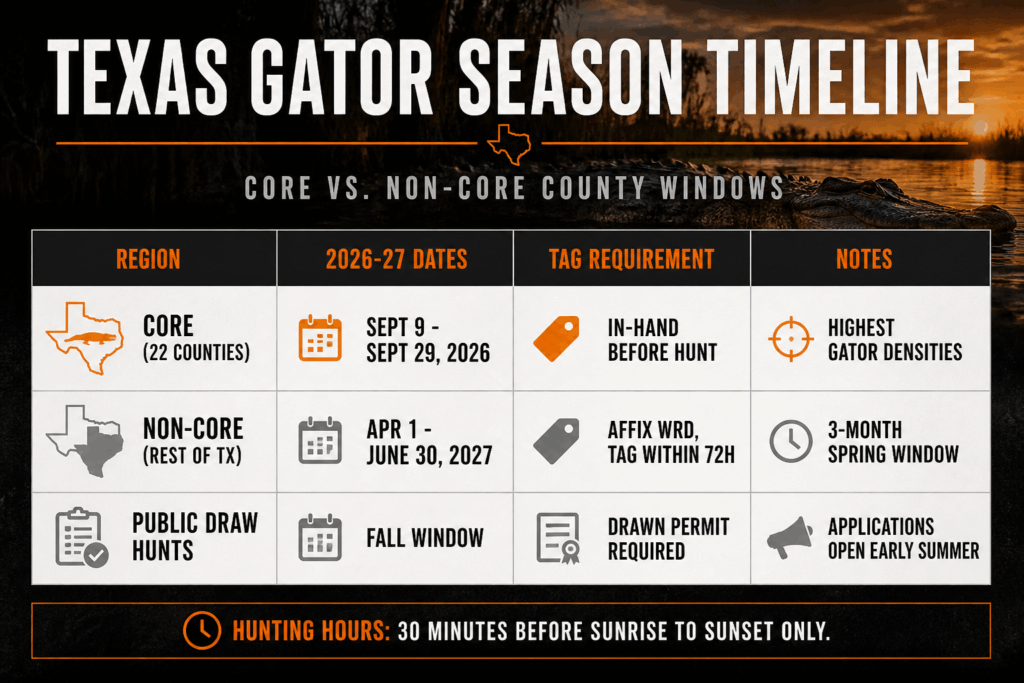
Your hunting window: September 9-29, 2026. Just 21 days to chase gators in the 22 counties with the highest alligator densities. These counties stretch along the eastern Gulf Coast between Houston and Louisiana where the habitat is perfect for big populations.
Core counties: Angelina, Brazoria, Calhoun, Chambers, Galveston, Hardin, Jackson, Jasper, Jefferson, Liberty, Matagorda, Nacogdoches, Newton, Orange, Polk, Refugio, Sabine, San Augustine, San Jacinto, Trinity, Tyler, and Victoria.
Here’s where hunters mess up: In core counties and on special properties, no person may hunt an alligator without possessing a valid CITES tag on their person prior to hunting an alligator. You need that tag BEFORE you start hunting, not after you harvest.
Time restrictions are non-negotiable: One-half hour before sunrise to sunset. Between sunset and one-half hour before sunrise, no person shall set any baited line capable of taking an alligator. No exceptions.
Non-Core Counties Season (Spring 2027)
The non-core season runs April 1 through June 30, 2027 – that’s three full months compared to core counties’ three weeks. Every Texas county not listed above falls into this category. The bag limit in non-core counties is one alligator per person per license year.
The paperwork process is different here. Instead of getting your CITES tag first, upon killing an alligator in a non-core county, a person must IMMEDIATELY affix a WRD to the alligator, which shall accompany the alligator until it is permanently tagged with a CITES tag.
Then you’ve got 72 hours to handle the bureaucracy: WITHIN 72 hours, complete the Non-Core Alligator Hide Tag Report (PDF) and mail it to TPWD, 4200 Smith School Road, Austin, TX 78744, along with a $21 hide tag fee.
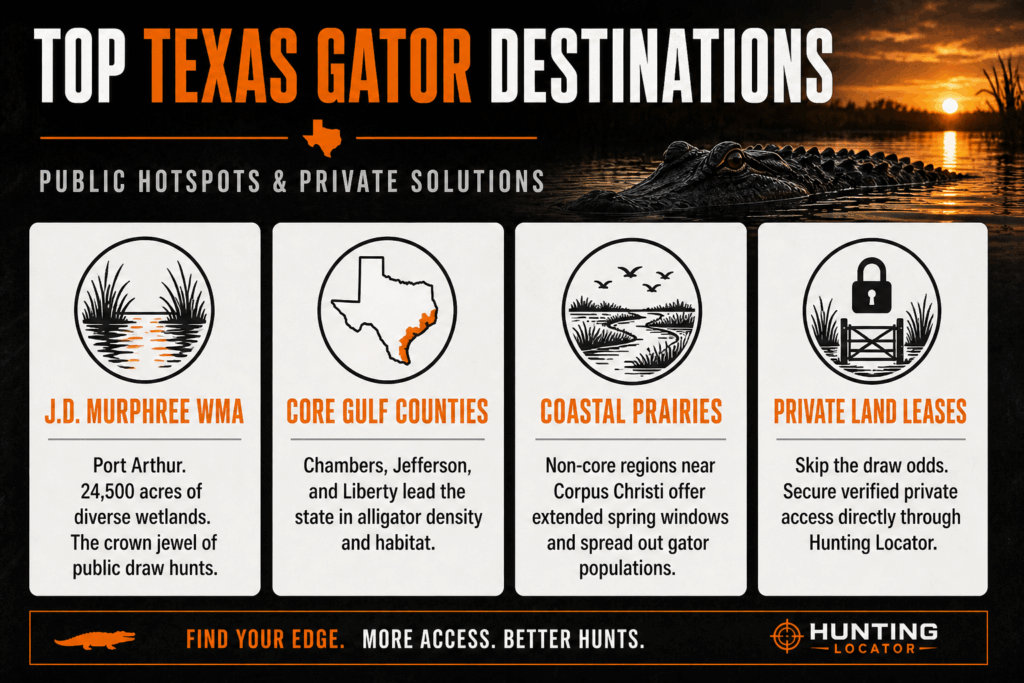
Don’t assume non-core means no alligators. A good number of alligators can also be found along the coastal prairies down towards Corpus Christi. The populations are just more spread out.
Texas Alligator Licenses and Permits
Getting your paperwork wrong will end your hunt before it starts. Here’s exactly what you need and what it’ll cost you.
Texas Hunting Licenses
Start with your basic hunting license – everything else builds from here.
| License Type | Resident Cost | Non-Resident Cost | Notes |
|---|---|---|---|
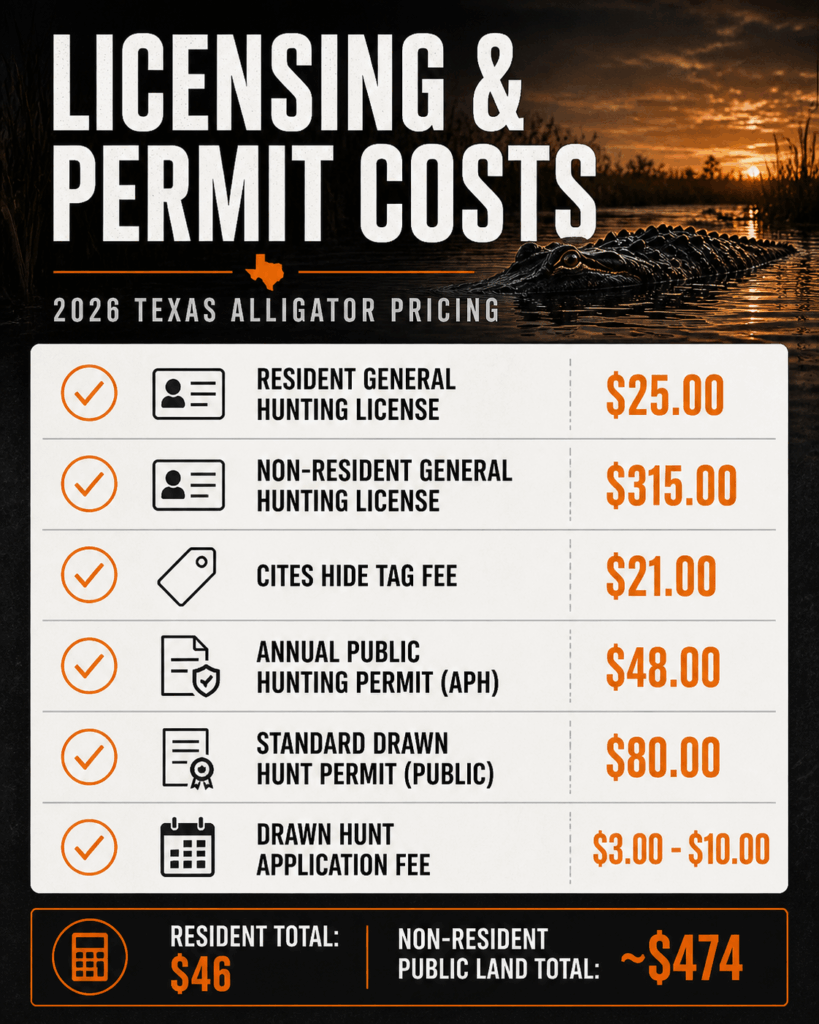
| General Hunting License | $25.00 | $315.00 | Required for alligator hunting |
| 5-Day Small Game License | N/A | $48.00 | Does NOT cover alligator—for dove, quail, exotics only |
That resident license is a steal: A Texas resident General Hunting License ($25) includes the right to harvest up to 5 deer and 4 turkey annually on top of alligator privileges.
Hunter Education: Anyone born on or after September 2, 1971, must complete hunter education. No exceptions for residents or non-residents. You can knock this out online through TPWD.
Texas Alligator Permits and Tags
The CITES tag requirement comes from international trade regulations – even if you’re keeping the meat and hide locally, you still need it. The $21 hide tag (CITES tag) fee is required, usually paid upon harvesting.
The timing difference matters:
- Core counties: Get your CITES tag BEFORE you hunt
- Non-core counties: Tag immediately with WRD, then submit paperwork and $21 within 72 hours
Public Hunt Costs:
| Permit Type | Fee | Notes |
|---|---|---|
| Standard Drawn Hunt (Adult) | $80.00 | Most WMA alligator hunts |
| Extended Drawn Hunt (Adult) | $130.00 | Longer duration hunts |
| Youth Drawn Hunt | $0 | Free for youth-only hunts |
| Application Fee | $3–$10 | Per hunt category |
| CITES Hide Tag | $21 | Required upon harvest |
Want to hunt public land? The Annual Public Hunting (APH) Permit ($48) is required for hunting on TPWD-managed Wildlife Management Areas.
Real-world cost example: Non-resident hunting public land will spend around $467-474 minimum: $315 (license) + $48 (APH permit) + $3-10 (application) + $80 (drawn hunt if selected) + $21 (CITES tag). That’s before gas, food, and lodging.
Where to Hunt Alligators in Texas
You’ve got three paths: public draws (cheap but competitive), guided hunts (expensive but effective), or private land (middle ground with best flexibility). Public land has fewer hunting opportunities compared to private land, which is why private access is becoming more valuable every year.
Best Public Lands for Alligator Hunting
TPWD’s drawn hunt system is your budget option. While outfitters charge thousands of dollars to take clients on a guided alligator hunt, the public hunt is far less costly. The drawing entry fee is only $3. With persistence and a bit of luck, you can win one of the 100 or so permits handed out every year.
Top WMAs for alligator hunting:
- J.D. Murphree WMA: Just outside the coastal town of Port Arthur, J.D. Murphree Wildlife Management Area offers 24,500 acres of highly diverse wetlands to explore and hunt. This is the crown jewel of public alligator hunting.
- Mad Island WMA: Open during drawn hunts for alligator, feral hog, and white-tailed deer. Coastal marsh habitat with solid alligator numbers.
- Guadalupe Delta WMA: Standard $80 adult hunt fee, offering prime coastal marsh opportunities.
Applications open through TPWD’s online system in early summer for fall hunts. Competition is fierce – only about 100 permits statewide means your odds aren’t great, but the price is right.
Guided Alligator Hunts
Guided hunts are the premium experience, especially for out-of-state hunters who want guaranteed action. Prices for alligator hunting can range anywhere from about $964 to $8,425, but the average price for a half day trip for alligator hunting is $5,031. Alligator hunting is usually priced on a daily rate + trophy fee basis, with the daily rate starting from $500.
What you get: Most guided trips provide everything you need for the hunt, including firearms. Hunts include a fully guided experience, top-tier equipment, and the flexibility to hunt by airboat or bay boat depending on conditions.
Size expectations: Guides work to help you get a “trophy” alligator, one that is at least 8 feet long. 8′ to 10′ alligators are almost assured with experienced guides on quality private water.
Book early: Most hunters book their trips 100 days in advance, and one outfitter recommends making alligator hunting reservations well in advance to secure availability.
Private Land Hunting
Private land gives you the best balance of access, success rates, and control over your hunting experience. Hunting on private land not only improves success rates but also ensures a controlled hunting environment.
Legal requirement: Alligators may be taken from public water, however, the person and the taking device must be on private property. This makes legitimate private land access crucial for legal compliance.
Why private land works:
- Higher success rates than public draws
- Less hunting pressure from other hunters
- Flexible scheduling within season dates
- Better access roads and facilities
- Opportunity to scout and return
Finding quality private land doesn’t have to mean cold calls and rejections. Hunting Locator connects you directly with landowners who want responsible hunters on their property. No guesswork, no awkward conversations – just verified access to properties with alligator populations.
Alligator Hunting Tips
Alligator hunting success comes down to understanding both the rules and the animal’s behavior patterns. But before you even think about setting a line, understanding the rules is paramount. Texas Parks and Wildlife Department (TPWD) lays out a clear framework, and getting it right ensures a safe, legal, and ultimately, more rewarding hunt.
What actually works:
- Scout during legal hours: One-half hour before sunrise to sunset are your only legal hunting hours. Use every minute to locate active gators and identify ambush spots.
- Bait height matters: Smart hunters place bait about 18 inches above the water… Hopefully, we’ll catch a little bit bigger gator putting it that high above the water.
- Don’t cheap out on gear: Minimum 300 lb. test line is required by law. Your safety depends on quality hooks, snares, and dispatch equipment.
- Hunt the right weather: Alligators, being cold-blooded, are most active when the temperatures are in the 80 to 90 Fahrenheit (28-33 C) range. Plan accordingly.
- Master safe dispatch: After the gator is secured, hunters must use an approved device for dispatching, with a bang stick being the most common and effective tool.
- Focus on prime habitat: Look for highly diverse wetlands including shallow bays, creek mouths, and areas loaded with baitfish.
More Resources from Hunting Locator
Maximize your Texas hunting opportunities with these specialized guides:
- Texas Hunting Seasons Overview – Coordinate alligator season with other Texas hunting opportunities
- Texas Waterfowl Season – Hunt the same wetland habitats for ducks and geese
- Texas White-tail Season – Plan your fall hunting calendar around both alligator and deer seasons
- Texas Turkey Season – Spring turkey overlaps with non-core county alligator season
- Texas Hunting Leases – Browse verified private land access for alligators and other species
- Hunting Locator Platform – Complete database of hunting opportunities and land management tools
FAQ
When can I hunt alligators in Texas in 2026?
Season dates depend on where you’re hunting. Core counties (22 counties along the Gulf Coast) run September 9-29, 2026. All other counties run April 1-June 30, 2027. Legal hunting hours are half hour before sunrise to sunset only.
How much does it cost to hunt alligators in Texas as a non-resident?
Non-residents need a $315 hunting license as the foundation. For public land hunting, add $48 (Annual Public Hunting Permit), $3-10 (application fee), $80 (drawn hunt permit if selected), and $21 (CITES hide tag). You’re looking at $467-474 minimum before travel expenses.
Do I need a CITES tag before hunting alligators in Texas?
It depends on location. Core counties require you to possess a valid CITES tag BEFORE hunting. Non-core counties let you immediately attach a Wildlife Resource Document (WRD) upon harvest, then submit paperwork and $21 fee within 72 hours to get your CITES tag.
What are the best places to hunt alligators on public land in Texas?
J.D. Murphree Wildlife Management Area offers 24,500 acres of highly diverse wetlands and is the top public alligator destination. Mad Island WMA and Guadalupe Delta WMA also offer drawn hunts. Competition is intense though – only about 100 permits are handed out every year across all WMAs.
What hunting methods are legal for alligator hunting in Texas?
Legal methods include hook and line, archery with barbed arrows, gigs, and hand-held snares. Minimum 300 lb. test line is required by law. You cannot shoot a free-swimming alligator – it must be secured with a restraining device first.
How far in advance should I plan my alligator hunt?
For guided hunts, most hunters book their trips 100 days in advance. Public land draw applications typically open in early summer for fall hunts. Private land access should be secured as early as possible, especially for prime locations during peak season.
The Final Shot
Texas alligator hunting delivers an adrenaline rush that no other hunting experience can match. With over 250,000 wild alligators throughout the state, your chances of connecting with a trophy are solid – if you understand the regulations and secure proper access.
Your success hinges on mastering the core vs. non-core county differences, getting your licensing right, and choosing the hunting access method that fits your budget and experience level. Whether you go the budget public land route, invest in a guided experience, or secure private land access, preparation and TPWD compliance are non-negotiable.
Ready to make 2026 your alligator hunting year? Browse verified hunting leases on Hunting Locator to find private land access that matches your needs and budget. Your prehistoric trophy is out there waiting.


