This Texas deer guide covers what you need to plan the season, whether you’ve hunted Texas for years or you’re coming down for the first time. Start planning at Hunting Locator to look at your options, and get outfitted at the Hunting Locator store before opening day. Texas holds more white-tailed deer than any other state — an estimated 5.4 million across its 254 counties — and more than 700,000 hunters pursue them each year, according to TPWD harvest survey data.
Here’s what this guide covers:
- Exact 2026 season dates by method and zone (archery, general North/South, late & youth)
- License costs and requirements for residents, non-residents, and youth hunters
- Where to legally hunt — public land, private leases, and guided hunts

Quick Overview: Texas Deer Season 2026 at a Glance
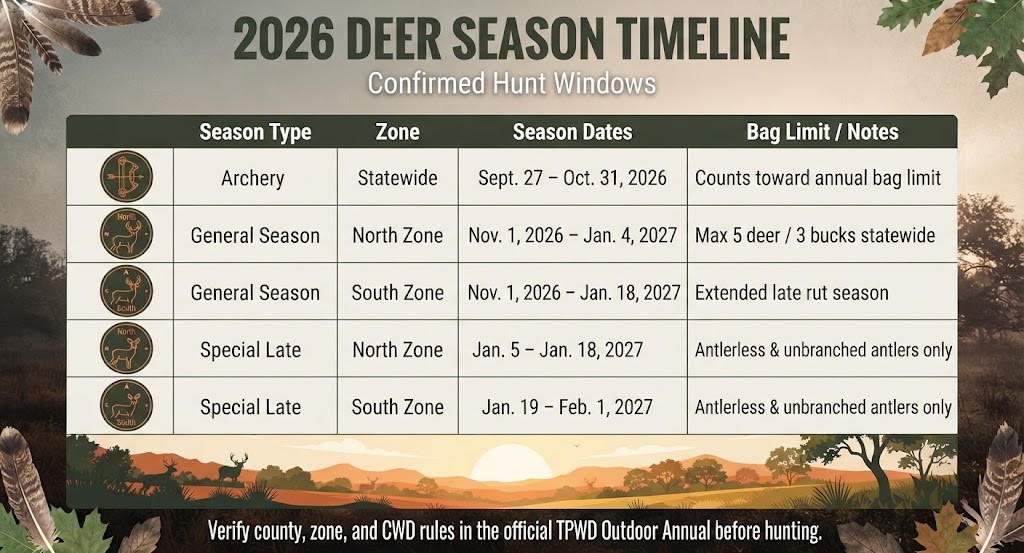
Use this table as your fast reference for dates, limits, and requirements. Treat these as planning dates and confirm final county, zone, and CWD rules in the official TPWD season dates before heading out.
| Season Type | Zone | Start Date | End Date | Bag Limit / Notes |
|---|---|---|---|---|
| Archery | Statewide | Sept 27 | Oct 31 | Counts toward annual bag limit |
| General | North Zone | Nov 1 | Jan 4 | Max 5 deer / 3 bucks statewide |
| General | South Zone | Nov 1 | Jan 18 | Later rut = extended season |
| Special Late | North Zone | Jan 5 | Jan 18 | Antlerless & unbranched antlers only |
| Special Late | South Zone | Jan 19 | Feb 1 | Antlerless & unbranched antlers only |
| Youth-Only | Statewide | Early (late Oct) & Late (Jan 5–18) | — | All legal weapons |
Dates only get you halfway there — where you hunt matters just as much. If you don’t have ground secured yet, browse Texas hunting leases to start locking in access, and check our Texas hunting seasons hub for other species to add to your fall calendar.
Before heading afield, check these boxes:
- A valid Texas hunting license (type depends on residency/age — full breakdown below)
- Hunter education certification (required for anyone born on or after Sept. 2, 1971)
- Awareness of your county’s specific antler restrictions and bag limits
- The Texas Hunt & Fish app for mandatory harvest reporting within 24 hours
Texas Deer Hunting Seasons
Texas splits deer hunting into three main windows: archery, general season (divided by North and South zone), and the special late/youth seasons that follow. For deeper whitetail strategy, see our Texas white-tailed deer guide. The zone split exists because South Texas deer enter peak rut later, typically mid-to-late December, which gives that zone two extra weeks of general season. These are planning dates — verify your county’s rules in the TPWD Outdoor Annual before you go.
Archery Season
Archery season runs September 27 through October 31 statewide, giving bowhunters first access to deer before rifle pressure changes their movement patterns. Any deer harvested during archery season counts toward your annual bag limit, so factor that into your season total if you’re hunting multiple methods.
General Season (North & South Zones)
The general season is Texas’s primary rifle season and the busiest stretch of the year. The North Zone runs November 1 through January 4; the South Zone runs November 1 through January 18. That extra two weeks reflects the later rut cycle typical of South Texas deer. Confirm which zone your hunting county falls into using the TPWD Outdoor Annual — the zone determines your legal season length.
Special Late & Youth-Only Seasons
The Special Late season runs January 5 through January 18 in the North Zone and January 19 through February 1 in the South Zone, restricted to antlerless deer or bucks with unbranched antlers. It’s a herd-management measure meant to protect mature bucks while still allowing harvest opportunities. Youth-Only seasons run in two windows: an early season in late October and a late season from January 5 through 18, with all legal weapons allowed for young hunters during both.
Texas Deer Hunting Licenses and Permits
Getting the license right matters — it’s one of the most common and costly mistakes hunters make. All Texas hunting licenses run from your purchase date through August 31 of the following year, and TPWD is the official authority for purchasing and verifying your license type.
Texas Hunting Licenses
| License Type | Who It’s For | Cost | Valid for Deer? |
|---|---|---|---|
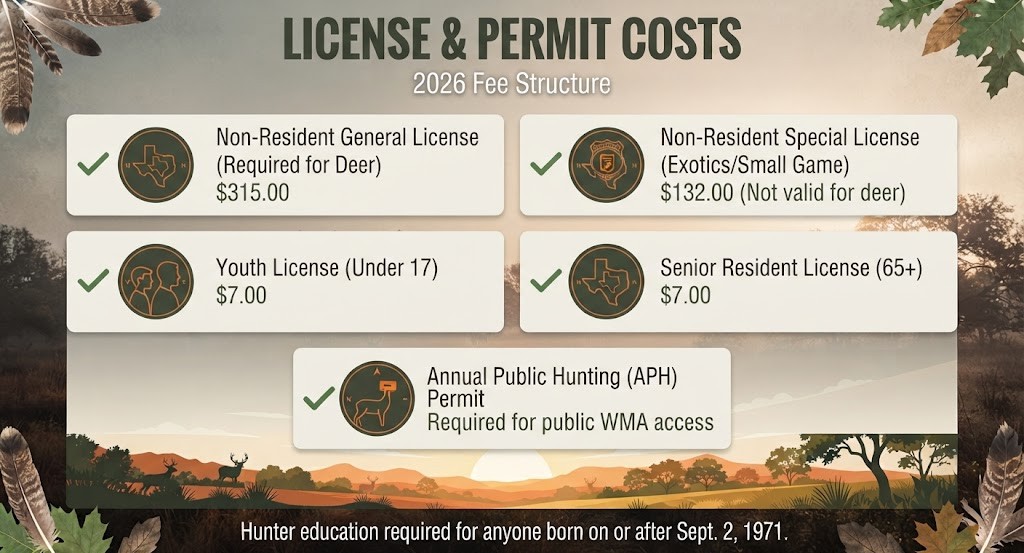
| Non-Resident General | Out-of-state hunters pursuing deer | $315 | Yes — the only valid deer license for non-residents |
| Non-Resident Special | Out-of-state hunters pursuing exotics, game birds, small game | $132 | No — not valid for whitetail or mule deer |
| Youth License (Under 17) | Hunters under 17 | $7 | Yes |
| Senior Resident License (65+) | Texas residents 65+ | $7 | Yes |
If you’re hunting from out of state, note that the $132 Non-Resident Special license does not cover deer. Non-residents need the $315 Non-Resident General license to legally hunt whitetail or mule deer in Texas. Check current TPWD license requirements before you buy so you’re not caught off guard in the field.
Anyone born on or after September 2, 1971 must complete hunter education certification before purchasing a license or hunting. Depending on your season plans, you may need additional endorsements for other species, but the table above covers what you need for deer.
Texas Hunting Permits & Reporting
General whitetail tags print directly on your hunting license — there’s no draw for general-season tags, which simplifies things compared to other states. Once you harvest a deer, you’re required to report it to TPWD within 24 hours through the Texas Hunt & Fish mobile app or online portal. If you’re hunting public land, you’ll also need the Annual Public Hunting (APH) Permit, which opens access to over a million acres across the state — more on that below.
Here’s how the reporting process works:
- Harvest and tag your deer in the field per your license requirements.
- Open the Texas Hunt & Fish app (or visit the online reporting portal).
- Submit your harvest report within 24 hours of taking the deer.
TPWD’s white-tailed deer regulations page has the current requirements, including bag limits and county-specific notes.
Where to Hunt Deer in Texas
Roughly 95% of Texas is privately held, so where you hunt matters as much as when. That reality shapes almost every access decision Texas hunters make, from choosing public land to leasing private ground to booking a guided hunt.
Best Public Hunting Land
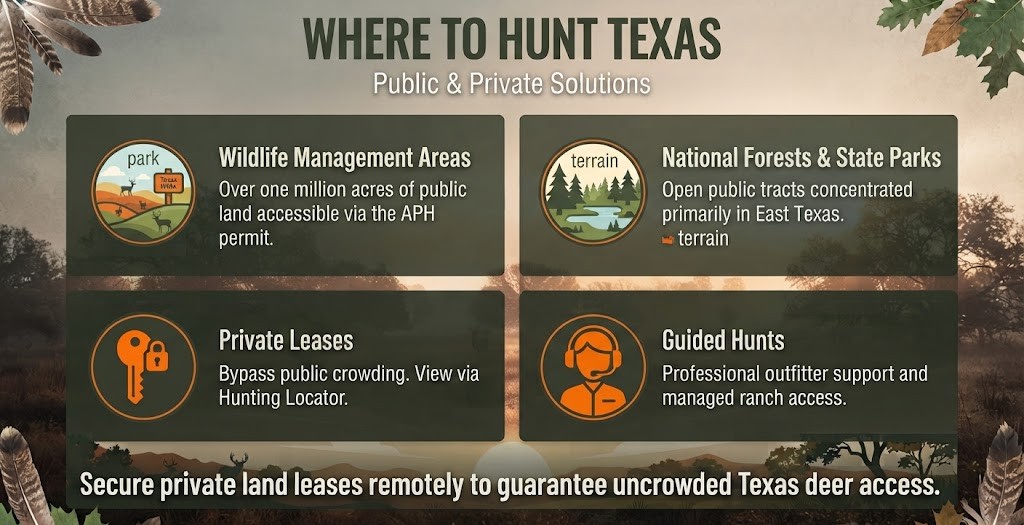
Public land access in Texas runs through the Annual Public Hunting Permit, which opens up Wildlife Management Areas, national forest tracts, and select state park hunts. WMAs balance conservation goals with public hunting access, making them a solid resource if you know where to look.
- Wildlife Management Areas (WMAs) — over a million acres accessible through the APH permit
- National Forests — open public tracts concentrated in East Texas
- State Parks — select drawn or limited hunts available seasonally
Public land is affordable and legal, but it’s also pressured — plenty of hunters working the same acreage. That’s part of why many hunters turn to private access instead.
Private Land Hunting with Hunting Locator
With 95% of Texas privately owned, leasing private land is how most hunters secure quality, low-pressure ground for the season. A lease also gives you consistent access you can plan around year after year, rather than a one-off public-land hunt. For hunters weighing a bigger commitment, buying hunting land outright is worth considering if you’re ready to invest in a property you’ll return to season after season.
Whether you’re an out-of-state hunter racing to secure ground before archery season opens or a Texas resident looking for affordable acreage closer to home, the access challenge is the same: finding land that’s legitimate, available, and worth your time. That’s the gap Hunting Locator fills. Our platform connects hunters directly with landowners across Texas who are ready to lease or sell — searchable by acreage, game type, and region, so you’re not sifting through dead listings or guessing at legitimacy.
Browse our Texas lease listings to start narrowing down ground that fits your season, budget, and hunting style.
Guided Deer Hunts
A guided hunt is the full-service option — an outfitter handles the land, the setup, and often lodging, so you show up ready to hunt. This works well for out-of-state hunters with limited days to scout, or beginners who want hands-on coaching. Experienced guides can teach you to read sign, exercise patience in the stand, and time your shot with confidence, all while you’re hunting real ground instead of researching it.
A guided hunt may be right for you if you:
- Are traveling from out of state with limited days to scout
- Are new to hunting and want experienced coaching in the field
- Want a turnkey experience without arranging your own land access
Whether you end up leasing your own ground or booking a guided hunt, the goal is the same: getting onto quality land with confidence.
Deer Hunting Tips for a Successful Texas Season
These fundamentals tend to separate a full tag from a long, quiet season.
- Scout Before You Sit: Know your land — locate food sources, bedding areas, and travel corridors before you set a stand. Dawn and dusk remain the prime windows for deer movement.
- Master Your Weapon: Whether you’re running a bow or a rifle, practice until the shot is second nature. A reliable bolt-action rifle with a quality scope — common calibers include .243, .270, and .308 — is a dependable starting point for newer hunters.
- Control Your Scent & Stay Concealed: Deer smell danger long before they see it, so scent control and camo that breaks up your outline both matter. Tree stands and ground blinds each have their place — pick based on your terrain.
- Gear Up Right: Good boots, weather-appropriate layers, and dependable optics make long sits productive instead of miserable. Browse quality hunting gear before opening day.
- Know Before You Shoot: Confirm your county’s antler restrictions — many counties enforce the 13-inch inside spread rule or an unbranched-antler requirement — so every buck you take is legal.
More Resources from Hunting Locator
Texas hunting doesn’t end with deer season. Explore the rest of our Texas season guides to plan your whole year in the field:
- Texas Hunting Seasons Hub — Your master calendar for every Texas hunting season.
- Texas White-Tailed Deer Guide — A deeper dive into whitetail-specific tactics and dates.
- Texas Mule Deer Season — Planning a West Texas mule deer hunt.
- Texas Turkey Season — Spring and fall turkey dates and tips.
- Texas Alligator Season — Rules and dates for gator hunting.
- Texas Javelina Season — Where and when to pursue javelina.
- Texas Small Game Season — Squirrel, rabbit, and more.
- Texas Waterfowl Season — Duck and goose dates for the flyway.
- Texas Pronghorn Season — Pronghorn antelope hunting in the Panhandle.
- Texas Game Bird Season — Dove, quail, and upland bird seasons.
Frequently Asked Questions
Can a non-resident hunt deer in Texas with the $132 special license?
No. The $132 Non-Resident Special license covers exotics, game birds, small game, javelina, and alligator, but not whitetail or mule deer. Non-residents must purchase the $315 Non-Resident General license to legally hunt deer in Texas.
How much is a youth hunting license in Texas?
A youth hunting license for hunters under 17 costs $7 and is valid for deer hunting. Young hunters born on or after September 2, 1971 must also complete hunter education certification before hunting.
What are the Texas deer season dates for 2026?
Archery season runs September 27 through October 31 statewide. General Season runs November 1 through January 4 in the North Zone and November 1 through January 18 in the South Zone, followed by special late and youth seasons. Always verify final dates in the TPWD Outdoor Annual.
How do I know if I’m hunting in the North or South Zone?
Texas deer zones are determined by county, and the zone boundary directly affects your season length — the South Zone runs about two weeks longer due to its later rut timing. Confirm your county’s zone assignment in the TPWD Outdoor Annual before you plan your trip.
How do I report a harvested deer in Texas?
Harvested deer must be reported to TPWD within 24 hours using the Texas Hunt & Fish mobile app or the online reporting portal. There’s no draw process for general tags — they print directly on your license. TPWD’s regulations page has the full reporting requirements.
Do I need hunter education to hunt deer in Texas?
Yes. If you were born on or after September 2, 1971, hunter education certification is required before you can purchase a license or hunt. The course is available online or in a classroom setting, and TPWD offers beginner-friendly resources to help you get certified.
The Final Shot
Filling your tag in 2026 comes down to three things: knowing your dates (archery opens September 27, general season opens November 1 by zone), buying the right license (especially the $315 Non-Resident General license if you’re coming from out of state), and locking in your land early. Confirm your dates in the TPWD Outdoor Annual, buy the license that matches your residency and target species, and secure your hunting ground — in that order.
Before you head out, take one more pass through the TPWD Outdoor Annual to verify your final county, zone, and CWD rules. It’s a small step that keeps your season legal from start to finish.
Ready to lock in your ground for 2026? Browse Texas hunting leases and secure your spot before the season fills up around you.


