This Texas small game guide covers what you need before opening morning: season dates by county type, resident and non-resident license costs, and where you can legally hunt, whether you’re a Texas resident or driving in from out of state.
Before you get into the details, check your gear against the Hunting Locator store. Here’s what this guide covers:
- Squirrel, rabbit, and hare season dates and bag limits broken down by county type
- Resident vs. non-resident license costs, including the $315 general license and the $48 5-day option
- Where to legally hunt — public land, private leases, and guided hunts for every budget and experience level
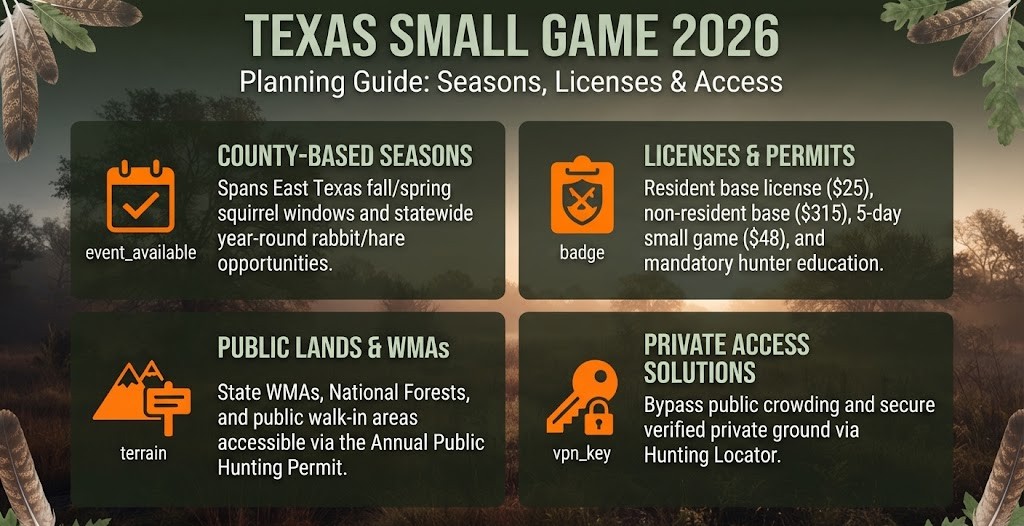
Quick Overview: Texas Small Game Seasons at a Glance
Your county determines your rules. Squirrel season splits Texas into two categories: East Texas special-season counties, which follow set fall and spring dates, and year-round open counties, where squirrel hunting is legal all twelve months. Rabbits and hares are open year-round no matter where you hunt.
| Species | Season Type | Dates | Bag Limit | Notes |
|---|---|---|---|---|
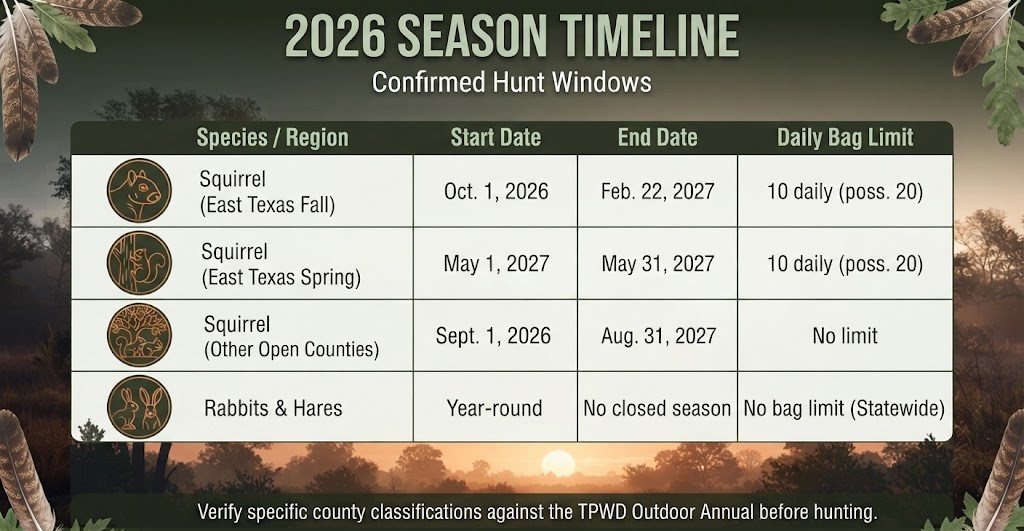
| Squirrel (East Texas counties) | Fall + Spring | Oct 1 – Feb 22 and May 1 – 31 | 10/day | Possession limit 20 |
| Squirrel (Other open counties) | Year-round | Sept 1 – Aug 31 | No limit | Open all year |
| Rabbits & Hares | Year-round | No closed season | No bag or possession limit | Statewide |
Every hunter needs some combination of a license, permit, and — depending on birth year — hunter education certification.
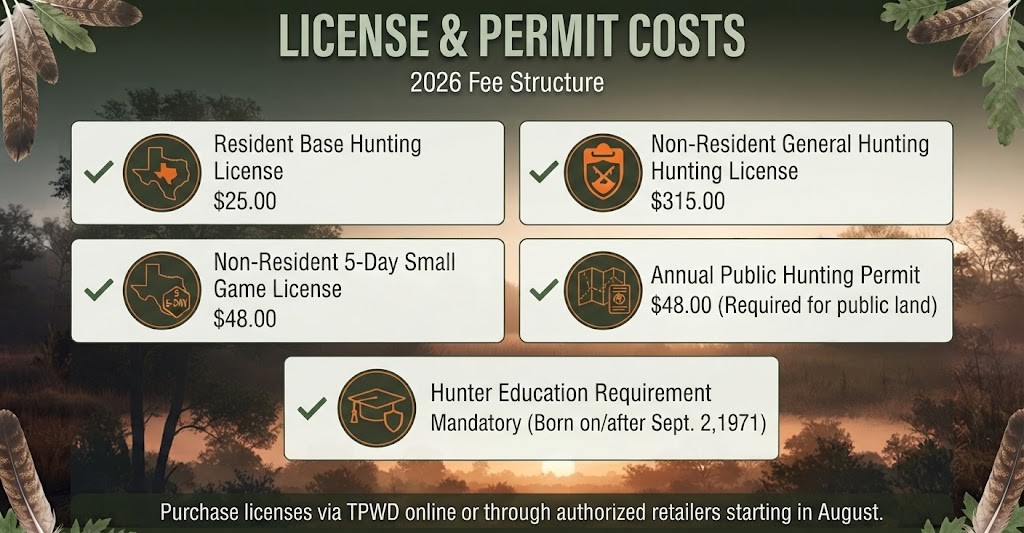
- Resident base hunting license — $25
- Non-resident base hunting license — $315
- Non-resident 5-day small game license — $48
- Hunter education required for anyone born on or after September 2, 1971
- Annual Public Hunting Permit — $48 (for public land access)
For a broader breakdown of small game hunting strategy, see our Texas small game deep-dive. If you’re planning a season that stretches beyond squirrel and rabbit, our full Texas hunting seasons calendar puts everything in one place.
County classifications and season dates can shift from year to year. Confirm your specific county and current dates against the TPWD Outdoor Annual before you head out on opening day.
Texas Small Game Hunting Seasons
Everything about your Texas small game season comes down to which county classification you’re hunting in. A bag limit is the number of animals you can legally take in a single day. A possession limit is the total you’re allowed to have on hand at once. An open county is one without a restricted season.
Squirrel Season in East Texas (Fall & Spring)
In East Texas special-season counties, the fall season runs October 1 through February 22, with daily bag limits capped at 10 and a possession limit of 20. A second, shorter window opens May 1 through 31, giving hunters a brief late-spring opportunity before summer heat and thick foliage make the woods harder to hunt.
This split-season structure manages pressure on East Texas squirrel populations while giving hunters two windows each year. Both dates are worth marking on your calendar — the spring stretch is easy to miss.
Squirrel Season in Year-Round Counties
Outside the East Texas special-season counties, squirrel hunting is open year-round, September 1 through August 31, with no bag limit. If you’re not sure which classification applies to your county, check it against the current TPWD Outdoor Annual before you plan your trip.
For hunters outside East Texas, this is about as flexible as small game hunting gets. There’s no need to squeeze a hunt into a narrow window — you can plan around your own schedule instead of the calendar.
Rabbit & Hare Season (Year-Round Statewide)
Rabbits and hares are open year-round with no closed season anywhere in Texas, and there’s no daily bag or possession limit. That makes them one of the more accessible species in the state to pursue.
If you’re introducing a new hunter to the field — a kid, a spouse, or a friend who’s never carried a gun into the woods — rabbit hunting is low-pressure by design. No tight windows, no limit math to track, just time in the field.
Texas Small Game Licenses & Permits
Legal small game hunting starts with the right license, and which one you need depends on where you live and how long you’re hunting. Getting this wrong is one of the more common — and costly — mistakes non-resident hunters make.
Texas Hunting Licenses (Resident vs. Non-Resident)
| License | Who It’s For | Cost | Best For |
|---|---|---|---|
| Resident Base (General Hunting) | Texas residents | $25 | Weekend & family small game hunters |
| Non-Resident Base (General Hunting) | Out-of-state hunters | $315 | Multi-species / longer trips |
| Non-Resident Special 5-Day Small Game | Out-of-state hunters | $48 | Short small-game-only trips |
If you’re planning a trip from out of state, the non-resident license costs $315 for the full general hunting license, but it’s not your only option. The 5-day small game license is valid for five consecutive days and covers small game and exotics, including squirrel, javelina, and legal game birds excluding turkey — but not big game like deer. If you’re combining species on your trip, you might also add a javelina hunt or chase Texas game birds while you’re at it.
If you’re only after squirrel and rabbit on a short trip, the $48 5-day license is the better value. If you want the option to hunt big game like whitetail or turkey on the same trip, you’ll need the full $315 non-resident general license. Most Texas licenses go on sale in late summer, so plan ahead and confirm current availability with TPWD before your trip.
Texas Hunting Permits & Hunter Education
Hunter education is a legal requirement, not a suggestion. Texas requires Texas hunter education certification for anyone born on or after September 2, 1971 — this applies to residents and non-residents alike, and out-of-state certification with reciprocity is accepted. If you were born before that date, you’re exempt. If you were born after, you’ll need proof of completion before you can buy a license.
If you plan to hunt public land, you’ll need more than your hunting license. The $48 Annual Public Hunting permit grants walk-in access to nearly a million acres of public land across Texas, on top of whatever base license you’re carrying.
Licenses and permits are purchased through TPWD, either online or through authorized retailers, and most go on sale starting in August ahead of the fall season. Buying early avoids the last-minute scramble during opening week.
Where to Hunt Small Game in Texas
Once your license situation is squared away, the next question is where you’re actually going to hunt. Your three options are public land, private leases, and guided hunts, and the right choice depends on your budget, experience level, and how much certainty of access you want.
Best Public Lands for Small Game
Texas offers substantial public hunting opportunity if you know where to look.
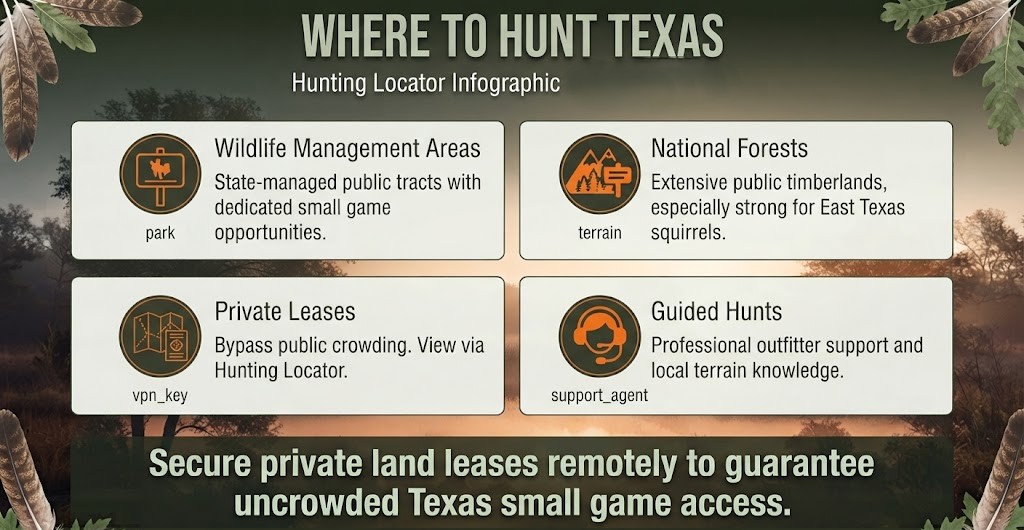
- Wildlife Management Areas (WMAs) — managed public tracts spread across the state, many with dedicated small game opportunity
- National Forests — especially strong for East Texas squirrel habitat during the fall season
- Public walk-in areas — accessible with the $48 Annual Public Hunting Permit on top of your hunting license
Public land is a legitimate, affordable path into the field, but it comes with a tradeoff: popular WMAs and national forest tracts can get crowded fast, especially on opening weekends. For more consistent, lower-pressure access, private land is worth a look.
Private Land Hunting with Hunting Locator
Many hunters eventually move toward private land for less competition, more predictable access, and the freedom to hunt on their own schedule. Whether you’re leasing for a season or looking to buy outright, private land cuts down on both the guesswork and the crowds.
Leasing a private tract for the season is one of the more affordable ways to lock in reliable access, whether you’re a weekend hunter chasing squirrels close to home or a first-timer who wants a quiet, low-pressure place to learn. Buying land is the more permanent option — no lease renewals, no uncertainty about access from year to year.
This is where Hunting Locator comes in. We connect hunters directly with landowners who are ready to lease or sell, cutting out the cold calls. Browse current listings, connect with landowners, and secure access without doing it all on your own. Browse Texas hunting leases to see what’s currently available across the state.
Guided Small Game Hunts
If you’d rather skip the legwork of finding land, a guided hunt is worth considering. A good guided hunt gets you access to quality ground, local knowledge of where the animals are moving, and often gear support if you’re light on equipment.
Guided hunts tend to make the most sense for out-of-state hunters working with a limited trip window, or new hunters who want some mentorship in the field before going out on their own. If you go this route, book well ahead of your target dates and confirm exactly what’s included — land access, gear, cleaning services — before you show up.
Small Game Hunting Tips
Success in the field comes down to a handful of fundamentals that hold true whether you’re chasing squirrels through East Texas timber or working rabbit cover on a private lease.
- Match your gun to the game — A .22 LR or 20-gauge shotgun is typically all you need for small game. The .22 LR offers precision for squirrel shots, while the 20-gauge is more forgiving on fast-moving rabbits.
- Scout predictable habitat — Both rabbits and squirrels favor reliable cover types. Learn to read the terrain and you’ll cut down your search time.
- Hunt the edges of the day — Early morning and late afternoon consistently produce more movement and better shot opportunities.
- Wear blaze orange — Staying visible matters, especially on shared public land during busy weekends.
- Move slow and listen — Squirrels give themselves away by sound long before you see them. Patience beats speed.
- Consider a squirrel dog — For hunters looking for an extra edge, a trained dog can meaningfully increase your success rate on both squirrel and rabbit.
Whatever’s on your list — a new .22, blaze orange gear, or calls — you can find the right small game gear to round out your kit before opening day.
More Resources from Hunting Locator
Planning more than small game this season? Here’s where to go next.
- Texas Small Game Hunting Guide — a deeper companion piece on small game strategy and season planning
- All Texas Hunting Seasons — the full statewide season calendar across every species
- Browse Texas Leases — find and secure private land for your season
- Hunting Locator Store — gear for every hunt, from small game to big game
- Hunting Locator Home — explore everything the platform has to offer
- Big Game: White-tailed Deer · Mule Deer · Pronghorn
- Birds: Turkey · Waterfowl · Game Birds
- Other: Javelina · Alligator
Frequently Asked Questions
What are the Texas squirrel season 2026 dates?
East Texas squirrel season runs October 1 – February 22 for the fall window, plus a spring window from May 1 – 31. In year-round open counties, squirrel season runs all year, September 1 – August 31. Which dates apply to you depends on your county classification.
What are the Texas small game bag limits?
Squirrel hunters in East Texas general-season counties are limited to 10 per day with a possession limit of 20. In year-round counties, there’s no bag limit. Rabbits and hares carry no bag or possession limit anywhere in the state.
How much is a non-resident Texas hunting license?
The non-resident general hunting license runs $315 and covers big game and small game alike. If you’re only after small game and exotics on a short trip, the $48 5-day license is a more budget-friendly option, though it excludes big game species.
Do I need hunter education to hunt small game in Texas?
Yes. Hunter education certification is required for anyone born on or after September 2, 1971, whether you’re a resident or non-resident. Out-of-state certification is accepted through reciprocity, so you don’t need to retake a course if you’re already certified elsewhere.
Where can I hunt small game in Texas without private land?
Public WMAs, national forests, and walk-in areas are all legal options, accessible with the $48 Annual Public Hunting Permit in addition to your license. Public land can get crowded on opening weekends — for more consistent access, you can browse Texas leases instead.
Is a .22 or a shotgun better for Texas small game?
A .22 LR rifle is the better choice for precise squirrel shots, while a 20-gauge shotgun handles fast-moving rabbits more forgivingly. Many small game hunters eventually own both and choose based on the day’s target.
The Final Shot
Planning a Texas small game season comes down to three things: know your county classification, whether that’s East Texas special-season rules or a year-round window; pick the license that fits your trip, whether that’s the $25 resident license, the $315 non-resident general, or the $48 5-day option; and lock in legal, reliable land before opening day. Get those three pieces right and the rest of the planning is straightforward.
Confirm your county’s specific rules against the TPWD Outdoor Annual, buy the license that matches your plans, secure your spot to hunt, and make sure your gear is squared away. Dates and county rules can shift from year to year, so double-check against the official TPWD Outdoor Annual before you head out.
We built this Texas Small Game Season Guide for 2026 to take the guesswork out of your planning, and we’re here to help with the part that matters most: finding somewhere legitimate to hunt. When you’re ready, secure your Texas lease and lock in your access for the season, or gear up before opening day. We’ll see you out there.


