This guide pulls together season dates, permit costs, and land access into one place so you’re not cross-referencing forum posts and outdated PDFs. Utah remains one of the better elk destinations in the Lower 48 — an estimated 83,020 elk roam its mountains and high desert, and the opportunity holds up for both residents and non-residents. Whether you’re after a general-season spike close to home or you’ve been banking bonus points for a limited entry trophy unit, this covers what you need to plan the 2026 season.
Here’s what’s covered:
- Season dates by weapon type — archery, general rifle, muzzleloader, and late/extended hunts, confirmed for 2026
- License and permit requirements — resident and non-resident cost breakdowns
- Where to hunt — public land, private leases through Hunting Locator, and guided hunt options across budgets
Season dates vary by unit and tag type, so confirm specifics against official Utah DWR sources before you apply. Start with the fast facts below.

Quick Overview: Utah Elk Seasons 2026 at a Glance
Utah runs several distinct elk seasons based on weapon type, and your exact dates depend on unit and tag. A “unit” is a geographic management area that governs when you can hunt, what tags are available, and where your permit is valid — the term comes up throughout this guide.
| Season Type | 2026 Dates | Bag Limit | Notes |
|---|---|---|---|
| Archery | Mid-August through mid-September (e.g., Aug 15 – Sept 4 Spike; Aug 15 – Sept 16 Any Bull; Limited Entry ends Sept 12) | 1 elk | Overlaps the rut |
| General Rifle — Spike | Oct 3 – Oct 15 and Oct 28 – Nov 5 | 1 elk | Two separate windows |
| General Rifle — Any-Bull | Oct 3 – Oct 9 and Oct 10 – Oct 16 | 1 elk | Two separate windows |
| Muzzleloader | Late Oct – early Nov (e.g., Oct 28 – Nov 5) | 1 elk | Overlaps general rifle timing |
| Late & Extended | Stretches into December and January in limited units | 1 elk | Limited-unit availability only |
For the full breakdown of dates, tag types, and unit-specific details, see our full Utah elk breakdown.
Before any of these seasons apply to you, a few basic requirements have to be in place:
- A valid Utah hunting license before applying for or buying an elk permit
- Hunter education completion before you can purchase that license
- A bag limit of 1 elk per permit, across all elk seasons
- Applications open in March 2026, and general-season permits go on sale July 7–16, 2026
Utah Elk Hunting Seasons
Utah structures its elk seasons around weapon type, each with its own dates and challenges. Timing matters more than most hunters expect — September marks the rut, when bull elk get vocal and aggressive, and knowing how each season lines up with that window tends to improve your odds.

Archery Elk Season
Utah’s general archery elk season runs mid-August through mid-September: Aug 15 – Sept 4 for Spike, Aug 15 – Sept 16 for Any Bull, and Limited Entry archery ending Sept 12.
This window is popular because it overlaps the rut, when bull elk bugle loudest and respond most aggressively to calls. The “rut” is the elk breeding season, and a “bugle” is the wild, echoing call bulls use to challenge rivals and attract cows.
Some Utah units also offer extended archery season dates that run well beyond the general archery window, with certain areas open from mid-August into December or January. These extended seasons give dedicated archery hunters significantly more field time, though they’re limited to specific units — check your unit’s guidebook page before planning around one.
General Rifle (Any Legal Weapon) Season
Utah’s general rifle season splits into two hunt types, each with its own dates:
- Spike hunts: Oct 3 – Oct 15 and Oct 28 – Nov 5
- Any-Bull hunts: Oct 3 – Oct 9 and Oct 10 – Oct 16
The distinction matters if you’re new to elk hunting. A spike hunt restricts you to young bulls with unbranched, single-point antlers. An any-bull hunt allows any legal bull regardless of antler configuration. Both carry the same 1-elk bag limit, so the choice comes down to what tag you draw or purchase and what your unit offers.
By mid-rifle season, most rutting activity has wound down, and bulls that survived archery and early rifle pressure tend to retreat into thick, steep terrain away from roads and trails. Late-rifle hunters should expect to work harder and go deeper to find mature bulls that have gone into hiding.
Muzzleloader & Late/Extended Seasons
Utah’s muzzleloader elk season runs late October to early November, with dates like Oct 28 – Nov 5 in the current schedule. It overlaps closely with the tail end of general rifle season, so expect similar bull behavior and terrain challenges.
Late and extended seasons in select units stretch into December and January for hunters holding the right tags. These later hunts tend to favor experienced hunters familiar with specific units — cold weather, thinner crowds, and elk that have shifted into winter patterns all change the equation.
Utah Elk Licenses and Permits
Before applying for or purchasing an elk permit in Utah, you need a valid hunting license. Applications for 2026 permits open in March, so getting the license squared away early avoids a scramble when the window opens.
Utah Hunting Licenses
A hunting license is the prerequisite to everything else in this guide — no license, no elk permit, regardless of unit choice.
| License Type | Resident | Non-Resident |
|---|---|---|
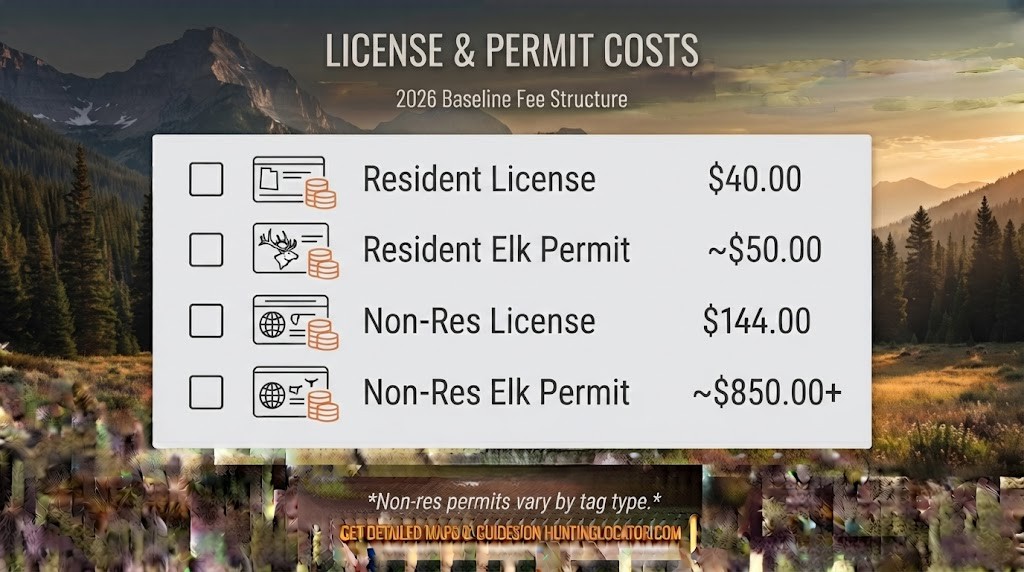
| Adult basic hunting license (18–64) | $40 | $144 |
| Senior resident (65+) | $31 | — |
| Youth (14–17) | $16 | $44 |
| Combination (hunting + fishing) | $44 | $190 |
These 2026 fees reflect the current schedule and apply before any elk-specific costs come into play.
Hunter education is required before you can buy a hunting license, and you’ll need that valid license before applying for any elk permit. Build both steps into your timeline early.
Utah Elk Permits & Application Process
Once licensed, you’ll choose between several permit types depending on budget, experience, and residency status. Each permit allows 1 elk, applied for or purchased through Utah’s online draw system.
| Permit Type | Resident | Non-Resident |
|---|---|---|
| General Season (Spike or Any Bull) | ~$50 | ~$850 |
| Multi-Season General Tag | — | ~$1,250 |
| Limited Entry Tag | ~$314 | ~$1,950 |
| Antlerless (Cow Elk) | $56 | ~$649 |
| Application fee (nonrefundable) | $10.00 | $21 |
Non-residents should budget for a few additional costs. A new 2026 processing fee of 2.2% is now added to all transactions on top of listed permit prices. For limited entry tags, non-resident elk tag pricing comes with a hard cap: only 10% of limited entry tags go to the non-resident pool, with the remaining 90% reserved for residents.
For limited entry units, Utah uses a hybrid bonus point system. Bonus points work like raffle tickets — the more you accumulate, the better your odds in the draw. If you don’t draw, you earn a point for that species heading into next year, gradually improving your odds over time. “Limited entry” refers to a unit with capped, controlled tag numbers, typically reserved for higher-quality trophy hunting.
The 2026 application process, step by step:
- Complete hunter education (if not already certified) — required before purchasing any hunting license
- Buy a valid Utah hunting license — required before applying for or purchasing any elk permit
- Apply during the March 19 – April 23, 2026 window through Utah’s official draw system
- Check draw results by May 31, 2026 to know whether you drew your requested unit
- If applying for general tags, note that these go on sale July 7–16, 2026, separate from the limited entry draw
A few 2026 changes are worth noting before you apply. Utah has a new application vendor this year, so the site will look and function differently than in past years — applying early gives you buffer time if anything’s unfamiliar. Utah is also rolling out a new WMA access permit beginning July 1, 2026, requiring visitors 18 and older to carry either a valid license or a free digital access permit for certain wildlife management areas in Davis, Salt Lake, Utah, and Weber counties. And starting in 2026, harvest reports filed late carry a new $50 penalty, so note that deadline once your season closes.
Where to Hunt Elk in Utah
Utah offers strong access for hunting across the state, but where and how you hunt shapes your odds as much as tag type does. Public land, private leases, and guided hunts each come with tradeoffs worth understanding before you commit.
Utah has 79% public land ownership, with more than 23 million acres managed across Forest Service, BLM, and state wildlife areas. Private access often means less pressure and more consistent opportunity, which is where leasing and guided options come in.
Best Public Lands for Elk
For a general-season tag on public land, a handful of units consistently produce solid elk numbers and reasonable access:
- Manti — a perennial general-season favorite offering realistic bull odds for newcomers
- Cache — large public blocks with strong elk numbers
- Wasatch Mountains (general portions) — accessible and popular with resident hunters
- North Slope Uintas — big, rugged country holding huntable elk populations
- Fish Lake region — another solid option for hunters new to the unit
For newcomers, a general-season tag on the Manti, Cache, or Fish Lake region gives a realistic shot at a bull without burning years of bonus points chasing a limited entry trophy unit.

Private Land Hunting with Hunting Locator
Private land access can mean the difference between fighting for a spot on crowded public ground and hunting elk that haven’t seen pressure all season. Whether you lease for a season or buy land outright, private access gives you more control — though hunting private land always requires the landowner’s explicit permission.
Leasing makes sense for reliable seasonal access without the long-term commitment of ownership. Buying land is a bigger step, but it gives you a permanent base for elk hunting year after year, plus the option to manage habitat on your own terms.
This is where the Hunting Locator platform is useful. Instead of cold-calling landowners or hoping a Facebook group has a lead, you can browse listings, see real acreage and access details, and connect directly with landowners ready to lease or sell.
Browse available Utah elk leases directly through Hunting Locator, or explore the Hunting Locator platform for the full range of tools built for hunters searching for land access nationwide.
Guided Elk Hunts
Guided hunts remove much of the guesswork that trips up first-timers and non-residents. Your guide already knows the terrain, the elk’s patterns, and where bulls tend to hide once pressure builds, which lets you focus on the hunt instead of logistics.
Guided elk hunts in Utah generally fall into two cost tiers: general hunts typically run roughly $4,000 to $7,000, while Cooperative Wildlife Management Unit (CWMU) hunts — which offer access to private, managed land with healthy elk populations — can run $20,000 to $40,000.
A typical guided hunt includes:
- Local guide expertise on elk behavior, seasonal patterns, and terrain
- Access to managed or private land with consistently healthy elk populations
- Field dressing and pack-out support once you’ve got your bull down
- Logistics handled for you, so you can focus on the hunt itself
For a first-time elk hunter or someone coming in from out of state, a guided hunt can be worth the cost, particularly on a unit you’ve never set foot on before.
Utah Elk Hunting Tips
A few field-tested fundamentals can separate a frustrating week from a successful hunt, whether it’s your first elk season or your fifteenth.
- Play the Wind Religiously — Elk have an extraordinary sense of smell, and if a bull catches your scent, the hunt is over. Approach with the wind in your face, not at your back.
- Don’t Over-Call — During the rut, calls and decoys can bring bulls in close, but over-calling pushes wary bulls away. Let the elk do most of the talking, and only call when it feels natural.
- Glass at First Light — Morning glassing from a high vantage point is one of the most reliable tactics for spotting elk at sunrise, before they bed down. A quality set of binoculars makes a real difference here.
- Get in Shape & Acclimate — Utah’s high country tops 10,000 feet in many units, and thin air catches unprepared hunters off guard. Build in time to acclimate, and train beforehand for steep, sustained climbs.
- Layer Your Clothing — Mountain temperatures can swing 40 degrees between sunrise and midday, so layering keeps you comfortable regardless of weather.
For gear to cover the first-light glassing or the shifting mountain temperatures, check the Hunting Locator store before your season starts.
More Resources from Hunting Locator
This guide covers Utah elk hunting in depth, but Hunting Locator’s library extends across every major species and hunting need in the state. Here’s where to go next, organized by category.
Platform & Utah Planning:
- the Hunting Locator platform — Your home base for land access, gear, and hunting guides nationwide
- Utah hunting leases — Browse current private land leases available across Utah
- the Hunting Locator store — Curated hunting gear for every season and species
- hunting in Utah guide — A broader look at hunting opportunities across the entire state
- Utah elk hunting season guide — An even deeper dive into Utah’s elk seasons and strategy
Big Game Guides:
- Utah deer hunting season — Season dates and tag information for Utah’s deer hunters
- Utah pronghorn hunting season — Everything you need to plan a Utah pronghorn hunt
- Utah moose hunting season — Season structure and permit details for Utah moose
- Utah black bear hunting season — Dates and regulations for black bear hunters
- Utah bison hunting season — A look at Utah’s unique bison hunting opportunities
- Utah desert bighorn sheep hunting season — Details on this premier limited entry hunt
Birds & Waterfowl:
- Utah turkey hunting season — Spring and fall turkey season details
- Utah game bird hunting season — Upland game bird seasons across the state
- Utah waterfowl hunting season — Duck and goose season dates for Utah wetlands
Small Game:
- Utah small game hunting season — A complete guide to small game opportunities statewide
Frequently Asked Questions
What are the 2026 Utah archery elk season dates?
Utah’s 2026 archery elk season runs mid-August through mid-September, with dates like Aug 15 – Sept 4 for Spike, Aug 15 – Sept 16 for Any Bull, and Limited Entry archery ending Sept 12. Exact dates vary by unit and tag type, so confirm specifics with Utah DWR before applying.
Do I need a hunting license before applying for a Utah elk permit?
Yes. A valid Utah hunting license is required before you can apply for or purchase an elk permit, and you must complete hunter education before buying that license. This sequence applies to every hunter, resident or non-resident.
How much does a non-resident Utah elk permit cost in 2026?
Non-resident elk permits run roughly $850 for general season spike or any-bull, $1,250 for multi-season general tags, and $1,950 for limited entry tags. Add a $144 hunting license, a $21 application fee, and a new 2.2% processing fee applied to all transactions.
What’s the difference between a spike and an any-bull hunt?
A spike hunt restricts you to young bulls with unbranched, single-point antlers, while an any-bull hunt allows any legal bull regardless of antler configuration. Both carry the same 1-elk bag limit, so your choice depends on the tag you draw or purchase.
When is the 2026 Utah elk application deadline?
The big game application window runs March 19 through April 23, 2026, with draw results posted by May 31. General-season permits go on sale separately, July 7–16, 2026. Utah has a new application vendor for 2026, so applying early helps avoid last-minute surprises.
What does “unit” mean in Utah elk hunting?
A unit is a defined geographic management area that sets the season dates, tag availability, and boundaries for a specific piece of Utah. Your permit is only valid within its designated unit, so understanding unit boundaries matters before you apply or head afield.
Are guided elk hunts worth it for first-timers?
For many first-timers and non-residents, yes. Guides remove the guesswork around terrain and elk behavior, letting you focus on the hunt itself. Costs typically run $4,000 to $7,000 for general guided hunts, and $20,000 to $40,000 for CWMU hunts on managed private land.
The Final Shot
Planning a Utah elk hunt for 2026 comes down to three things: knowing your season dates by weapon type, understanding the license-before-permit sequence and its costs for residents and non-residents, and deciding where you’ll hunt — public land, a private lease, or a guided experience.
Your action framework heading into 2026: complete hunter education if you haven’t already, secure your Utah hunting license, mark March 19 through April 23 on your calendar for the application window, and start scouting land access early rather than waiting until summer. With a new application vendor and processing fee changes rolling out this year, early planning matters more than usual.
Hunting Locator is built as a companion for this kind of planning — season and permit information, real Utah leases, gear, and a library of species guides across the state. As you finalize your 2026 plans, consider exploring available leases now, before the best access gets locked up by hunters who planned earlier.


