This Utah game bird guide lays out the confirmed 2026 season dates, bag limits, license and permit costs, and where you can hunt, drawing on Hunting Locator’s work helping hunters find access nationwide. It covers:
- 2026 season dates and bag limits for every major Utah game bird—ruffed grouse, chukar, Hungarian partridge, and mourning dove
- Resident and non-resident license and permit costs, including special-species permits and the Federal Duck Stamp
- Where to hunt—public land strategy, private land leasing, and guided hunt options for every experience level
Get your gear sorted early so you’re not hunting for shells or boots the week before opening day. Start with the dates and limits below.
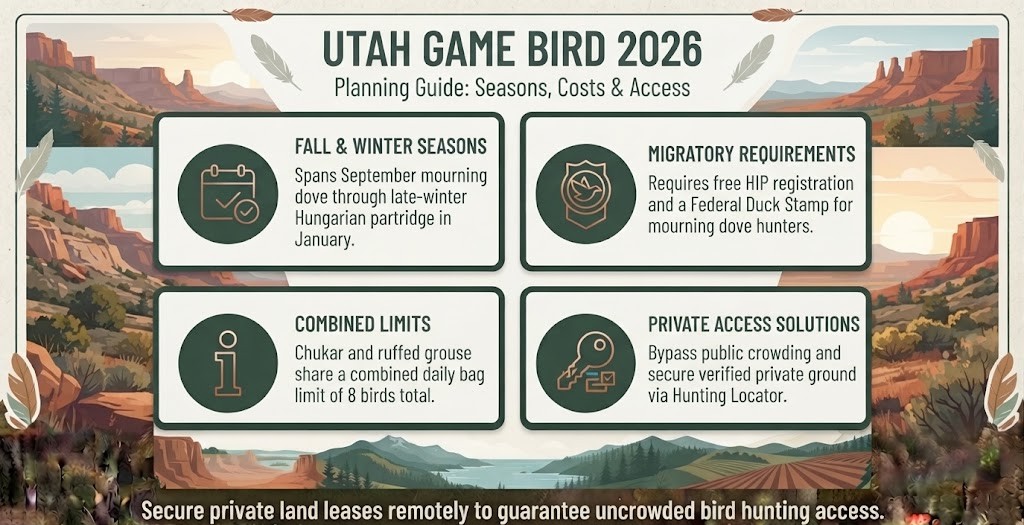
Quick Overview: Utah 2026 Game Bird Seasons at a Glance
Utah’s game birds fall into two regulatory categories. Upland game birds—ruffed grouse, chukar, and Hungarian partridge—operate under one set of rules. Migratory game birds, including mourning dove, trigger additional federal requirements like HIP registration and the Federal Duck Stamp. That distinction determines which license you need and which stamps you’ll be carrying. For more on how these seasons fit together, see this Utah game bird hunting overview.
Here’s the 2026 season snapshot, from the current fee and season schedule:
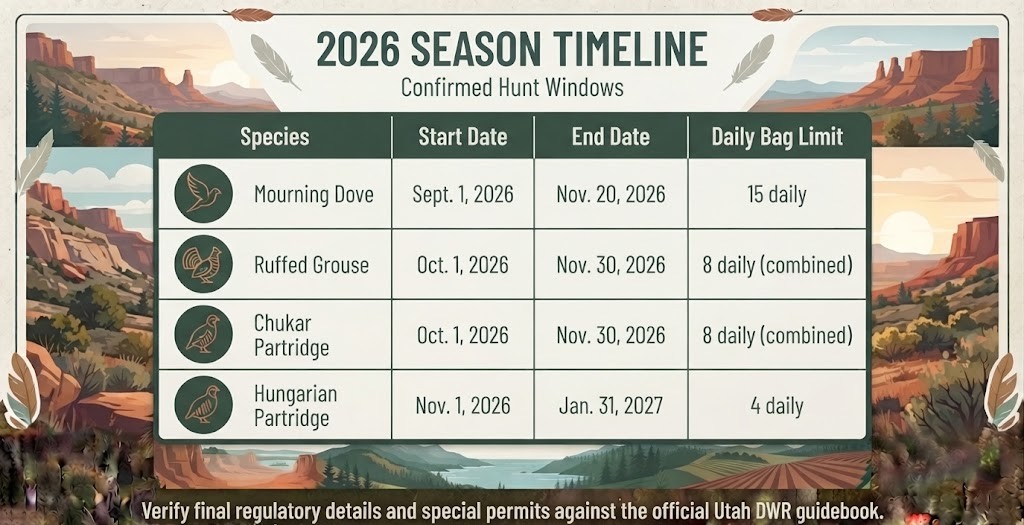
| Species | Season Type | Start Date | End Date | Daily Bag Limit | Notes |
|---|---|---|---|---|---|
| Ruffed Grouse | General | Oct 1, 2026 | Nov. 30, 2026 | 8 daily (combined with chukar) | Upland |
| Chukar Partridge | General | Oct 1, 2026 | Nov. 30, 2026 | 8 daily (combined with ruffed grouse) | Upland |
| Hungarian Partridge | General | Nov 1, 2026 | Jan. 31, 2027 | 4 daily | Upland |
| Mourning Dove | General | Sep 1, 2026 | Nov. 20, 2026 | 15 daily | Migratory — HIP + Federal Duck Stamp required |
Season calendars shift from year to year, and this table reflects the most current confirmed 2026 dates. Cross-check against the official Utah DWR guidebook before you head out—it’s the final word on Utah regulations.
Requirements, in plain terms:
- A valid Utah hunting license, resident or non-resident, covering upland and small game
- HIP registration for anyone hunting migratory birds like mourning dove—free and required annually
- A Federal Duck Stamp for dove hunters age 16 and older
- Hunter education for anyone born after December 31, 1965, before you can buy a license
- Free special-species permits for sage-grouse, sharp-tailed grouse, ptarmigan, and band-tailed pigeon, applied for separately
Each of these is covered in more detail in the licenses and permits section below.
Utah Game Bird Hunting Seasons
Utah’s upland birds—grouse, chukar, and Hungarian partridge—share a fall-into-winter window, while mourning dove opens earliest as a migratory species with its own set of rules. The dates below reflect the confirmed 2026 schedule, but check the Utah game bird hunting overview or the official DWR guidebook before opening day.
Utah Chukar Season 2026 & Ruffed Grouse Season 2026
Both Utah chukar season 2026 and Utah ruffed grouse season run October 1 through November 30, 2026, with a combined daily bag limit of 8 birds total, not 8 apiece. That combined limit trips up hunters who assume they can take 8 chukar and 8 grouse in the same day, so keep a close count in the field.
The two species reward different terrain, which makes for a good two-in-one trip. Chukar favor steep, rocky, sagebrush-and-cheatgrass hillsides where you earn every bird with your legs. Ruffed grouse prefer forested edges, aspen stands, and mountain draws with denser cover. Planning a trip around both means packing for elevation changes and varied habitat in the same week.
Utah Hungarian Partridge Season 2026
Hungarian partridge hunters get a longer runway: the season opens November 1, 2026 and runs through January 31, 2027, with a 4-bird daily limit. That extended window makes it a good option if your fall calendar is already full—Huns give you a legitimate late-season target well into winter, after other upland seasons have closed.
Utah Mourning Dove Season 2026
Utah mourning dove season 2026 is the earliest opener on the calendar, running September 1 through November 20, 2026 with a 15-bird daily limit. If you want to start the season before the fall chill sets in, dove is where to begin.
Because dove is classified as a migratory game bird, it carries two requirements upland species don’t: HIP registration and a Federal Duck Stamp for hunters age 16 and older, per Utah DWR migratory bird rules. Miss either one and you’re not legal in the field, even with a valid hunting license in hand. Since dove shares its migratory classification with ducks and geese, the Utah waterfowl and migratory bird rules explain how these overlapping requirements work together.
Utah Game Bird Licenses and Permits
Licensing in Utah breaks down into a few pieces: a basic hunting license, HIP registration and a Federal Duck Stamp if you’re after migratory dove, and a free special permit if you’re targeting certain limited species. Here’s the cost and process for each.
Utah Hunting Licenses
Your license is the foundation everything else builds on. Current fees:
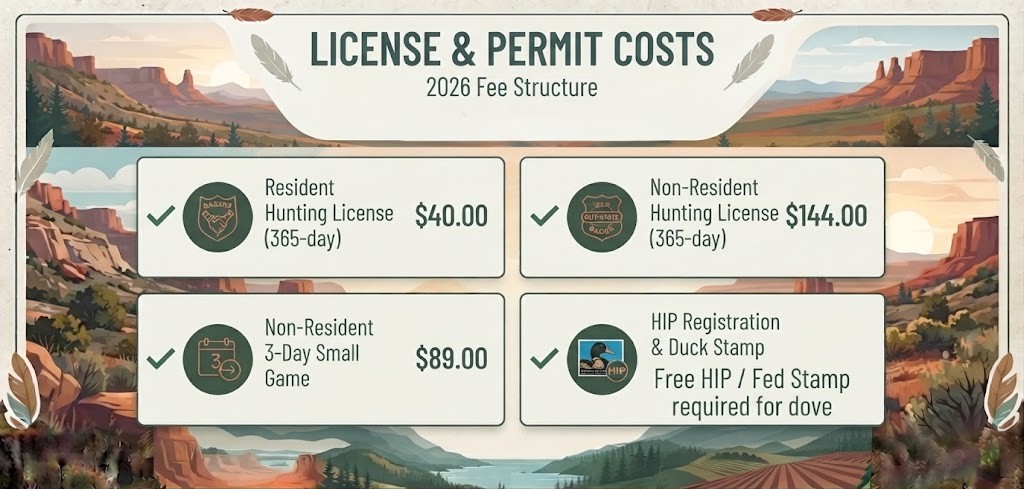
| License Type | Validity | Cost |
|---|---|---|
| Resident Hunting License | 365 days | $40 |
| Non-Resident Hunting License | 365 days | $144 |
| Non-Resident 3-Day Small Game License | 3 days | $89 |
The 3-day option is worth noting for non-residents making a short trip specifically for upland birds or dove—it’s a lower-commitment entry point than the full 365-day license if you’re not planning multiple visits this year.
A few notes before you buy: anyone born after December 31, 1965, must complete Utah’s hunter education requirement before purchasing a license. Non-residents don’t need to transfer their hunter-ed certification, but carry your card in the field just in case. Licenses go through the official state licensing system, not third-party resellers. For more on how licensing fits into a broader Utah hunting plan, see this hunting in Utah overview.
Utah Hunting Permits
Beyond the basic license, a few additional permits come into play depending on what you’re hunting:
- HIP registration — Free and required for anyone hunting migratory birds, including mourning dove. Register directly through the state system in a few minutes.
- Federal Duck Stamp — Required for any migratory bird hunter age 16 or older, a separate federal requirement on top of your state license and HIP number.
- Special-species permits — Sage-grouse, sharp-tailed grouse, ptarmigan, and band-tailed pigeon each require their own free permit. The permit itself costs nothing, but expect a non-refundable application/handling fee of roughly $10 for residents and $16–$21 for non-residents.
Licenses, HIP registration, and Duck Stamps are all available through the official DWR system and authorized license agents. Special-species permits require a separate application process, so plan ahead if one of those birds is on your list this season.
Where to Hunt Game Birds in Utah
Once the paperwork is squared away, the question is where to go. Utah hunters generally choose from three paths—public land, private leases, and guided hunts—ranging from free-and-DIY to premium-and-full-service. For many hunters, leasing private ground hits the balance between cost and guaranteed access.
Best Public Lands for Bird Hunting
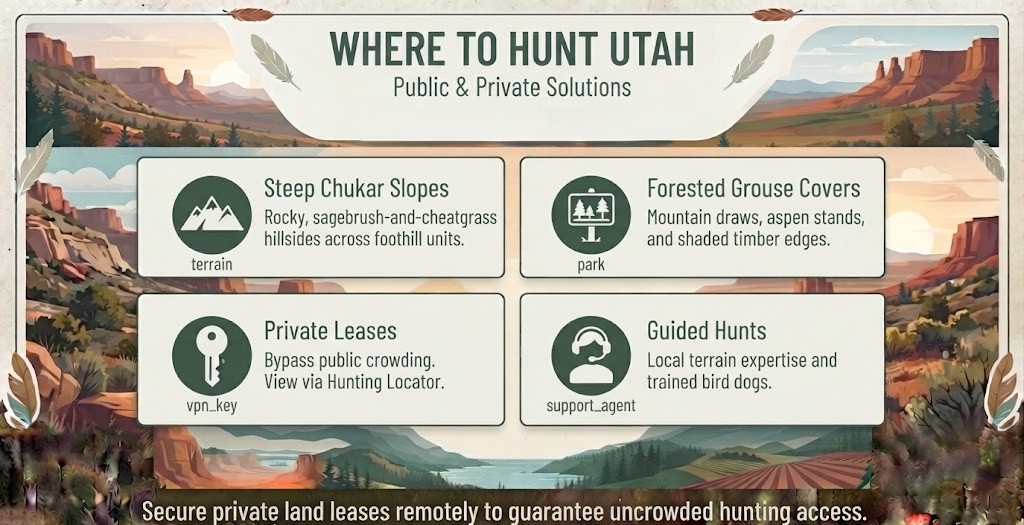
Utah’s public land offers real opportunity if you know what terrain to target for each species. Rather than chasing a specific named spot, focus on the habitat type that matches your target bird:
- Chukar — Look for steep, rocky terrain mixed with sagebrush and cheatgrass, particularly on foothill slopes
- Ruffed grouse — Target forested mountain edges, aspen stands, and shaded draws with dense understory
- Hungarian partridge — Favor open agricultural edges and grassy foothills bordering farmland
- Mourning dove — Concentrate near water sources, grain fields, and agricultural edges where birds feed and water
Before heading out, use the state’s Hunt Planner tool and confirm land ownership and access boundaries ahead of time—public/private boundaries in Utah can be less obvious than expected. Popular public units get crowded fast during peak chukar season in October and November, which is why many hunters start looking at private access as an alternative.
Private Land Hunting with Hunting Locator
Crowded public units and uncertain access are the main reasons hunters turn to private land leasing. Instead of competing for the same ridgeline every October weekend, a lease gives you—and often just your group—exclusive access to quality bird habitat for the season. That matters whether you’re a resident tired of fighting for parking at the trailhead or a non-resident who’s traveled hundreds of miles and can’t afford a wasted trip.
Leasing works simply: a landowner agrees to let hunters access their property, typically for a season or annual fee, in exchange for respectful, responsible use of the ground. Some hunters go further and look at buying hunting land outright, turning a single season’s access into ground they control for years. Either route addresses two common frustrations: the anxiety of losing access to a spot, and the time cost of scouting new ground every year.
This is where Hunting Locator comes in. We connect hunters directly with Utah landowners who are ready to lease or sell their land for hunting, cutting out the cold-calling. Browse current listings, connect directly with landowners, and secure your ground before the season crowds set in. Browse Utah hunting leases to see what’s available.
Guided Upland Hunts in Utah
A guided hunt isn’t for everyone, but it’s worth considering for a few types of hunters: first-time Utah visitors unfamiliar with the terrain, non-residents on a tight travel schedule, and beginners who haven’t built up upland hunting experience yet.
A guided hunt typically offers what self-guided hunting doesn’t:
- Local terrain knowledge built over years of hunting the same ground
- Trained bird dogs for flushing and retrieving, especially valuable in chukar’s rugged country
- Established access to productive private or leased ground you couldn’t find on your own
- Logistics handling—lodging, licensing questions, and trip planning support
Self-guided hunting leaves you responsible for scouting, access, and navigation on your own, often on unfamiliar public ground. If a fully guided experience isn’t the right fit but you still want reliable access, leasing ground through Hunting Locator’s Utah listings offers a middle path: the certainty of quality access without the full-service price tag.
Utah Game Bird Hunting Tips
A few field-tested basics that matter heading into Utah’s 2026 season:
- Match Your Gun and Load — A 12 or 20 gauge with light loads and smaller shot sizes works well for the quick, close flushes typical of chukar and grouse cover. Pattern your gun before the season so you know how it performs.
- Prepare for the Terrain — Chukar country is steep, rocky, and unforgiving on knees and ankles. Sturdy, ankle-supporting boots and some pre-season conditioning pay off fast once you’re a mile into a canyon.
- Dress for the Swing in Temperatures — September dove hunts can run hot, while late-season Hungarian partridge hunts in January bring real cold. Pack layers you can add or shed as the day and the season change.
- You Don’t Need a Dog to Start — Plenty of successful chukar and grouse hunters have never owned a bird dog. Success comes down to time spent in good habitat and sharp wing-shooting, not necessarily a four-legged partner.
- Know Your Birds — Learn how each species looks and sounds in flight before opening day. Confident identification keeps you legal and prevents costly mistakes in the field.
- Secure Access Early — Don’t wait until the week before the season to figure out where you’re hunting. Lock down your ground now, whether that means confirming public land access or securing a private lease.
For shotguns, boots, blaze orange, and other gear, the Hunting Locator store carries what you need to get set up before the season starts.
More Resources from Hunting Locator
Utah’s hunting opportunities extend well beyond game birds, and Hunting Locator has planning resources for nearly every season the state offers.
Bird and small game hunting:
- Hunting in Utah overview — A broad look at Utah’s hunting landscape across species and seasons
- Utah game bird hunting season — A deeper dive into game bird regulations and strategy
- Utah small game hunting season — Coverage of adjacent small game opportunities beyond birds
- Utah waterfowl hunting season — Migratory bird rules that overlap with dove season requirements
- Utah turkey hunting season — Season dates and strategy for Utah’s spring and fall turkey hunts
Planning other Utah hunts:
- Utah black bear hunting season — What to know before pursuing black bear
- Utah bison hunting season — A look at Utah’s limited bison hunting opportunities
- Utah deer hunting season — Season structure for Utah’s most popular big game hunt
- Utah elk hunting season — Dates and unit information for elk hunters
- Utah pronghorn hunting season — Planning resources for pronghorn antelope hunts
- Utah desert bighorn sheep hunting season — Information on this limited-draw hunt
- Utah moose hunting season — What to expect pursuing Utah moose
Access and gear:
- Utah hunting leases — Browse current private land leasing opportunities across the state
- Hunting Locator home — Explore the full platform connecting hunters with land access nationwide
Frequently Asked Questions
When does Utah’s game bird season open in 2026?
Mourning dove opens first on September 1, 2026. Chukar and ruffed grouse follow on October 1, 2026, and Hungarian partridge opens latest, on November 1, 2026. Confirm these dates against the official DWR guidebook before your trip, since regulations can shift year to year.
How much is a Utah hunting license for non-residents in 2026?
A non-resident 365-day hunting license costs $144, while a non-resident 3-day small game license runs $89—a solid option for shorter trips. Residents pay $40 for a full 365-day license.
Do I need a Federal Duck Stamp to hunt mourning dove in Utah?
Yes. Hunters age 16 and older need a Federal Duck Stamp to hunt migratory game birds, including mourning dove, in addition to a valid HIP number. This comes directly from Utah’s Federal Duck Stamp requirement for all migratory bird hunters.
What are the bag limits for Utah game birds in 2026?
Chukar and ruffed grouse share a combined 8-bird daily limit, Hungarian partridge is capped at 4 daily, and mourning dove allows 15 daily. These limits support long-term conservation and can be adjusted year to year, so verify with the DWR before heading out.
Do I need hunter education to hunt birds in Utah?
Yes, if you were born after December 31, 1965, you must complete hunter education before purchasing a Utah hunting license. Non-residents should carry proof of their hunter-ed certification in the field, even though it doesn’t need to be formally transferred to Utah.
Can I hunt Utah chukar and grouse without a dog?
Yes—many successful Utah upland hunters have never owned a bird dog. Success comes down to time spent in good habitat and sharp wing-shooting skills, though a trained dog helps with flushing birds and retrieving downed game.
Where can I find private land to hunt birds in Utah?
Hunting Locator connects hunters directly with Utah landowners offering land to lease or buy for the season. Browsing current Utah hunting leases gives you access away from crowded public units, without the guesswork of cold-calling landowners yourself.
The Final Shot
The 2026 season, in short: dove opens September 1, upland birds open October 1, and Hungarian partridge stretches the season into late January. Know your bag limits, get the right license and permits squared away—including HIP and the Federal Duck Stamp if you’re chasing dove—and settle where you’ll be hunting well before opening day.
The remaining steps: verify the final dates against the official DWR guidebook, buy your license and stamps through the state system, and secure your access. That last piece is where a lot of hunters get stuck, and it’s where Hunting Locator can help, connecting you with landowners and quality ground so you’re not scrambling for a spot the week before the season opens.
This guide covers what’s needed to plan the 2026 season, whether you’re chasing chukar in the foothills or dove over a stubble field. When you’re ready for the next step, Hunting Locator can help you find the ground and the gear to make it happen.


