You get two completely different hunts depending on where you go. West of the Cascades, massive Roosevelt elk disappear into rainforest so thick you might bump into one at 20 yards. East of the mountains, Rocky Mountain elk roam open country where your binoculars matter more than your machete.
This guide breaks down everything you need for Washington’s 2026 elk season. The WDFW’s 2026-2027 regulations run from April 1, 2026 through March 31, 2027, and there’s a lot to unpack. Make sure you’ve got proper gear for whatever terrain you choose—coastal timber hunting requires completely different equipment than eastern canyon country.
Here’s what we’ll cover:
- Season dates for every hunting method
- License costs that’ll make non-residents wince
- Where to actually find elk instead of just boot prints
Let’s get into the details that matter.
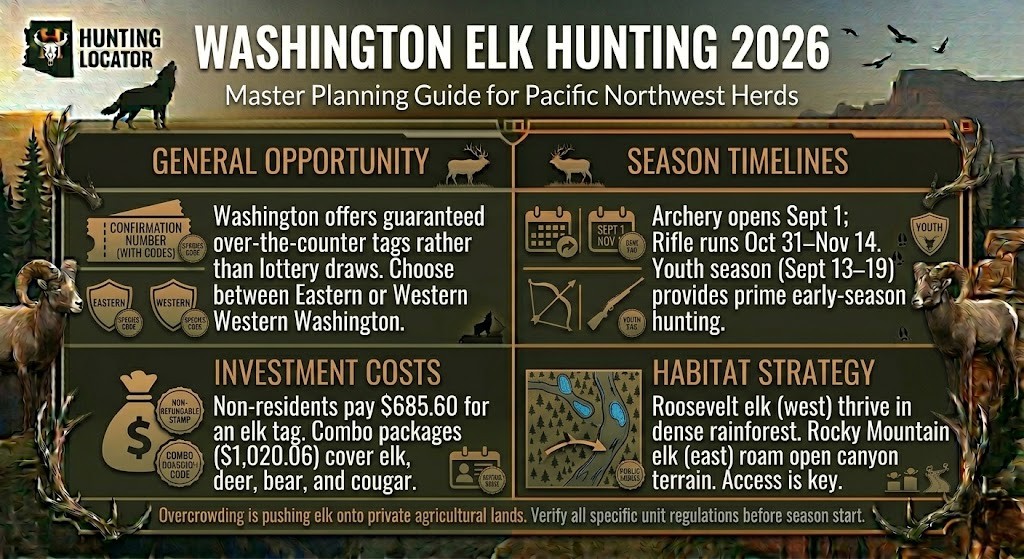
Quick Overview of Washington Elk Season 2026
Here are the dates and rules that determine when and how you can hunt elk in Washington this year.
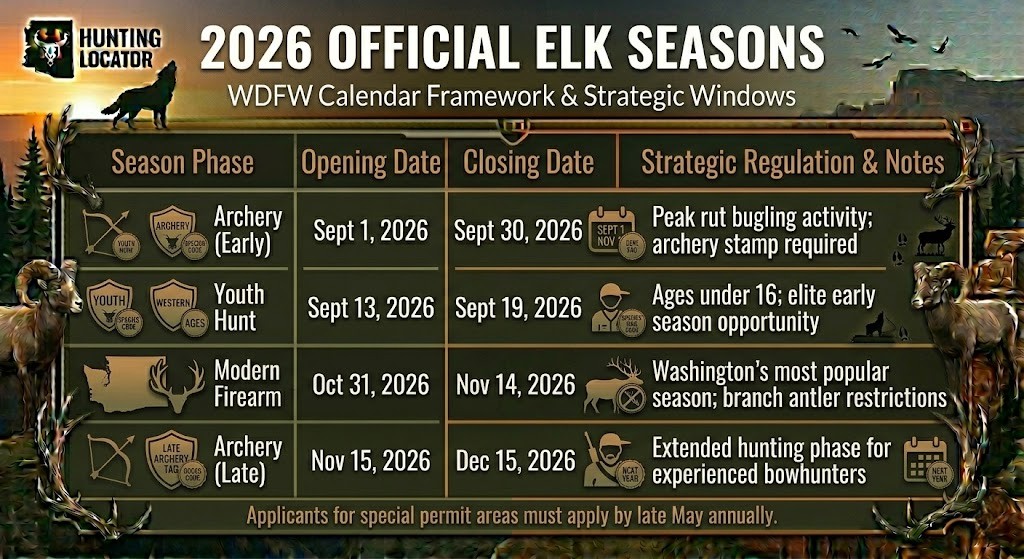
| Season Type | Start Date | End Date | Bag Limit | Notes |
|---|---|---|---|---|
| Youth Hunt (select GMUs) | Sept. 13, 2026 | Sept. 19, 2026 | 1 elk | Hunters under 16 |
| Archery – Early (select GMUs) | Sept. 1, 2026 | Sept. 30, 2026 | 1 elk | Peak bugling activity |
| Muzzleloader – Early (select GMUs) | Oct. 3, 2026 | Oct. 10, 2026 | 1 elk | Limited GMU availability |
| Modern Firearm – General (varies by GMU) | Oct. 31, 2026 | Nov. 14, 2026 | 1 elk | Branch bull or antlerless w/permit |
| Muzzleloader – Late (select GMUs) | Nov. 15, 2026 | Nov. 25, 2026 | 1 elk | Post-rut hunting |
| Archery – Late (select GMUs) | Nov. 15, 2026 | Dec. 15, 2026 | 1 elk | Extended opportunity |
Before you even think about hunting, you need these basics:
- Washington hunting license (resident or non-resident)
- Elk tag for either Eastern OR Western Washington (pick one, you can’t do both)
- Hunter education card if you were born after January 1, 1972
- Choose your weapon: rifle, bow, or muzzleloader (stick with one)
- Report your harvest even if you eat tag soup
Elk Hunting Seasons in Washington
Washington makes you commit. Pick your weapon, pick your region, and live with your choices. Here’s how each season plays out.
Archery Elk Season
Early archery runs September 1-30, 2026, with a late season November 15 – December 15 in select units. September is prime time—bulls are screaming, cows are receptive, and elk activity peaks during the rut.
Roosevelt elk on the west side will test your nerves. Imagine calling a 700-pound bull through timber so thick you can’t see 30 yards. Eastern Washington’s Rocky Mountain elk give you more room to work, but they’re not pushovers either.
Double-check that your bow setup meets WDFW requirements. Getting turned away at a check station because your broadheads don’t measure up would ruin anyone’s season.
Muzzleloader Elk Season
Early muzzleloader season runs October 3-10, 2026, with late season November 15-25. Both seasons are limited to specific GMUs, so verify your target area actually has a muzzleloader season before buying tags.
October timing hits that sweet spot after peak rut when bulls might still respond to calls but aren’t completely insane anymore. Late season can be productive if you don’t mind potentially cold, wet conditions.
Modern Firearm Elk Season
General rifle season runs October 31 – November 14, 2026, though exact dates vary by GMU. This is Washington’s most popular elk season, probably because most hunters prefer the range and accuracy of modern rifles.
Here’s where things get interesting. Western Washington lets you shoot any bull during general seasons. Eastern Washington restricts you to true spike bulls during general rifle and archery seasons. Know the difference—a forked-horn will cost you big money and potentially your hunting privileges.
Expect company. Hunting pressure gets intense in easy-access areas during rifle season. Plan accordingly.
Youth Elk Hunt
Youth season runs September 13-19, 2026 in select GMUs for hunters under 16. This timing is brilliant—early season conditions with minimal competition. Perfect for introducing kids to elk hunting without the chaos of general seasons.
Youth licenses cost just $29.82 whether you’re resident or non-resident. That’s a bargain compared to adult pricing.
Washington Elk Licenses and Permits
Washington’s licensing system is straightforward but expensive, especially for non-residents. You need both a hunting license and an elk tag.
Washington Hunting Licenses
Here’s what you’ll pay for the privilege of elk hunting in Washington:
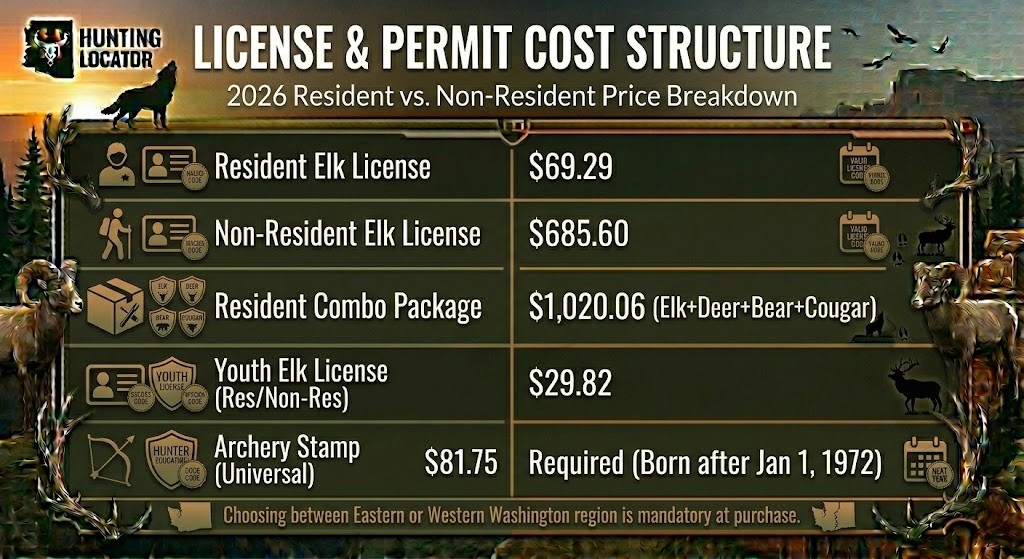
| License Type | Cost |
|---|---|
| Resident Elk License | $69 |
| Resident (with discounted small game) | $100 |
| Non-Resident Elk License | $685.60 |
| Youth (under 16) – Resident | $29.82 |
| Youth (under 16) – Non-Resident | $29.82 |
| Combination Package (deer, elk, bear, cougar) – Resident | $1,020.06 |
| Combination Package (deer, elk, bear, cougar) – Non-Resident | $1,020 |
That non-resident price stings, but consider the alternative. Washington sells elk tags over the counter while most western states make you apply and wait. You’re paying for guaranteed opportunity instead of playing the lottery for years.
The combination package makes sense if you’re hunting multiple species. Check our guides for Washington deer, black bear, and cougar hunting to see if it’s worth the extra cost.
Remember: you must choose Eastern OR Western Washington when buying your elk tag. No fence-sitting allowed, except for special permit holders who can hunt both regions.
Washington Elk Permits
Washington offers two paths: general season tags you can buy anytime, and special permits for premium areas that require entering a point-based lottery. Washington uses a squared bonus point system. Each unsuccessful year gets you another point, and some units take over a decade to draw.
Non-residents pay $608 total to apply for special permit areas. Applications close in late May, so you’re always planning a year ahead.
Special permit holders with multi-season tags hit the jackpot—they can hunt all general seasons (archery, muzzleloader, rifle) in any open GMU across both Eastern and Western Washington.
Where to Hunt Elk in Washington
Location makes or breaks your elk hunt. Washington offers about 9.1 million acres of public hunting land, but not all acres are created equal. You’ve got two distinct elk populations: Roosevelt elk in the coastal forests west of the Cascades, and Rocky Mountain elk in the more open country to the east.
Best Public Lands for Elk Hunting
Washington provides roughly 9.1 million acres of public hunting access through WDFW wildlife areas, national forests, and DNR trust lands. WDFW manages about 1 million acres across 33 wildlife areas specifically for wildlife habitat and hunting access.
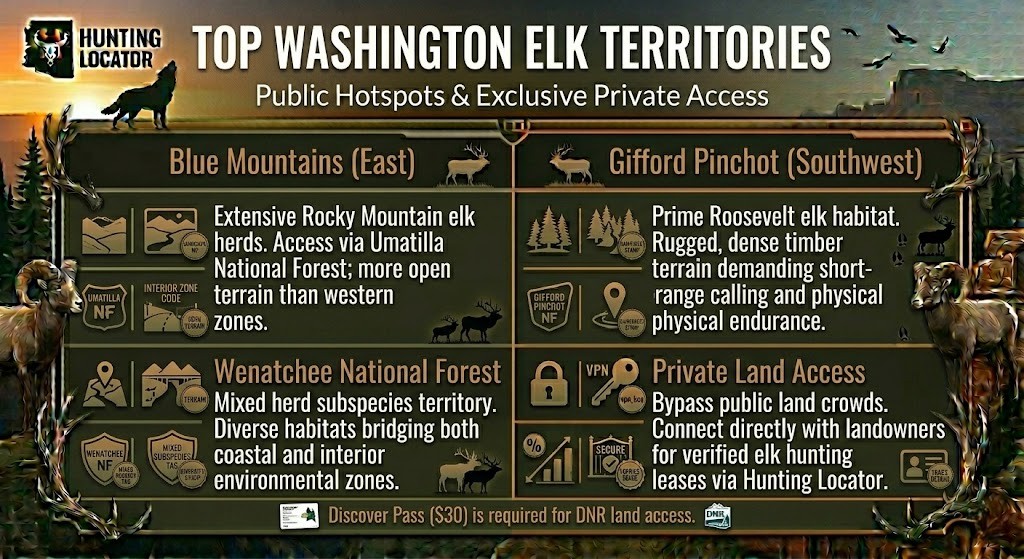
Here are the public land areas that consistently produce elk:
- Blue Mountains (Eastern Washington): Focus on GMU 186 and surrounding units in Asotin and Garfield counties. The Umatilla National Forest provides access to large Rocky Mountain elk herds. More open terrain means glassing opportunities.
- Gifford Pinchot National Forest (Southwest Washington): Lewis County holds high Roosevelt elk populations in dense forest that demands close-range hunting skills. Expect thick cover and short shots.
- Olympic Peninsula (Western Washington): Dense forests with abundant elk activity. This terrain will test your physical conditioning and hunting skills equally.
- Wenatchee National Forest (Central Washington): Yakima County area with access to both elk subspecies. The Yakima herd numbers about 10,000 animals, while the northern Colockum herd reaches approximately 4,000.
Your hunting license gets you onto WDFW lands for free. Add a Discover Pass ($30/year) and you unlock another three million acres of DNR trust lands. Just remember that easy-access areas get hammered with hunting pressure.
Guided Elk Hunts
Guided hunts make sense for non-residents unfamiliar with Washington terrain, new hunters wanting mentorship, or anyone willing to pay for higher success odds. Washington has 29 licensed outfitters offering everything from day hunts to multi-day wilderness expeditions.
Good outfitters bring local knowledge, access to quality hunting areas (often including private land), game care help, and mentorship. The numbers speak for themselves—one operation maintains a 100% opportunity rate and 95% kill rate.
Private Land Elk Hunting with Hunting Locator
Public land pressure keeps getting worse, making private access increasingly valuable. It’s harder to avoid crowds on public land, making private access more important for quality hunting.
Private land offers obvious advantages: less pressure, potentially better game densities, predictable access, and the ability to scout without interference. One private ranch holds 150-400 free-ranging Roosevelt elk.
Hunting Locator solves the private land access problem by connecting hunters directly with landowners who want to share their property. Instead of driving backroads hoping someone says yes, you can browse verified properties, compare options, and connect with landowners ready to make deals. Whether you want a weekend hunt or your own hunting property, Hunting Locator’s Washington listings provide access that transforms your hunting experience.
Elk Hunting Tips for Washington Success
Washington’s terrain and elk subspecies demand specific strategies:
- Learn the Terrain: West side hunting offers dense woods and rugged terrain that tests skill and endurance. Roosevelt elk require close-range skills, while eastern hunts favor glassing from ridges.
- Time It Right: Early archery season in September coincides with the rut, when bulls are most vocal and responsive to calling.
- Scout Hard: Research access points, trail systems, and boundaries to maximize field time. Use maps and online tools to identify promising basins and drainages.
- Master Still Hunting: Move at a snail’s pace, taking three or four steps before stopping to look and listen. This technique works well in Washington’s thick timber.
- Find Bedding Areas: Elk use benches to bed during the day. Understanding these patterns helps you position for legal hunting hours.
- Prepare for Weather: Washington’s coastal climate changes fast. Layer your clothing and pack rain gear regardless of forecasts. Waterproof boots are essential in Roosevelt elk country.
More Resources from Hunting Locator
Expand your Washington hunting knowledge with these guides and services:
- Washington Hunting Season Guide – Complete overview of all hunting seasons
- Washington Deer Hunting – Detailed deer hunting guide
- Washington Black Bear – Bear hunting essentials
- Washington Turkey Hunting – Spring and fall turkey opportunities
- Washington Waterfowl – Duck and goose hunting guide
- Washington Private Leases – Browse hunting properties
- Hunting Gear Store – Quality equipment for Washington conditions
Frequently Asked Questions
Do I need hunter education to hunt elk in Washington?
Yes, if you were born after January 1, 1972, you must complete hunter education before buying your first Washington hunting license. This applies to residents and non-residents.
Can I hunt both Eastern and Western Washington with one elk tag?
No. You must choose Eastern OR Western Washington when buying your elk tag. You can’t hunt both regions with a general tag. Multi-season special permit holders are the exception—they can hunt both regions.
What’s the difference between Roosevelt and Rocky Mountain elk hunting?
Roosevelt elk live west of the Cascades in dense coastal forests requiring close-range hunting skills. Rocky Mountain elk inhabit eastern Washington’s open canyon country where glassing and longer shots are common. Roosevelt elk are bigger but harder to hunt due to terrain.
How much does non-resident elk hunting cost in Washington?
A non-resident elk license costs $685.60 for 2026. The combination package with deer, elk, bear, and cougar costs $1,020.06. Special permit applications cost non-residents $608 total.
What are elk hunting success rates in Washington?
Only 1 out of 10 elk hunters fills their tag statewide, though success varies dramatically by location and method. Private land operations report much higher rates, with one outfitter maintaining 100% opportunity and 95% kill rates.
When do I apply for Washington elk special permits?
Applications close in late May for the following year’s special permit hunts. You’re always planning a year ahead for premium draw units.
The Final Shot
Washington’s 2026 elk season delivers something rare in western hunting: guaranteed opportunity. While other states make you play the lottery, Washington sells tags to anyone willing to pay. From Roosevelt elk in coastal rainforests to Rocky Mountain elk in eastern canyons, you get diverse hunting experiences without the uncertainty of draw systems.
But success requires more than just buying a license. You need preparation, local knowledge, and increasingly, access to quality areas away from crowded public lands. The difference between a successful hunt and another story about the one that got away often comes down to where you hunt, not just how well you hunt.
Ready to secure access to Washington’s best elk hunting? Explore private land leases and hunting properties that can turn your 2026 elk season from ordinary into unforgettable.


