This Washington turkey guide pulls the official rules, dates, and fees into one place. All the regulatory specifics come from the Washington Department of Fish & Wildlife (WDFW), so the information holds whether you’re a lifelong resident or flying in from out of state.
Once your dates are locked in, the next step is putting a season plan together. Start planning your season and pick up gear for Washington hunting before opening day.
Here’s what you’ll find below:
- Season dates & bag limits — Fall and spring turkey season windows, GMU-specific limits, and county exceptions
- Licenses, tags & fees — What residents and non-residents pay, and exactly what documents you need in hand
- Where to hunt — Public land options, private leases, and guided hunts across the state
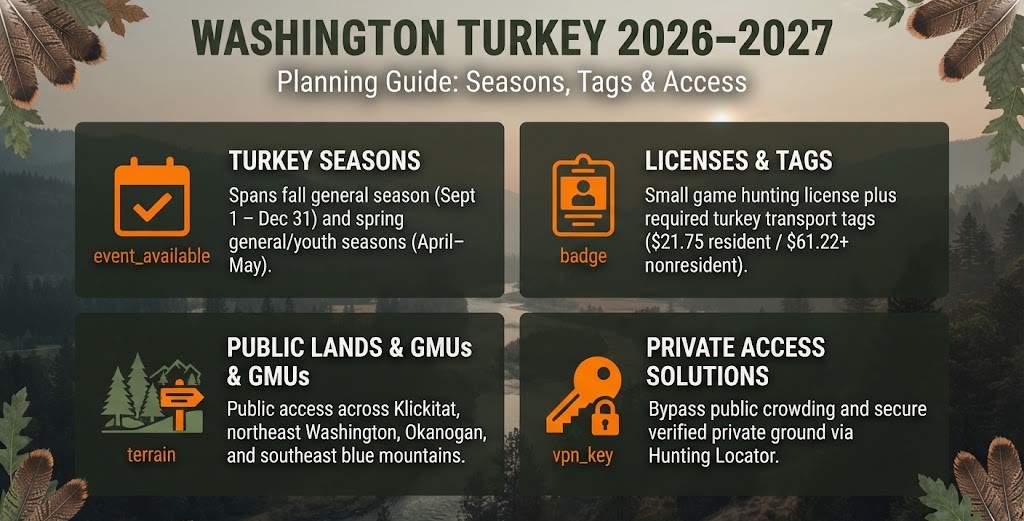
Quick Overview: Washington Turkey Season at a Glance
Washington’s turkey hunting structure comes down to two separate seasons — fall and spring — each governed by its own bag limit, according to WDFW. Filling your spring limit doesn’t touch your fall opportunity, and vice versa.
| Season | Dates | Bag Limit | Key Notes |
|---|---|---|---|
| Fall General Season | September 1 – December 31 | 4 turkeys total (varies by GMU; e.g., 2 beardless + 2 either-sex in GMUs 101–154 and 162–186) | Seasonal limit, not daily |
| Spring General Season | April 15 – May 31 | 3 turkeys statewide, combined with youth (county limits vary — Klickitat 2, Spokane 3, Western WA general areas 1) | Male/bearded turkeys only in spring |
| Spring Youth Season | April 1 – April 7 (2027) | Counts toward the 3-turkey spring/youth combined limit | Youth must be accompanied by an adult 18+ |
Always verify current regulations with official WDFW hunting regulations before your hunt — bag limits and GMU boundaries can change.
Every Washington turkey hunter needs the right paperwork before stepping into the field. According to WDFW, that means:
- A valid Washington small game hunting license
- A turkey transport tag (a separate tag required in addition to your license, proving you legally harvested and are transporting a turkey)
- Hunter education certification for most first-time hunters
- Mandatory harvest reporting to WDFW within required timelines
One definition worth knowing: a GMU, or Game Management Unit, is a geographic zone WDFW uses to set localized bag limits and season rules — the state’s way of managing turkey populations region by region.
Washington Turkey Hunting Seasons
Fall and spring aren’t just different windows on the calendar. They’re legally separate seasons with their own bag limits, according to WDFW. A hunter who fills their full spring limit can still head out again in the fall, since each season is scored independently.
Washington is home to three wild turkey subspecies, each occupying its own corner of the state. Merriam’s turkeys populate portions of Spokane, Pend Oreille, Stevens, Ferry, Okanogan, Chelan, Kittitas, Yakima, Klickitat, and Skamania counties. Rio Grande birds are found in Asotin, Garfield, Columbia, Walla Walla, Whitman, and Lincoln counties. Eastern turkeys occupy the western side of the Cascades, in Cowlitz, Wahkiakum, Pacific, Grays Harbor, Mason, Thurston, and Lewis counties.
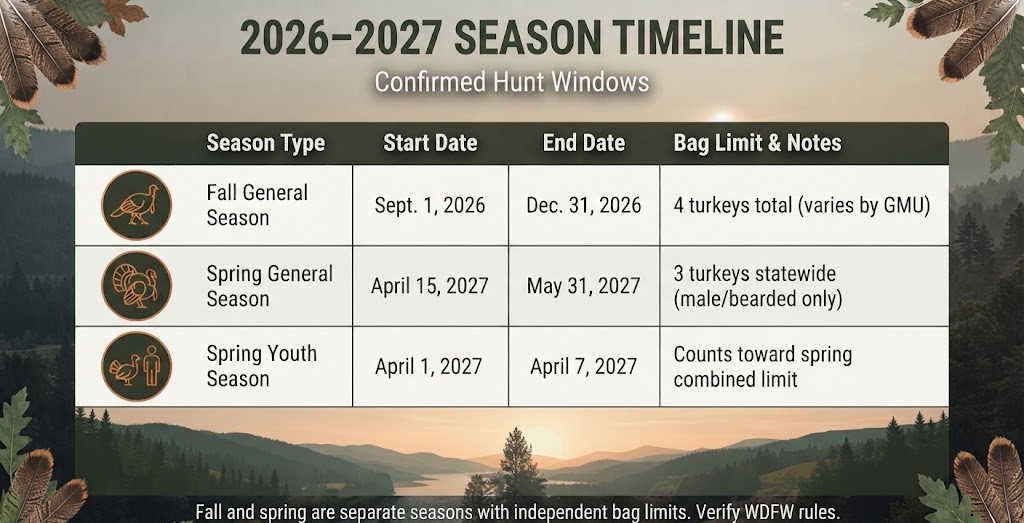
Fall General Season (September 1 – December 31)
The fall general season runs September 1 through December 31, with a seasonal bag limit of 4 turkeys total, though the exact breakdown varies by GMU. In GMUs 101–154 and 162–186, for example, that limit splits into 2 beardless and 2 either-sex birds.
Some southwest Washington GMUs in Klickitat and Skamania counties offer increased fall opportunity, per WDFW’s fall season guidance. In Klickitat County specifically, quality hunting tends to concentrate below 1,500 feet near the White Salmon and Klickitat River drainages — worth keeping on your scouting list if you’re hunting fall birds in that region.
Spring General Season (April 15 – May 31)
Spring general season runs April 15 through May 31, with a combined spring/youth statewide limit of 3 turkeys. County-specific limits apply on top of that statewide number — Klickitat sits at 2, Spokane at 3, and Western Washington’s general areas cap out at 1.
Spring hunting comes with a rule that matters: only male turkeys and turkeys with visible beards are legal game. A “bearded” bird has a visible tuft of modified feathers protruding from its chest; a “beardless” bird lacks this feature and is off-limits in spring. Because Washington hosts three distinct subspecies across different regions, traveling hunters sometimes plan trips aiming to encounter Merriam’s, Rio Grande, and Eastern birds all within a single spring season.
Spring Youth Season (April 1 – April 7, 2027)
Washington’s youth-only spring season runs April 1 through April 7, 2027, and is open statewide. Youth hunters must be accompanied by an adult 18 years or older, and all standard turkey hunting methods and regulations apply during this window, per WDFW.
Any birds taken during the youth season count toward the combined 3-turkey spring/youth limit, so families planning multiple hunts should track combined totals carefully.
Washington Turkey Licenses and Permits
Washington requires two separate items to legally hunt turkey: a small game hunting license and a turkey transport tag. These aren’t interchangeable — WDFW treats them as distinct requirements, and forgetting one is a common mistake for first-time turkey hunters.
Washington Hunting Licenses
Tag pricing differs significantly between residents and non-residents, so it pays to know the numbers before you buy.
| Item | Resident | Non-resident |
|---|---|---|
| Turkey Tag #1 | $22 | $61 |
| Additional Turkey Tags | $22 | $91.58 |
| Small Game Hunting License | Required — check current pricing with WDFW | Required — check current pricing with WDFW |
Licenses and tags are purchased directly through the Washington Department of Fish & Wildlife. Additional tags allow you to pursue multiple birds across the season, giving dedicated hunters more flexibility to fill out their bag limit. Confirm the latest license and tag pricing directly with WDFW before purchasing, since fees can change from year to year.

Washington Hunting Permits & Reporting
Beyond your license and tag, a few additional requirements round out Washington’s turkey hunting rules. Hunter education certification is required for most first-time hunters before a license can be issued.
Washington also enforces a legal transport rule: it’s unlawful to possess or transport a wild turkey without the fully feathered head and beard (if present at harvest) attached, until the bird has been processed or stored for consumption. This helps game wardens confirm legal harvest in the field.
Harvest reporting is mandatory and timing-dependent. If you purchase a turkey tag before the end of spring season, you must submit a spring hunting report. If your spring tag goes unfilled, or you purchase a tag after spring season ends, a fall hunting report is required instead. A harvest report is your official record to WDFW confirming whether — and how — you filled your tag, and it factors directly into how the department sets future season limits.
Where to Hunt Turkey in Washington
Washington offers solid public-land turkey hunting, but popular spots can get crowded fast once the season opens. Public ground, private leases, and guided hunts each suit different goals and budgets.
Best Public Lands
Several regions across the state consistently produce good turkey numbers on public ground:
- Klickitat County — High-density turkey areas below 1,500 feet near the White Salmon and Klickitat River drainages, plus WDFW-managed Klickitat Wildlife Area units.
- Northeast Washington (Stevens, Ferry, Pend Oreille) — Prime Merriam’s turkey country with consistent public access.
- Okanogan region — A healthy, expanding Merriam’s population with room to roam.
- Southeast Washington (Asotin, Garfield / Blue Mountains) — Rio Grande birds concentrated near river corridors and agricultural fields.
WDFW’s Private Lands Access Program is also worth exploring as a way to secure permission on managed properties near public ground. Popular public units can see real crowding during peak spring weekends, which is why many hunters start looking at private access as their season approaches.
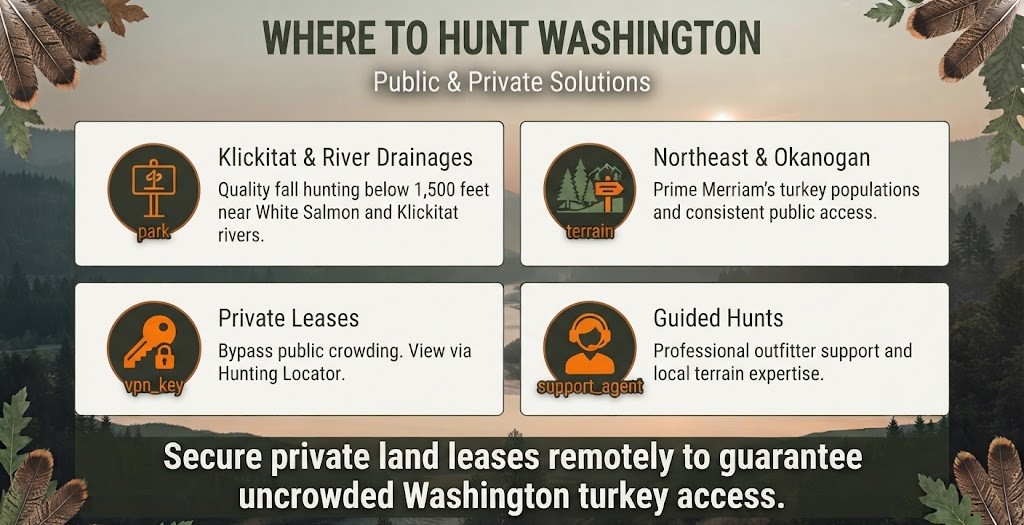
Private Land Hunting with Hunting Locator
Private land addresses the two biggest turkey hunting headaches: pressure and unpredictability. Less competition means birds behave more naturally, and having dedicated ground means you can build a trip around a location you know is available, rather than hoping a public spot isn’t already occupied on opening morning. Whether you’re looking for a seasonal lease or considering long-term ownership, private access gives you a level of control public land doesn’t offer.
Hunting Locator connects hunters directly with landowners across Washington who are ready to lease or sell hunting ground. Instead of cold-calling landowners or guessing which private parcels might be available, you can search, compare, and connect in one place.
Browse Washington hunting leases to see what’s currently available before the best ground gets locked up by other hunters. If you’re thinking beyond this season, buying hunting land in Washington is worth considering as a long-term path to guaranteed access year after year.
Guided Hunts
Guided hunts are a strong option for non-residents unfamiliar with Washington’s terrain and regulations, as well as beginners who want hands-on instruction during their first season. A guide’s local knowledge can shorten the learning curve considerably, especially when you’re hunting unfamiliar ground on a tight travel schedule.
Regions like the Okanogan offer guided spring turkey hunts targeting primarily Merriam’s birds, with occasional opportunities at Rio Grande and Eastern turkeys as well. If you’re weighing a guided option, browse Washington hunting leases is a good starting point for connecting with landowners and outfitters who can point you toward the right fit for your experience level and goals.
Turkey Hunting Tips for Success
These fundamentals won’t guarantee a tag on your first morning out, but they’ll improve your odds regardless of experience level.
- Scout Before the Opener: Early-season birds tend to gather in larger groups, making them easier to pattern before opening-day pressure scatters them.
- Learn a Locator Call: A locator call can trigger a shock gobble that pinpoints a tom’s location; once you’ve found him, switch to hen yelps to draw him in, a technique detailed in WDFW’s turkey hunting guidance.
- Set Up Smart: Conceal yourself near meadows or small clearings with food nearby, and use a blind whenever the terrain allows.
- Know Your Target: In spring, only male or bearded turkeys are legal game — always confirm the beard before you take the shot.
- Gear Up Right: A properly patterned shotgun with the correct choke, quality decoys, and reliable calls make a real difference in the field. Find turkey hunting gear to round out your setup before opening day.
More Resources from Hunting Locator
Planning more than turkey this year? We’ve organized Washington’s full lineup of season guides so you can plan every hunt in one place.
- Washington Hunting Season Guide — The flagship statewide guide covering every season across every species.
- Washington Turkey Hunting Season — Our companion turkey-specific breakdown for deeper regional detail.
If big game is next on your list, these guides cover the state’s major species:
- Washington Deer Hunting Season — Season structures and unit-by-unit deer hunting details.
- Washington Elk Hunting Season — Everything you need for planning an elk hunt this year.
- Washington Black Bear Hunting Season — Spring and fall bear season dates and tag requirements.
- Washington Cougar Hunting Season — What you need to know before pursuing cougar.
- Washington Moose Hunting Season — Permit-based moose hunting opportunities across the state.
- Washington Mountain Goat Hunting Season — Alpine hunting logistics and permit details.
- Washington Bighorn Sheep Hunting Season — A guide to one of the state’s most sought-after tags.
And for bird and small game hunters:
- Washington Small Game Hunting Season — Rules and opportunities across the state’s small game species.
- Washington Waterfowl Hunting Season — Duck and goose season dates and regulations.
Frequently Asked Questions
What are the Washington turkey season dates for 2026?
The Fall General Season runs September 1 – December 31, 2026, and the Spring General Season runs April 15 – May 31, 2027, with a youth-only season April 1–7, 2027, according to WDFW. Fall and spring are separate seasons with independent bag limits.
How much does a non-resident turkey tag cost in Washington?
Non-resident hunters pay $61.22 for Turkey Tag #1 and $91.58 for each additional tag, compared to $21.75 for residents at either level. A small game hunting license is also required and is purchased through WDFW.
Do I need both a license and a turkey tag to hunt turkey in Washington?
Yes — Washington requires both a small game hunting license and a turkey transport tag, according to WDFW. The transport tag is a separate document proving legal harvest and is required in addition to your license, not instead of it.
Can I hunt both the spring and fall turkey seasons?
Yes. Filling your spring bag limit doesn’t affect your fall opportunity, because WDFW treats each season as its own independent scorecard with a separate bag limit. You can pursue turkeys in both seasons within the same year.
Is there a youth turkey season in Washington?
Yes — a youth-only spring season runs April 1–7, 2027, open statewide. Youth hunters must be accompanied by an adult 18 or older, and all standard turkey regulations apply during this window, per WDFW.
Where can non-residents find guaranteed turkey hunting access in Washington?
Public land is available statewide, but popular areas can get crowded fast during peak season. Many non-resident hunters turn to private leases for reliable, plannable access — browse Washington hunting leases to secure ground before your trip.
The Final Shot
Planning a Washington turkey hunt comes down to three essentials: understanding that fall and spring are separate seasons with their own bag limits, securing both your small game license and turkey transport tag, and choosing the right access path — public, private, or guided — for your hunting style.
The next steps are straightforward. Confirm your season dates and bag limits for the GMU or county you’re hunting. Purchase your small game license and turkey tag through WDFW. Lock in your hunting ground well before opening day arrives.
Verify current regulations directly with WDFW before you head out — rules and fees can shift from year to year, and the official source is your best safeguard against surprises in the field.
This guide is meant to save you time digging through regulations so you can spend more of it hunting. Browse Washington hunting leases to lock in your ground, gear up at the Hunting Locator store before the season fills in, and check out our other Washington season guides to round out your year in the field.


