This Washington waterfowl guide covers the dates, licenses, and access options for the rest of the 2026–27 season. Check your dates, confirm your licenses, and gear up with quality waterfowl gear built for Washington’s wet, cold marshes.
It turns the official 2026–27 rules into a plan for the remaining weeks, whether you live here or are driving in from out of state. It also points to access through private leases, land for sale, and guided hunts. The Washington Department of Fish and Wildlife (WDFW) is the final authority on every regulation; Hunting Locator is not the regulator.
Inside:
- Every remaining 2026–27 date, bag limit, and closure in one table
- The license and permit stack for residents, non-residents, and new hunters
- Where to hunt: public land, private leases, land for sale, and guided hunts
Season status: Scaup reopened Nov 7. GMA 4 white goose closure starts Nov 30.
Washington Waterfowl Season Guide for 2026: Quick Overview
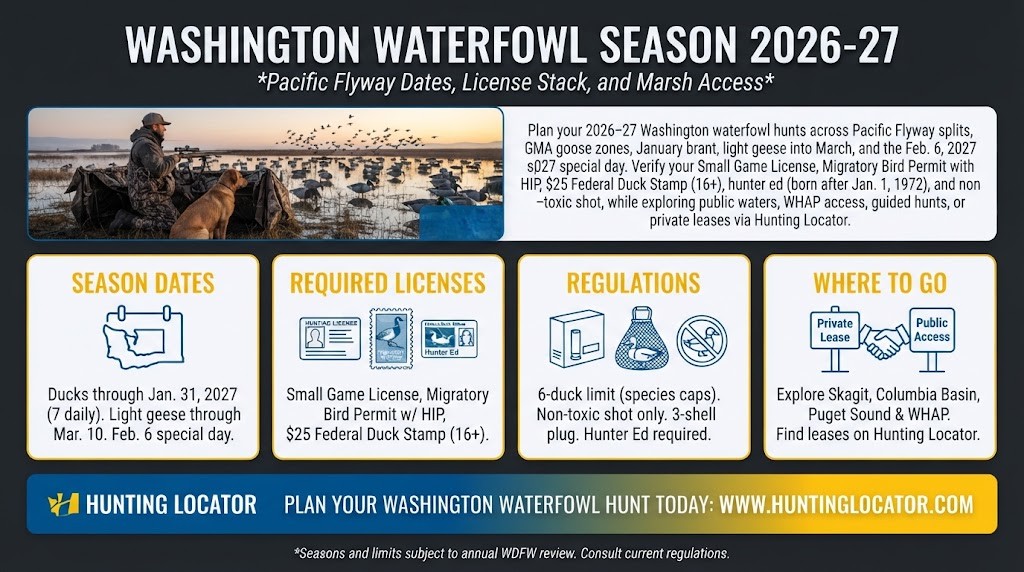
The table below summarizes the 2026–27 season dates and daily bags under Washington’s official waterfowl regulations (WAC 220-416-060) and WDFW guidance. The “daily bag” is the most birds you can take in one day, and “GMA” stands for Goose Management Area, a geographic zone with its own goose limits and closures.
| Species | Season Dates | Daily Bag | Notes |
|---|---|---|---|
| Ducks | Oct 17–25, 2026; Oct 28, 2026–Jan 31, 2027 | 7 | Max 2 hen mallards, 3 pintails, 2 scaup, 2 canvasbacks, 2 redheads. Western WA: up to 3 scoter, 2 long-tailed duck, 3 goldeneye. Possession limit 21. |
| Scaup | Closed Oct 17–Nov 6, 2026; open Nov 7–Jan 31 | 2 (within the 7) | Reopened Nov 7 |
| Coots | Same as ducks | $25.00 | — |
| Dark geese (GMAs 1–5) | Sept 5, 2026–Jan 31, 2027 | 2–5, depending on GMA | Segments vary by area. Check the WDFW pamphlet. |
| White-fronted geese | Within the dark goose season | 6 statewide | — |
| Light geese | Oct 17, 2026–Mar 10, 2027 | 6–20, depending on area | GMA 4 white goose closure Nov 30–Dec 22 |
| Brant | Jan 16–31 or Jan 23–30, 2027, depending on area | $2 | Check the WDFW pamphlet for areas |
| Youth days | Sept 26 (Western WA); Oct 3 (Eastern WA), 2026 | Per regular limits | Passed for 2026 |
| Youth/veteran/military day | Feb 6, 2027 (statewide) | Per regular limits | Still ahead |
What’s Still Open After Nov 19
- Ducks and coots through Jan 31
- Scaup open again
- Dark geese through Jan 31
- Light geese through Mar 10, except GMA 4 white geese Nov 30–Dec 22
- Brant in January
- The Feb 6 special day
Before you head out, make sure your paperwork matches your plans. Washington requires:
- Hunter education if you were born after Jan 1, 1972
- Small Game License
- Migratory Bird Permit plus HIP (Harvest Information Program) migratory bird authorization
- Federal Duck Stamp for hunters ages 16 and older
- Sea duck harvest record card for scoter, long-tailed duck, and goldeneye in Western Washington
For a full Washington license breakdown across species, see our statewide guide. Always verify with WDFW before hunting.
Washington Waterfowl Hunting Seasons
Washington sets seasons by species group and region, and the dates change every year, so don’t rely on last year’s pages. The 2026–2027 duck season sits inside the broader Pacific Flyway schedule, and each species group runs on its own calendar.
Duck & Coot Season
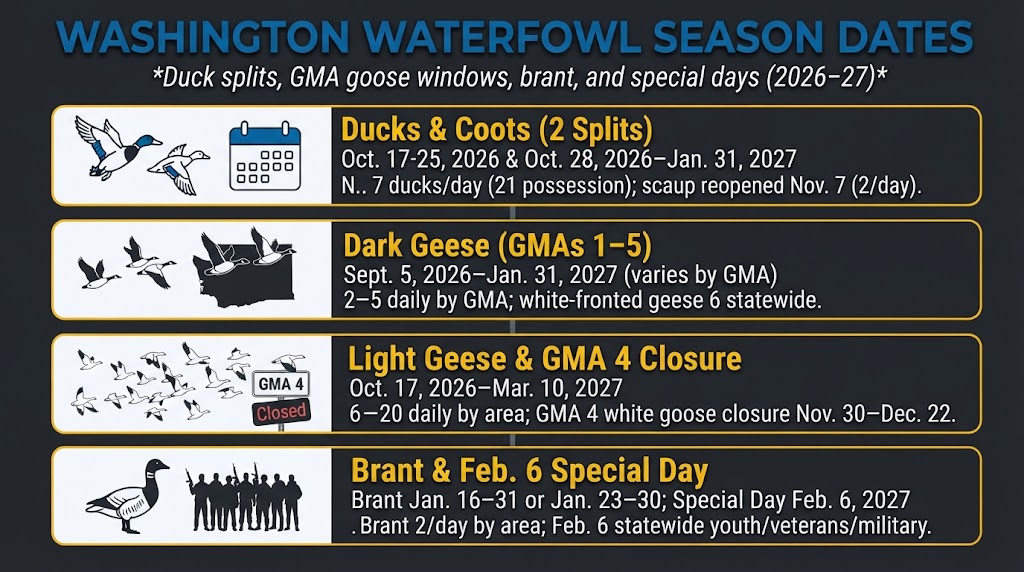
The 2026–27 duck and coot season runs in two splits: Oct 17–25, 2026, and Oct 28, 2026–Jan 31, 2027. Scaup were closed Oct 17–Nov 6, 2026, and have been open again since Nov 7.
The daily bag is your per-day cap. Possession is the total you can have on hand, which for ducks is three times the daily bag, or 21. Your daily bag of 7 ducks can include no more than:
- 2 hen mallards
- 3 pintails
- 2 scaup
- 2 canvasbacks
- 2 redheads
In Western Washington, hunters may also take up to 3 scoter, 2 long-tailed duck, and 3 goldeneye. You need the sea duck harvest record card for those species. Harlequin duck is closed statewide except by special draw permit.
Late-season duck hunting from December to January rewards hunters who scout and adjust. Tips are in the section below.
Goose Seasons: Dark and Light Geese
Goose Management Areas (GMAs 1–5) are geographic zones with different goose limits and closures. Know your GMA before you load a shell.
Dark geese run Sept 5, 2026–Jan 31, 2027, with a daily bag of 2 to 5 depending on the GMA. White-fronted geese are 6 statewide. For context, the September Canada goose segment ran Sept 5–13 (Eastern Washington Sept 5–6), with a 5-bird daily bag and a possession limit of 15. For the other segment dates in your area, check the GMA-specific dates in the WDFW pamphlet.
Light (snow) geese run Oct 17, 2026–Mar 10, 2027, with a daily bag of 6 to 20 depending on the area. The GMA 4 white goose closure runs Nov 30–Dec 22, 2026. During the closure you can shift your effort to ducks or other GMAs, then return Dec 23.
Brant & Special Youth/Veteran/Military Days
Brant season runs January 16–31 or January 23–30, 2027, depending on area, with a 2-bird daily bag. Check the specific areas in the WDFW pamphlet before you plan a trip.
The 2026 youth-only days were Sept 26 (Western WA) and Oct 3 (Eastern WA), as listed in WDFW’s 2026 hunting bulletin. The next one is the statewide youth, veterans, and active military day: Feb 6, 2027.
Mentors and parents should plan now, since licenses and hunter education take time and classes fill up. Always verify with WDFW before hunting.
Washington Waterfowl Licenses and Permits
Licensing works as a stack. Build it in this order:
- Complete hunter education if you were born after Jan 1, 1972. See the Washington hunter education requirements.
- Buy a Small Game License.
- Add the Migratory Bird Permit and complete your HIP/migratory bird authorization.
- Buy and sign the Federal Duck Stamp (ages 16 and older).
- Add the sea duck harvest record card if you hunt scoter, long-tailed duck, or goldeneye in Western Washington.
Washington Hunting Licenses
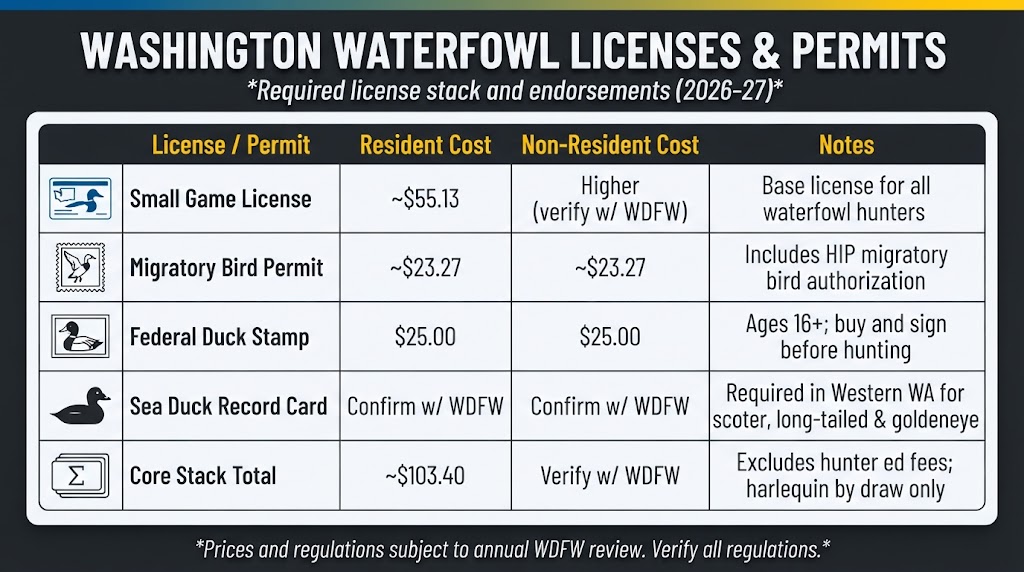
| License/Permit | Who Needs It | Cost | Where to Buy |
|---|---|---|---|
| Small Game License | All waterfowl hunters | ~$55.13 resident; non-resident: higher, verify with WDFW | WDFW licensing system/dealers |
| Migratory Bird Permit | Waterfowl hunters | ~$23.27 | WDFW |
| Federal Duck Stamp | Hunters 16+ | $25.00 | Post office, dealers, online |
| HIP / migratory bird authorization | Waterfowl hunters | Included with purchase; confirm with WDFW | WDFW |
| Sea duck harvest record card | Western WA scoter, long-tailed duck, and goldeneye hunters | Confirm with WDFW | WDFW |
| Harlequin permit | Drawn applicants only | Draw only | WDFW draw |
The Small Game License is the base license. Our Washington small game hunting guide has more on how it works.
Non-resident note: Non-resident small game pricing is higher than resident pricing, so confirm the exact amount in WDFW’s licensing system. The duck stamp and Migratory Bird Permit prices still apply.
For residents, the core stack comes to about $103.40 ($55.13 + $23.27 + $25), not counting hunter education course fees. Always verify with WDFW before you buy.
Washington Hunting Permits
Each permit covers something different:
- Migratory Bird Permit: the state endorsement required to hunt migratory birds.
- HIP (Harvest Information Program): a federal harvest survey you register for at the time of purchase.
- Sea duck harvest record card: required in Western Washington for scoter, long-tailed duck, and goldeneye, and you must physically carry it.
- Harlequin duck permit: to apply, you need a valid small game license, migratory bird permit, and migratory bird authorization. If you’re drawn, you must obtain the mandatory harvest report card, and the limit is one bird per season.
Non-toxic shot (steel, bismuth, or tungsten) is required for all waterfowl, per WDFW non-toxic shot guidance.
For updates and questions, call WDFW at 360-902-2200. Always verify with WDFW before hunting.
Washington Waterfowl Where to Hunt
Washington has strong public options, but pressure builds as the season goes on. When the crowds get thick, Washington hunting leases offer a quieter alternative.
Best Public Lands
These well-known waterfowl regions are good places to start scouting:
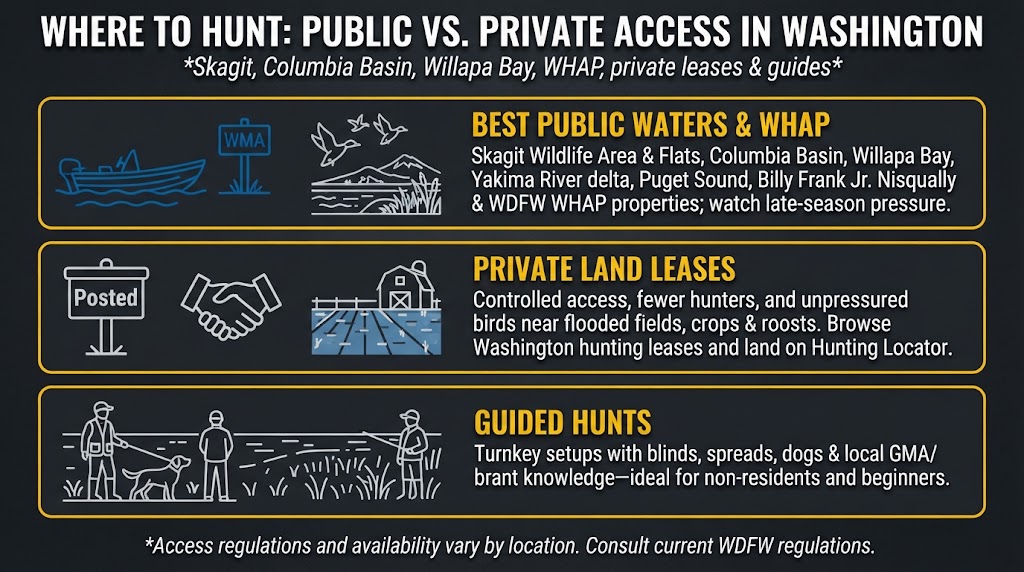
- Skagit Wildlife Area and Skagit Flats: flooded fields and estuaries that draw ducks and snow geese.
- Columbia Basin: a major waterfowl region with agricultural fields and wetlands.
- Willapa Bay: a coastal setting and the right context for brant season.
- Yakima River delta: river-delta habitat that holds migrating birds.
- Puget Sound estuaries: tidal flats and bays along the sound.
- Billy Frank Jr. Nisqually refuge: refuge-specific rules apply, so read them before you go.
- WDFW Waterfowl Habitat and Access Program (WHAP) properties: private land opened to hunters through WDFW habitat partnerships.
By late season, pressured birds and crowded parking lots are common, and private access can change how a hunt goes.
Private Land Hunting with Hunting Locator
A private lease gives you controlled access, fewer hunters, birds that haven’t been worked by a different crowd every morning, and the chance to learn one property across the whole season.
Leases range from single-season agreements to multi-year arrangements. When you evaluate a property, look at:
- Water sources and flooding potential
- Field crops that draw feeding birds
- Proximity to roosts
- Access rules and parking
- Liability terms and landowner expectations
Buying land is the permanent solution to access problems. If you’re shopping, look for wetlands, the ability to hold water, and agricultural fields that birds already use.
Hunting Locator connects you directly with landowners who lease or sell hunting land, and you can search by state, game type, and acreage. The platform also lists outfitters and guides, and it gives landowners a way to post property and connect with qualified hunters.
Browse Washington leases and land for sale before the late-season window closes. Listings change often, so check the page for current properties, acreage, and species.
Guided Hunts
A guide is a turnkey option for non-residents and beginners, since you skip the scouting, the gear logistics, and the guesswork about where birds are working.
Use this checklist when you choose a Washington waterfowl guide:
- Licensing and insurance: confirm they’re properly licensed and insured.
- Species and areas: ask which GMAs they hunt and whether they offer brant access.
- What’s included: find out about meals, lodging, and transportation.
- Blind and decoy setup: ask who handles setup and what the spread looks like.
- Dog work: ask whether retrievers are part of the hunt.
- Bird processing: ask whether they clean and bag your birds.
- Permits for your target species: make sure they hold what’s needed for the birds you want.
You can browse guided hunt listings on Hunting Locator’s Washington page to compare options and contact professionals directly.
Washington Waterfowl Hunting Tips
Access is only part of it. These tips help you make the most of it, and you can stock up on waterfowl gear from our store before your next hunt.
- Scout before you hunt: Find the feeding fields and roosts first, and set up where birds already want to be.
- Hunt the weather fronts: Cold fronts push fresh birds in, so watch the forecast and hunt the days after a change.
- Conceal everything: Waterfowl have excellent eyesight, so any gear worn facing out should be camouflage.
- Shrink the spread late: Use fewer, more realistic decoys for pressured birds. Check the store for decoy options.
- Stay dry and warm: Quality waders and layers keep you in the blind longer. Browse waders and cold-weather layers in the store.
- Call less late in the season: Educated birds have heard it all, so go soft and sparing. Find calls in the store.
- Carry legal non-toxic shells: Steel, bismuth, or tungsten are required for all waterfowl. Shop shotshells in the store.
- Know your birds: With caps on hen mallards, pintails, and scaup, species identification matters.
- Beginners, go with a mentor: Hunt alongside an experienced partner, or book a guide for your first outings.
More Resources from Hunting Locator
Keep planning your Washington season with these pages, grouped by topic.
Statewide Planning
- Washington hunting season guide: the big-picture look at seasons across species.
- Washington hunting leases: browse private land leases and land for sale.
Bird Seasons
- Washington waterfowl hunting season: a companion page on waterfowl hunting in the state.
- Small game: the base license and the other small game you can pursue.
- Turkey: spring and fall turkey details.
Big Game
- Deer: seasons and planning for Washington deer.
- Elk: elk hunting information for the state.
- Moose: moose hunting in Washington.
Predators & Bear
- Black bear: black bear seasons and basics.
- Cougar: cougar hunting information.
Once-in-a-Lifetime Draws
- Mountain goat: the draw-only mountain goat hunt.
- Bighorn sheep: the draw-only bighorn sheep hunt.
FAQ
What do I need to duck hunt in Washington?
You need hunter education if you were born after Jan 1, 1972, plus a Small Game License, a Migratory Bird Permit with HIP authorization, and a Federal Duck Stamp if you’re 16 or older. Western Washington sea duck hunters also need the harvest record card. Confirm everything with WDFW.
When is the Washington duck season for 2026–2027?
Ducks run Oct 17–25, 2026, and Oct 28, 2026–Jan 31, 2027, per WAC 220-416-060. Scaup were closed Oct 17–Nov 6, 2026, and reopened Nov 7. Coots follow the same dates as ducks. Always verify with WDFW before you hunt.
When does the GMA 4 white goose closure start?
The white goose closure in Goose Management Area 4 runs Nov 30–Dec 22, 2026. Light geese stay open elsewhere through Mar 10, 2027. Hunt ducks or other areas during the closure, then return to GMA 4 white geese on Dec 23.
When is the Washington youth waterfowl day in 2027?
The statewide youth, veterans, and active military day is Feb 6, 2027. The 2026 youth-only days were Sept 26 in Western Washington and Oct 3 in Eastern Washington. Licenses and hunter education take time, so mentors and parents should plan early.
Can non-residents hunt waterfowl in Washington?
Yes, non-residents can hunt Washington waterfowl with the same license stack residents use. Non-resident license pricing is higher, so verify current costs with WDFW. Non-residents also need the Federal Duck Stamp and must meet the HIP requirement.
What is the daily duck bag limit in Washington?
The daily bag is 7 ducks, with no more than 2 hen mallards, 3 pintails, 2 scaup, 2 canvasbacks, and 2 redheads. Western Washington adds caps of 3 scoter, 2 long-tailed duck, and 3 goldeneye. The possession limit is 21.
When is brant season in Washington?
Brant season runs Jan 16–31 or Jan 23–30, 2027, depending on the area, with a 2-bird daily bag. Check the WDFW pamphlet for the specific areas that apply, and confirm your licenses and authorizations before you head to the coast.
Do I need non-toxic shot for waterfowl in Washington?
Yes, non-toxic shot is required for all waterfowl hunting in Washington. Steel, bismuth, and tungsten blends all qualify. Lead is not legal for waterfowl, so check your shells before you leave the truck.
How do I avoid crowded public land for duck hunting in Washington?
Try WHAP properties, hunt weekdays when pressure drops, or secure a private lease through the Washington leases page. A lease gives you controlled access and birds that aren’t hammered by a new crowd every day.
The Final Shot
Ten weeks of duck hunting remain. Light geese run into March, brant opens in January, and the statewide special day falls on Feb 6. There is still plenty of good hunting left this season for anyone who plans it well.
To make the most of it:
- Confirm dates with WDFW. Check the pamphlet for your GMA and species.
- Complete your license stack. Hunter ed, Small Game License, Migratory Bird Permit, HIP, and Duck Stamp.
- Secure access. Public land, a lease, or a guide, depending on your plans.
If you’re planning the rest of your year, our deer and elk season guides are next. To line up late-season or next-season access, search private leases, land for sale, and guides on Hunting Locator. Always verify with WDFW before hunting.


