Knowing the calendar is only half the job — you also need a plan for where you’ll actually have room to hunt.
This Wisconsin small game guide pulls together the confirmed season dates, license fees, and access options for the 2026–2027 small game seasons, based on the Wisconsin DNR’s current framework. Before getting into the dates, it’s worth sorting out your gear for the season — browse Wisconsin hunting gear while you plan, so equipment isn’t a last-minute scramble.
Here’s what this guide covers:
- Season dates and bag limits by species and zone — squirrel, rabbit, grouse, pheasant, crow, coyote, and the no-limit species, all in one reference table.
- Resident and nonresident licenses, permits, and hunter education — what you need, what it costs, and how to buy it before the season opens.
- Where to legally hunt — public land, leased private ground through Hunting Locator, and guided hunt options.
Whether you’re a lifelong Wisconsin resident chasing squirrels every fall or planning your first small game trip from out of state, this guide should get you ready. Start with the quick reference below.
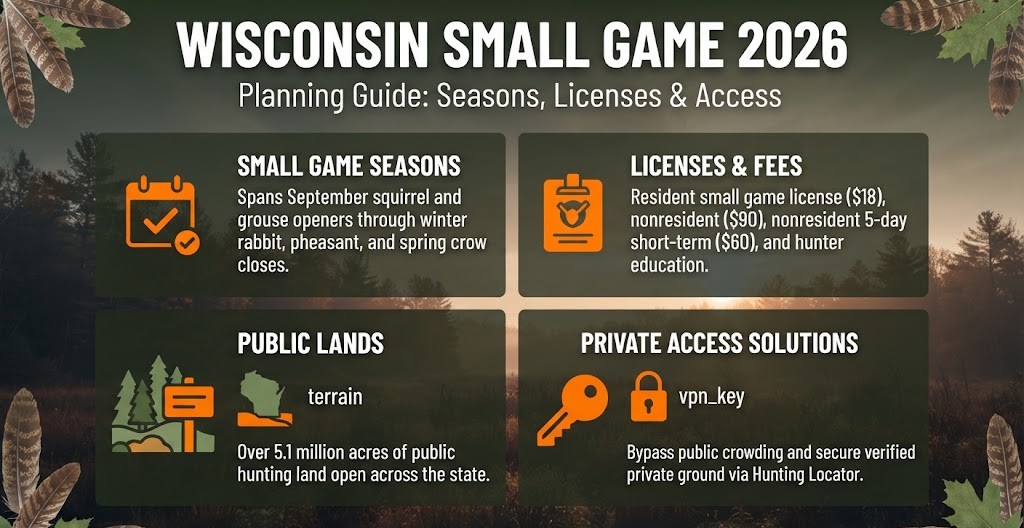
Quick Overview: Wisconsin Small Game Seasons at a Glance
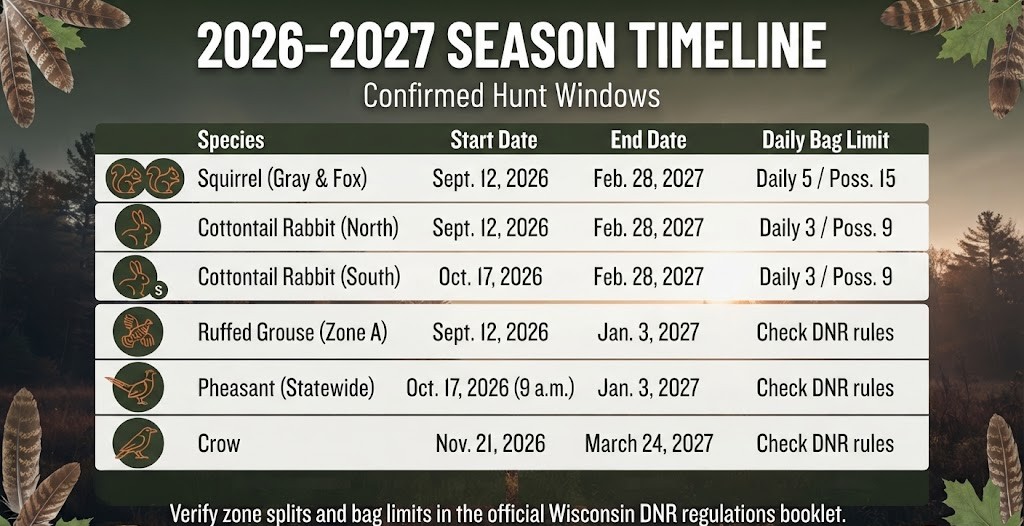
The table below covers every 2026–2027 Wisconsin small game season, bag limit, and key note. These figures reflect the current Wisconsin DNR season dates, but check the official regulations booklet before you head out — fine print can change.
Wisconsin splits several seasons by geography. Cottontail rabbit runs on a Northern Zone/Southern Zone split, and ruffed grouse runs on a Zone A/Zone B split. Confirm your zone before planning an opener.
| Species | Season Dates | Bag Limit | Notes |
|---|---|---|---|
| Squirrel (Gray & Fox) | Sept. 12, 2026 – Feb. 28, 2027 | Daily 5 / Possession 15 | Statewide, no zone split |
| Cottontail Rabbit | Northern Zone: Sept. 12, 2026 – Feb. 28, 2027; Southern Zone: Oct. 17, 2026 – Feb. 28, 2027 | Daily 3 / Possession 9 | Zone-dependent opener |
| Ruffed Grouse | Zone A: Sept. 12, 2026 – Jan. 3, 2027; Zone B: Oct. 17 – Dec. 8, 2026 | Confirm current daily limit in the DNR regulations booklet | Zone-dependent opener |
| Pheasant | Statewide, Oct. 17, 2026 (opens 9 a.m.) – Jan. 3, 2027 | Confirm current daily limit in the DNR regulations booklet | 9 a.m. opener statewide |
| Crow | Statewide, Nov. 21, 2026 – March 24, 2027 | Confirm current daily limit in the DNR regulations booklet | Late-season/spring window |
| Coyote | Open year-round | No specific limit; valid license required | Different shooting hours may apply |
| Snowshoe Hare, Woodchuck, Weasel, Porcupine, Opossum, Skunk | No season limits | No bag limits | Hunting license still required |
This guide covers small game hunting broadly, including the categories on the official DNR small game page — upland game birds, small game mammals, and furbearers. Check the specific rules for your target species rather than relying on the category alone.
A few eligibility basics apply across the board:
- Hunting license required — even for year-round species like coyote and snowshoe hare, and even on land you personally own.
- Hunter education — required for eligibility, and Wisconsin accepts certification earned in any U.S. state or Canadian province.
- Shooting hours — most small game runs ½ hour before sunrise to 20 minutes after sunset from September 1 through March 31, though coyote and a few other species follow different rules.
- Verify before you hunt — the DNR updates its combined regulations booklet every June/July, so a check closer to your hunt date is worth the few minutes it takes.
For a deeper species-by-species breakdown, see our Wisconsin small game breakdown.
Wisconsin Small Game Hunting Seasons by Species
Dates and limits vary by species and, for a couple of them, by zone. Confirm your zone before planning your opener.
Squirrel Season (Gray & Fox)
Squirrel season runs statewide from September 12, 2026, through February 28, 2027, with a daily bag limit of 5 and a possession limit of 15. There’s no zone split, which makes it one of the simpler seasons to plan around, and the long window makes it a reasonable entry point if you’re newer to small game hunting.
Cottontail Rabbit Season
Cottontail rabbit hunting splits into two zones with different openers. The Northern Zone runs September 12, 2026, through February 28, 2027. The Southern Zone opens later, running October 17, 2026, through February 28, 2027. The daily bag limit is 3, with a possession limit of 9. Getting your zone right matters most on opening day — hunting the wrong calendar means you could be out before your season legally starts.
Ruffed Grouse Season
Ruffed grouse also runs on a two-zone system. Zone A opens September 12, 2026, and runs through January 3, 2027, covering much of the state’s northern forest country. Zone B runs a shorter window, October 17 through December 8, 2026. Daily bag limits can shift year to year, so confirm the current number in the DNR regulations booklet before heading out.
Pheasant Season
Pheasant season opens statewide on October 17, 2026, at 9 a.m., and runs through January 3, 2027. The 9 a.m. opener matters if you’re planning a trip around opening day specifically — it’s not a sunrise start like most other seasons. As with grouse, confirm the current bag limit in the DNR regulations booklet.
Crow Season
Crow season runs statewide from November 21, 2026, through March 24, 2027. It’s a late-season option that extends well into spring, giving you an opportunity long after most other small game seasons have closed.
Coyote (Year-Round)
Coyote hunting is open year-round in Wisconsin with a valid hunting license, with no closed season to work around. Shooting-hour rules for coyote can differ from other small game, so check before heading out at odd hours.
No-Limit Species: Hare, Woodchuck, Weasel, Porcupine, Opossum & Skunk
Six species carry no season restrictions and no bag limits: snowshoe hare, woodchuck, weasel, porcupine, opossum, and skunk. Snowshoe hare, in particular, is effectively a year-round pursuit. No bag limit doesn’t mean no license, though — you still need a valid Wisconsin hunting license to pursue any of these.
Wisconsin Small Game Licenses and Permits
Costs differ significantly depending on whether you’re a Wisconsin resident or coming in from out of state.
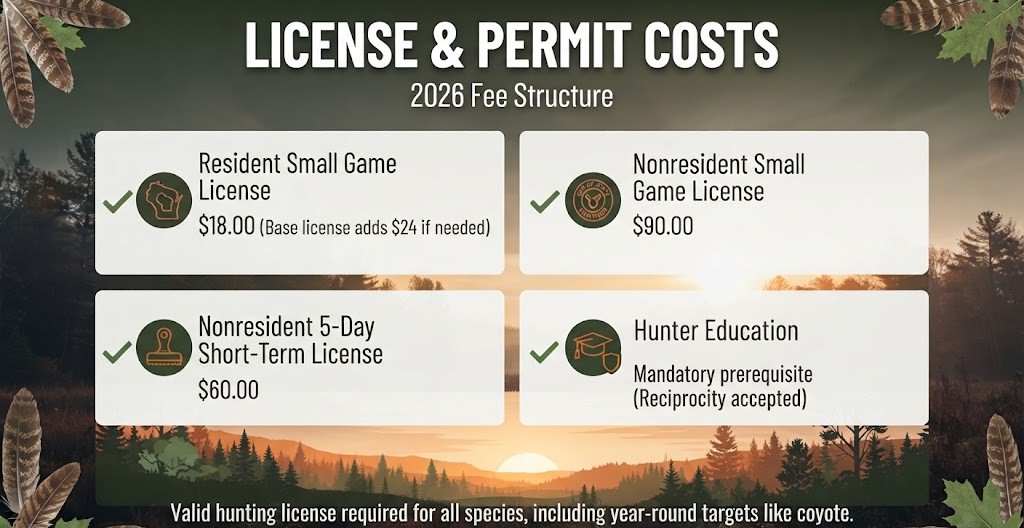
Wisconsin Hunting Licenses
| License Type | Who It’s For | Cost |
|---|---|---|
| Resident Small Game License | Wisconsin residents | $18 |
| Resident Base License | Residents who don’t already hold one | Typically $24 |
| Nonresident Small Game License | Out-of-state hunters | $90 |
| Nonresident 5-Day Short-Term | Out-of-state hunters on a short trip | $60 |
The $18 resident small game license is separate from the resident base license — if you don’t already hold a base license, budget for the additional $24. For nonresidents planning a quick trip rather than a full season, the $60 five-day short-term option covers a focused hunt without the cost of the full $90 season license.
Wisconsin Hunting Permits & How to Buy
Getting legal to hunt in Wisconsin comes down to a few requirements:
- What you need — a valid government-issued ID and proof of hunter education certification, which Wisconsin accepts from any U.S. state or Canadian province.
- Where to buy — licenses are available online through the official Wisconsin licensing system, typically issued immediately after purchase.
- Verify requirements — check the DNR regulations booklet for any species-specific stamps or additional permits that might apply to your hunt.
Nonresidents don’t need to redo hunter education — certification from your home state carries over.
Where to Hunt Small Game in Wisconsin
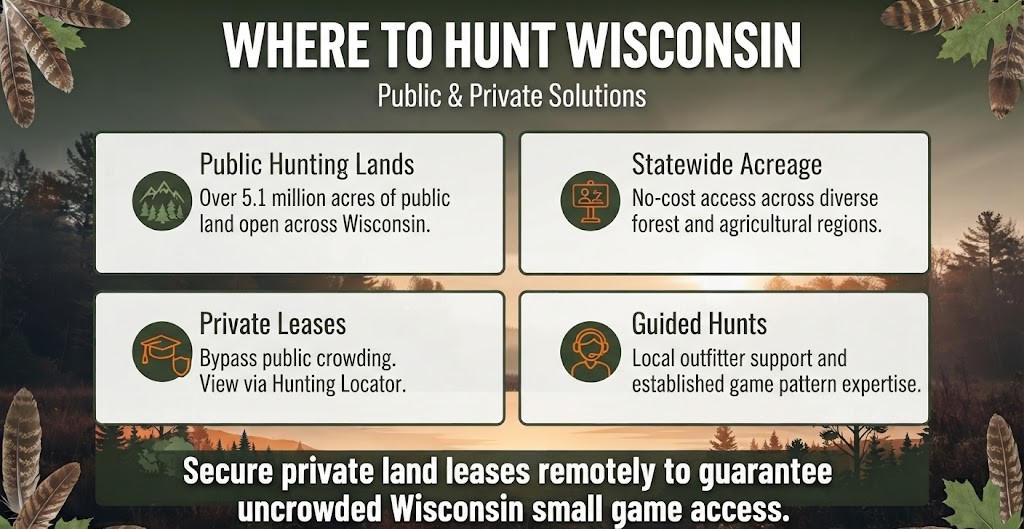
Once you know when you can hunt and confirm you’re legally set up to do it, the question becomes where. There are three main paths: free public land, leased private ground, and guided hunts, and each fits a different situation.
Best Public Hunting Lands
Wisconsin offers more than 5.1 million acres of public hunting land, covering species from squirrel and rabbit to deer, turkey, and waterfowl. It’s a solid, no-cost starting point, especially if you’re new to the state or building your first season.
- Abundant acreage statewide — millions of acres open to public hunting across the state, giving you options in nearly every region.
- Free access — no lease fees or land purchase required, making it the most budget-friendly path.
- Crowded on opening weekend — popular public tracts fill up fast during peak openers like squirrel and grouse season.
- Limited amenities — public land typically lacks the facilities, cover, and privacy that come with private ground.
Public land is a solid option, but the crowding on opening weekend is real, which is why more hunters look at private access as an alternative.
Private Land Hunting with Hunting Locator
Fighting crowds on public land opening weekend, or not knowing a single landowner willing to give you permission, is a common frustration. Private land solves that directly, giving you a crowd-free spot instead of sharing the woods with a dozen other hunters.
There are two main paths: lease private ground for the season, or buy land outright for long-term access you control completely. Leasing gives you flexibility and a lower upfront cost, while buying suits hunters who want a permanent home base. Pricing for leases varies by landowner, acreage, game type, amenities, and season, so it’s worth comparing a range of options before committing.
This is where the Hunting Locator platform comes in. It’s a marketplace that connects you directly with landowners across Wisconsin who are ready to lease or sell their hunting ground, without cold calls or door-knocking. Browse listings, compare what’s available, and find ground that matches your species, budget, and season. To start, see Wisconsin hunting leases for what’s currently available near you.
Guided Small Game Hunts
If you’re short on time or new to a region, a guided hunt can bridge the gap. Guides know where birds and small game are actually moving and typically bring established land access, which means less scouting and more time hunting.
- Local expertise — guides know the terrain, the game patterns, and the timing better than a first-time visitor.
- Built-in land access — no need to secure your own ground before the trip.
Guided hunts suit nonresidents on a short trip or new hunters who want a smoother introduction to the sport. If a guided option isn’t available for your dates or budget, browsing Wisconsin hunting leases is a reasonable way to secure your own access instead.
Small Game Hunting Tips (and the Gear That Helps)
Success in the field usually comes down to timing, quiet movement, and having the right gear ready before you need it.
- Hunt the calm hours — early morning and late afternoon tend to be prime windows for squirrel and rabbit activity.
- Move slow, glass often — small game rewards patience over ground covered; rushing through cover costs you more shots than it earns.
- Match your firearm to the quarry — a .22 rimfire suits squirrel hunting well, while a light shotgun handles grouse and pheasant more effectively.
- Dress for the zone and season — late-season crow and rabbit hunts demand more layers than an early-September squirrel opener.
- Know your shooting hours — most species run ½ hour before sunrise to 20 minutes after sunset, so plan your mornings and evenings accordingly.
- Scout your access early — especially on leased ground, so opening day runs smoothly instead of starting with confusion over boundaries.
Sorting out your gear ahead of time makes all of this easier. Appropriate layers, a reliable optic, and field-ready boots can be the difference between a comfortable, productive day afield and one cut short by preventable problems.
More Resources from Hunting Locator
Planning more than just small game this year? Here’s where to go next for other Wisconsin seasons and land access.
- Wisconsin hunting guide — a broad, all-species overview of hunting opportunities across the state.
- Wisconsin whitetail deer season — dates and rules for the state’s marquee big-game hunt.
- Wisconsin bear hunting season — season framework and permit notes for bear hunters.
- Wisconsin waterfowl season — duck and goose dates plus stamp requirements.
- Wisconsin small game deep dive — a companion breakdown covering this same topic in additional detail.
- Wisconsin bobcat season — another furbearer option worth adding to your season plans.
- Wisconsin turkey season — spring and fall turkey planning in one place.
- Browse Wisconsin hunting leases — the core lease inventory for finding your next piece of ground.
Frequently Asked Questions
When does Wisconsin squirrel season open in 2026?
Squirrel season runs statewide from September 12, 2026, through February 28, 2027, with a daily bag limit of 5 and a possession limit of 15. It’s one of the longest small game seasons in the state and doesn’t require tracking a zone split.
How much is a Wisconsin resident small game license?
A resident small game license costs $18. If you don’t already hold a resident base license, expect to add another $24 for that. Verify current fees with the DNR before purchasing, since pricing can be updated annually.
What does a nonresident Wisconsin small game license cost?
A full nonresident small game license runs $90, while a 5-day short-term option is available for $60 — a reasonable fit if you’re planning a quick trip rather than a full season. You’ll need a valid ID and proof of hunter education certification to purchase either.
What are the Wisconsin cottontail rabbit season zone dates?
The Northern Zone runs September 12, 2026, through February 28, 2027, while the Southern Zone opens later, running October 17, 2026, through February 28, 2027. The daily bag limit is 3, with a possession limit of 9. Confirm your zone before planning your opening day.
Is coyote hunting open year-round in Wisconsin?
Yes. Coyote hunting is open year-round in Wisconsin with a valid hunting license. Different shooting-hour rules can apply to coyote compared to other small game species, so check before an early or late outing.
How do I find private land to hunt small game in Wisconsin?
Hunting Locator connects you directly with landowners offering crowd-free leased or for-sale hunting ground across the state. Browse current Wisconsin hunting leases to see what’s available and narrow down options that fit your species and budget.
The Final Shot
Between confirmed season dates by species and zone, resident licensing at $18 and nonresident options at $90 (or $60 for a five-day trip), and three paths to legal ground, you should have what you need to plan your season. This guide covers the essentials, but regulations shift from year to year, so check the official WI DNR regulations booklet closer to your hunt date — it’s updated every June/July and remains the final word on any detail that matters.
When you’re ready to move past public-land crowds and secure your own piece of Wisconsin for the season, browse Wisconsin hunting leases and get your gear sorted while there’s still time before opening day.


