The Arizona Game and Fish Department puts it bluntly: hunting bison on the Kaibab Plateau is “very different than any other big game hunt in Arizona.”
This isn’t your typical Arizona hunt. You’ll need to attend mandatory clinics, study official packets, and prepare for an experience that can test you both mentally and physically. But here’s the thing—it’s also one of the most rewarding hunting experiences North America has to offer.
We’ve pulled together everything you need to know for the 2026 spring season: official regulations, costs that’ll make your wallet wince, and the real-world strategies that separate successful hunters from those who go home empty-handed.
What you’ll find in this guide:
- Season dates, bag limits, and unit breakdowns for spring 2026
- The full financial picture (spoiler: it’s expensive, especially for non-residents)
- Where your best chances lie, from the Kaibab Plateau to managed wildlife areas
Let’s dive into the details.
Quick Overview
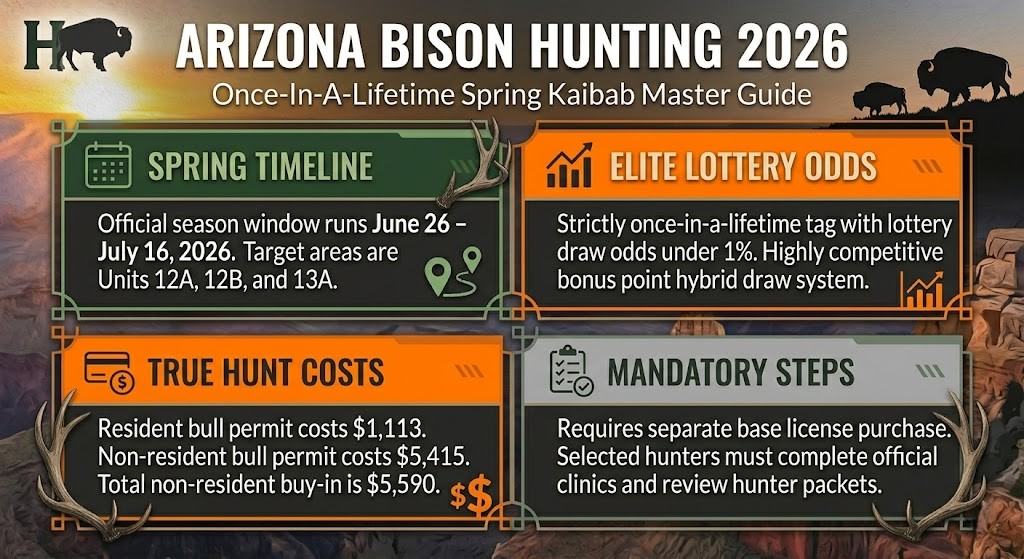
Here’s everything you need to know about Arizona’s 2026 spring bison season at a glance:
| Element | Details |
|---|---|
| Season Dates | June 26 – July 16, 2026 |
| Hunt Units | 12A (excluding House Rock Wildlife Area closure), 12B, 13A |
| Bag Limit | Bull bison only |
| Permits Available | 20 total |
| Hunt Numbers | 3, 114, 115, 116, 160 |
| Tag Type | Once-in-a-lifetime |
| Application Deadline | Early June 2026 (exact date TBD by AZGFD) |
| Resident Tag Cost | $1,113 |
| Non-Resident Tag Cost | $5,415 (bull) |
Before you can even think about applying, you’ll need to check these boxes:
- Valid Arizona hunting or combination license ($37 resident / $160 non-resident)
- Bison permit-tag fee only gets charged if you actually draw
- Hunter education isn’t required but completing it earns you a permanent bonus point
- Mandatory AZGFD hunter packet and clinic attendance for Kaibab Plateau hunts
- Remember: this is once-in-a-lifetime. You get one shot at harvesting a bison in Arizona, ever.
Arizona Bison Hunting Seasons
Arizona splits its bison hunting into three completely different experiences. Spring 2026 focuses on the Kaibab Plateau—the most challenging and rewarding option available. If you’re planning other Arizona hunts, our Arizona hunting seasons overview covers the complete calendar.
Spring 2026 Season: Kaibab Plateau (Units 12A, 12B, 13A)
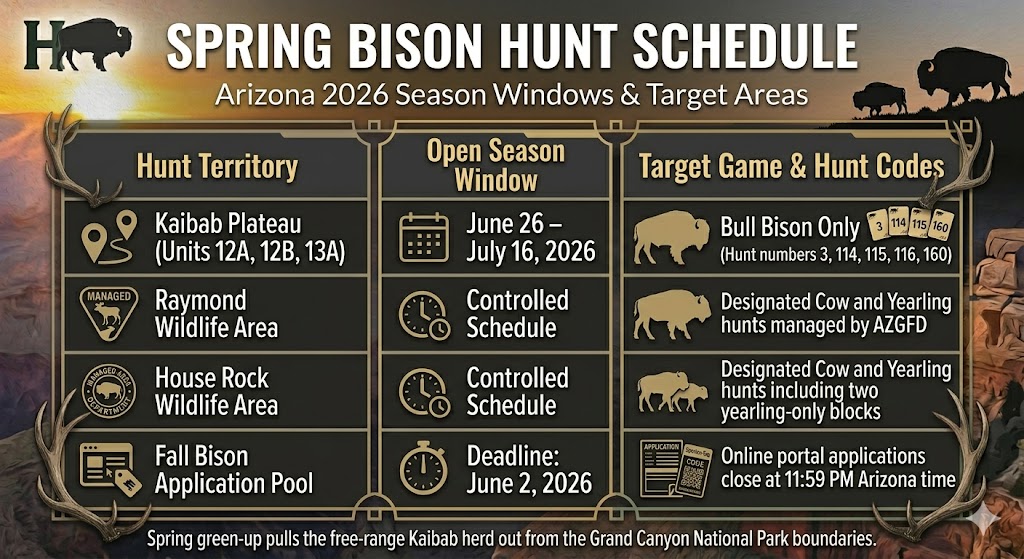
Mark your calendar: June 26 through July 16, 2026. You’re hunting Units 12A (minus the closed section in House Rock Wildlife Area), 12B, and 13A. AZGFD is issuing 20 bull-only permits spread across hunt numbers 3, 114, 115, 116, and 160.
Here’s what makes this hunt special—and difficult. The Kaibab Plateau herd lives mostly inside Grand Canyon National Park, only venturing outside when they need water or better forage. You can’t hunt inside the park, so you’re waiting for them to cross that invisible line.
Spring timing works in your favor. As spring green-up starts, bison are venturing out more and more from the park. The warming weather and new growth pull them toward huntable areas more frequently than during fall hunts.
Weather on the Kaibab Plateau during spring? Unpredictable doesn’t begin to cover it. Springtime brings warming temperatures and diminishing snowfall, leading to blooming wildflowers and increased wildlife activity, but weather can be unpredictable with sudden changes. Pack for everything from snow to heat waves.
If you draw, you’ll get a mandatory hunter packet with water and salt location maps. Study it like your success depends on it—because it does.
Raymond and House Rock Wildlife Area Hunts
These hunts couldn’t be more different from the Kaibab Plateau experience. Both Raymond and House Rock Wildlife Areas have hunts for designated cow and yearling bison, with House Rock adding two designated yearling bison hunts.
The big advantage here? Reliability. These hunts are as guaranteed as they can get, very controlled and typically one-day hunts. You’re hunting within managed boundaries with AZGFD personnel available to help if needed.
It’s a completely different experience from free-range hunting, but for hunters who want meat in the freezer with minimal uncertainty, these controlled hunts deliver.
Arizona Bison Licenses and Permits
Arizona’s cost structure hits you twice: first with the hunting license (required just to apply), then with the permit-tag fee (only if you draw). Here’s the breakdown from official AZGFD sources.
Arizona Hunting Licenses
You can’t even apply without a valid Arizona hunting or combination license. Your license must be valid on the last day of the application period.
| License Type | Resident Cost | Non-Resident Cost |
|---|---|---|
| General Hunting License | $37 | $160 |
| Combination Hunt and Fish | Contact AZGFD for current pricing | Contact AZGFD for current pricing |
Key points about licenses:
- License fee is gone whether you draw or not
- You need a license even if you’re just buying bonus points
- AZGFD portal account required (free to set up)
- Hunters 10 years and older need valid license
Arizona Bison Permit-Tags
Here’s where it gets expensive. Permit-tag fees only hit your credit card if you actually draw—but when they do, they hit hard.
| Hunt Type | Resident Cost | Non-Resident Cost |
|---|---|---|
| Any/Bull Bison | $1,113 | $5,415 |
| Cow/Yearling Bison | $1,113 | $3,250 |
| Yearling-Only Bison | $1,113 | $1,750 |
Don’t forget application fees: $15 per species for non-residents, $13 per species for residents. These get charged whether you draw or strike out.
For non-residents chasing a bull tag, you’re looking at $160 (license) + $15 (application) + $5,415 (if drawn) = $5,590 total investment. And remember—this is once-in-a-lifetime. You may harvest no more than one bison in Arizona in your lifetime.
Arizona runs two separate bison application periods. The big game online application deadline for sheep, fall bison, and deer is 11:59 p.m. Arizona time on June 2, 2026, while spring bison applications typically happen in September/October.
Arizona’s bonus point system is both a blessing and a curse. Arizona uses a bonus point hybrid draw where 20% of permits go to applicants with the most points, and the remaining 80% are randomly allocated with weight given to bonus points. Completing hunter education earns one permanent bonus point for all species. But here’s reality: some applicants are sitting on 57+ bonus points and still haven’t drawn.
Nonresidents get up to 10% of total statewide bison permits and no more than 50% per hunt code. Translation: this is a marathon, not a sprint.
Arizona Bison: Where to Hunt
Arizona’s bison hunting happens in three distinct areas, each offering completely different experiences. The Kaibab Plateau provides the ultimate challenge for spring 2026 bull hunters, while Raymond and House Rock Wildlife Areas offer more predictable controlled hunts.
Best Public Lands
Most Arizona bison hunting takes place on public lands managed by AZGFD and the Kaibab National Forest. The twist? Bison spend most of their time in Grand Canyon National Park where you can’t hunt them, only venturing onto huntable land when they need resources.
Here’s where you’ll be hunting:
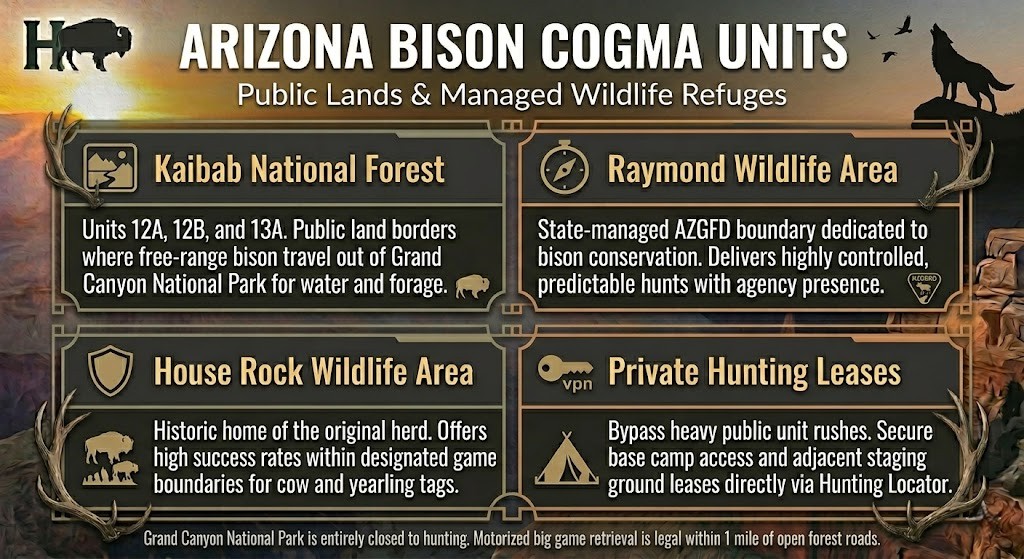
- Kaibab National Forest (Units 12A, 12B, 13A): This is the main event for spring hunts. Bison move between Grand Canyon National Park and forest lands based on water and food availability. Hunter access to the southern end of GMU 12A south of Jacob Lake on Highway 67 is normally available till mid-November or until snow closes it. AZGFD provides detailed water and salt location maps in your mandatory hunter packet.
- House Rock Wildlife Area: The original home of the House Rock herd, which now lives primarily within Grand Canyon National Park. This managed AZGFD wildlife area offers controlled cow and yearling hunts with high success rates.
- Raymond Wildlife Area: One of two AZGFD wildlife areas primarily dedicated to bison conservation and management. Similar controlled hunt structure to House Rock, where you work with AZGFD personnel within managed boundaries.
The Kaibab National Forest allows motorized big game retrieval of legally taken bison within one mile of an open road (one vehicle, one trip in and out), except in wilderness areas. This includes meadows along Highway 67—crucial for getting 1,200 pounds of meat out of the woods.
Guided Hunts and Outfitters
For Kaibab Plateau hunts, seriously consider hiring a guide. A guide will improve your chances of harvesting if you draw a permit on the Kaibab Plateau area.
Professional guides bring essential services:
- Knowledge of water sources and salt locations that drive bison movement
- Ground blind setups and strategic positioning near park boundaries
- Help with field dressing 900-1,200 pounds of meat
- Trophy care and taxidermy prep expertise
- Local weather and terrain insights you can’t get from books
Starting with Fall 2021 hunts, Raymond and House Rock Wildlife Area hunts no longer require mandatory AZGFD assistance—you can hunt independently after the mandatory morning meeting, though department help remains available.
Private Land Hunting with Hunting Locator
Arizona bison hunting happens almost exclusively on public lands and AZGFD wildlife areas. However, private land access can provide valuable scouting opportunities and hunting access for other species while you’re building points for bison.
For hunters interested in private land opportunities in Arizona—whether for bison-adjacent scouting or other big game species—Hunting Locator’s Arizona lease listings connect you directly with landowners offering hunting access.
Hunting Locator cuts through the hassle of finding quality hunting land. Our platform connects hunters directly with landowners willing to lease or sell hunting access across Arizona. With thousands of verified properties, detailed maps, and direct landowner contact info, you can secure your next hunting opportunity without the runaround.
Bison Hunting Tips
Arizona bison hunting will test everything you think you know about hunting. Hunting bison on the Kaibab Plateau is very different than any other big game hunt in Arizona. Here’s what actually works:
- Get Serious About Long-Range Shooting: Start practicing your long range shooting now. Bison hunting often means shots across open terrain. If you can’t consistently hit vitals at 300+ yards, you’re not ready.
- Prepare for Marathon Sits: Success requires being prepared to sit in the blind dark to dark. Bison are notoriously difficult to find—prepare for long sits near water in varying conditions. Bring entertainment, snacks, and patience.
- Water Sources Are Everything: Water availability drives bison movement patterns. During spring green-up when bison venture from the park, water sources become critical ambush points.
- Have a Meat Plan Before You Hunt: A mature bison bull weighs 1,500 to 2,000 pounds on the hoof, resulting in roughly 900 to 1,200 pounds of meat plus hide and skull. Line up processing services and figure out transportation logistics before you pull the trigger.
- Study Your Materials: The mandatory AZGFD hunter packet isn’t light reading—it’s your roadmap to success. Both the hunter packet and clinic are essential to review/watch before hunting.
- Get in Shape, Mentally and Physically: These hunts may tax you mentally and physically. Build endurance for long days in challenging terrain and unpredictable weather.
- Consider Team Hunting: Teaming up with other hunters on a single location is encouraged, especially given bison herd behavior to stick around and surround a wounded animal. More eyes and more firepower can mean the difference between success and disappointment.
- Pack for Anything: Spring weather on the Kaibab Plateau changes fast. Layer up for temperature swings and be ready for sudden weather changes at elevation.
More Resources from Hunting Locator
Expand your Arizona hunting knowledge with these comprehensive guides:
- Arizona Elk Hunting Guide – Complete elk hunting strategies and unit recommendations
- Arizona Deer Hunting Seasons – Coues whitetail and mule deer hunting coverage
- Arizona Bear Hunting Season – Spring and fall black bear regulations and techniques
- Arizona Javelina Hunting – Complete javelina hunting strategies
- Arizona Bighorn Sheep Hunting – Once-in-a-lifetime sheep opportunities
- Arizona Pronghorn Hunting – Antelope hunting seasons and strategies
- Arizona Mountain Lion Hunting – Lion hunting regulations and techniques
- Arizona Dove Hunting Guide – Mourning dove and white-winged dove opportunities
- Arizona Upland Game Hunting – Quail, rabbit, and small game info
- Arizona Small Game Seasons – Complete small game calendar
- Hunting Locator Store – Essential gear for Arizona bison hunting success
FAQ
How much does an Arizona bison tag cost for non-residents?
Non-resident Arizona bison tags run $5,415 for any/bull bison, $3,250 for cow/yearling bison, and $1,750 for yearling-only bison. Add in the non-resident hunting license ($160) and application fee ($15), and you’re looking at $5,590 total for a bull tag if you draw.
What are the draw odds for Arizona bison hunting?
Draw odds for all bison hunts are brutal—less than 1% for applicants through 18 bonus points. Some applicants have racked up 57+ bonus points and still haven’t drawn. This is a decades-long commitment.
Can I hunt bison in Grand Canyon National Park?
Absolutely not. Bison hunting is prohibited within Grand Canyon National Park boundaries. The challenge is that the Kaibab Plateau herd primarily lives within Grand Canyon National Park but will come out of the park occasionally to access water and forage on adjacent Kaibab National Forest lands where hunting is legal.
What’s the difference between Arizona’s bison hunting areas?
Arizona offers three completely different experiences: Kaibab Plateau provides challenging free-range bull hunting where bison move between park and forest lands; Raymond and House Rock Wildlife Areas offer controlled cow and yearling hunts that are typically one-day hunts with high success rates.
Do I need a guide for Arizona bison hunting?
Not required everywhere, but a guide will improve your chances of harvesting if you draw a permit on the Kaibab Plateau area. Guides know water sources, salt locations, and bison movement patterns that can make or break your hunt.
When should I apply for Arizona’s 2026 spring bison season?
Arizona runs two separate application periods. Spring bison applications typically happen during September/October, while the big game online application deadline for fall bison is 11:59 p.m. Arizona time on June 2, 2026. Check AZGFD’s official website for exact spring application dates.
The Final Shot
Arizona’s spring 2026 bison season isn’t just another hunting opportunity—it’s the hunting opportunity of a lifetime. With draw odds that make winning the lottery look easy and costs that’ll make you question your priorities, this hunt represents the absolute pinnacle of North American hunting.
But here’s the thing: if you do draw, you’ll experience something that fewer than 20 hunters get to do each spring. You’ll be pursuing free-ranging American bison in some of the most spectacular country on the continent. The combination of challenge, beauty, and the sheer majesty of these animals creates memories that justify every dollar spent and every year spent building points.
Success comes down to preparation, patience, and respect for both the animals and the incredible ecosystem they call home. Study the official materials, consider experienced guidance, and prepare for an adventure that will redefine what you think hunting can be.
Ready to explore more Arizona hunting opportunities while you’re building bison points? Check out Hunting Locator’s comprehensive database of private land hunting access across Arizona. We connect you directly with landowners who share your passion for ethical, memorable hunts.


