Here’s what you’ll find to get you ready for the Arizona Dove Hunting Season:
- Understanding Arizona’s Unique Dove Species and Their Seasons for 2025-2026
- Essential Licenses, Stamps, and Regulations for the 2025-2026 Hunts
- Top Areas and Proven Strategies for Locating Doves in Arizona
- Gearing Up: The Essential Equipment for Your Hunt
- Key Hunting Tips and Ethical Practices to Ensure a Great Outing
Now, let’s get you prepared for your Arizona dove hunt by looking at the species you’ll encounter and when you can pursue them.
Arizona’s Dove Lineup: Species and Seasons
Arizona is home to three primary dove species that hunters can pursue, each with its own characteristics and hunting regulations. The Arizona Game and Fish Department (AZGFD) manages these populations to ensure sustainable hunting opportunities. For the 2025-2026 period, the state features a split dove season structure for native species, and a generous season for an invasive one.
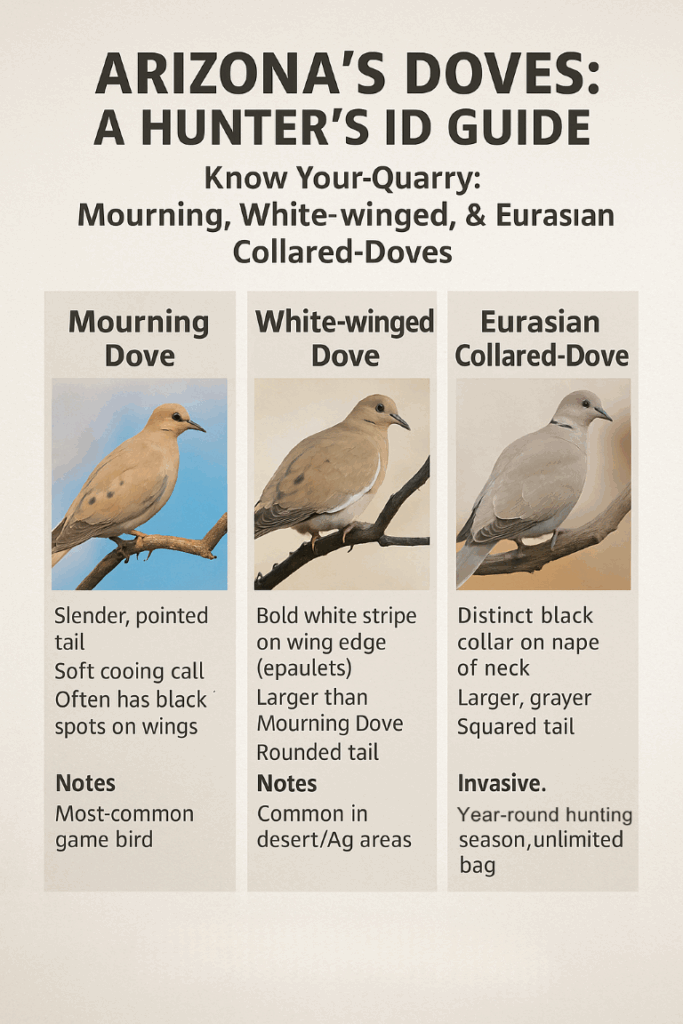
Mourning Dove: The Widespread Favorite
The Mourning Dove is perhaps the most recognized and widely occurring game bird in North America and a prime target for many dove hunters in Arizona. These birds are known for their slender build, pointed tails, and soft cooing calls. Mourning dove populations are monitored by both state and federal agencies to ensure healthy numbers.
White-Winged Dove: The Desert Dweller
A common sight in Arizona’s desert and agricultural areas, the White-winged Dove is distinguished by the noticeable white patches on the upper wing surfaces, especially visible in flight. These white wing epaulets help differentiate them from their mourning dove cousin. The population and breeding activity of white winged doves can influence hunting forecasts.
Eurasian Collared-Dove: The Year-Round Quarry
The Eurasian Collared-Dove is an invasive species that has established itself across Arizona. Larger than native doves, they feature a distinct black collar on the back of their necks and are often found near agricultural areas or buildings. Because they are an invasive eurasian collared dove, AZGFD allows them to be hunted year-round with an unlimited bag limit, encouraging hunters to help manage their numbers.
Planning Your Hunt: Arizona Dove Seasons and Key Regulations for 2025-2026
Understanding the regulations set by the Arizona Game and Fish Department is crucial for a successful and lawful hunt. This includes current season dates, bag limits, licensing, and specific rules of conduct for the 2025-2026 hunting season, as outlined in the official 2025-2026 Arizona Dove and Band-tailed Pigeon Regulations.
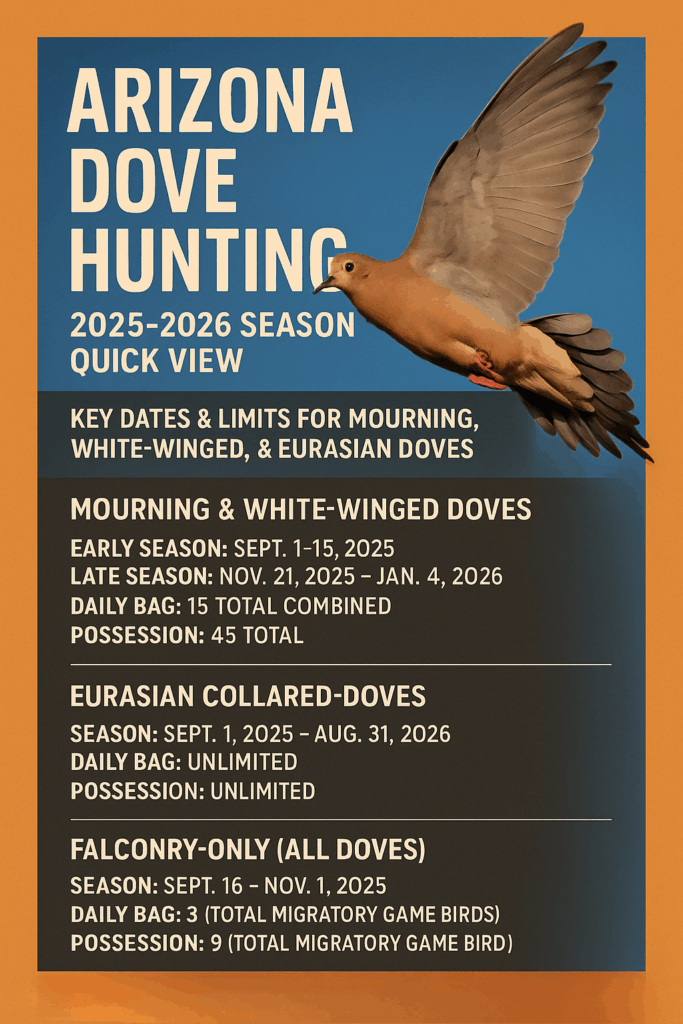
Quick Overview: 2025-2026 Dove Hunting Seasons & Limits
Here are the official seasons and limits for dove hunting in Arizona for 2025-2026:
| Species | Season Segment | 2025-2026 Dates | Daily Bag Limit | Possession Limit |
|---|---|---|---|---|
| Mourning & White-winged Dove | Statewide Early Dove Season | Sept. 1-15, 2025 | 15 total (Mourning & White-winged combined) | 45 total |
| Mourning & White-winged Dove | Statewide Late Dove Season | Nov. 21, 2025 – Jan. 4, 2026 | 15 total (Mourning & White-winged combined) | 45 total |
| Eurasian Collared-Dove | Statewide Eurasian Collared-Dove Season | Sept. 1, 2025 – Aug. 31, 2026 | Unlimited | Unlimited |
| All Dove Species | Statewide Falconry-only Dove Season | Sept. 16 – Nov. 1, 2025 | 3 (total migratory game birds) | 9 (total migratory game birds) |
Legal shooting hours (and hawking hours for falconry) are one-half hour before legal sunrise until sunset. The daily bag is the number of doves allowed to be harvested in one day. The possession limit is the total number of harvested doves you may have, including those from previous days or given to you, and applies to all doves you have on your person, in your cooler, vehicle, any temporary lodging, and at your place of permanent residence.
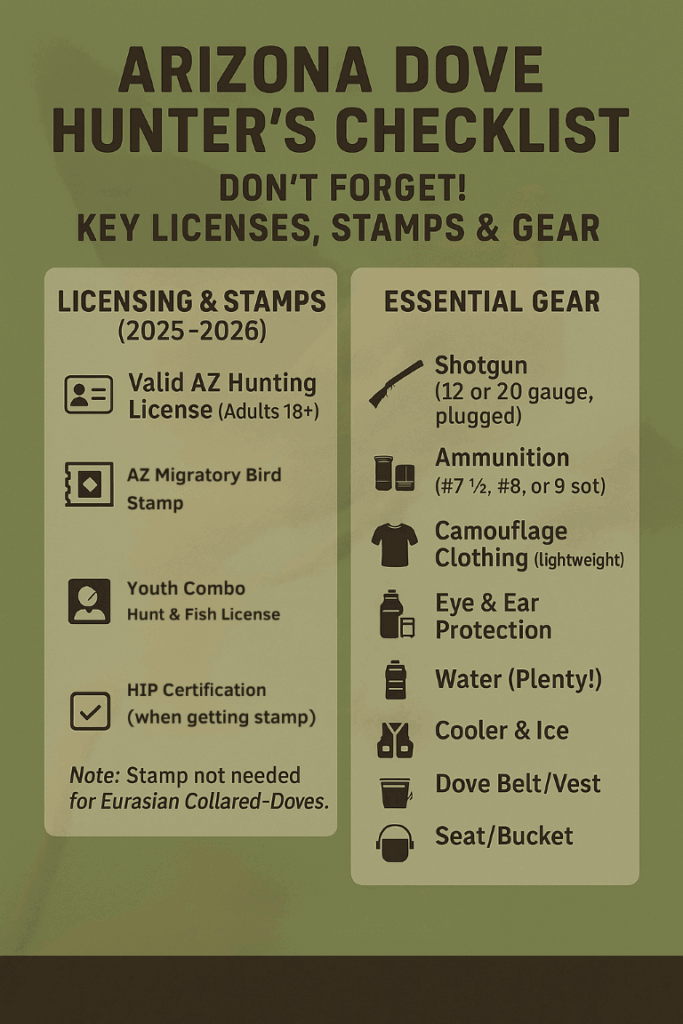
Essential Licenses and Stamps
To legally hunt doves in Arizona for the 2025-2026 season:
- Adults (18 and older): Must possess a valid Arizona hunting license (or a combination hunt and fish license) AND an Arizona migratory bird stamp for taking Mourning and White-winged doves. The Arizona Migratory Bird Stamp costs $5. A general hunting license for a resident is $37; resident combination hunt and fish license is $57. Licenses can often be purchased online from the AZGFD website.
- Youth Hunters (10 to 17): Must possess a valid youth combination hunt and fish license only (stamp privileges included). This license costs $5 for residents and non-residents.
- Children (under 10): May hunt wildlife other than big game (which includes doves) without a license if accompanied by a properly licensed adult age 18 or older (maximum two unlicensed children per adult).
- Eurasian Collared-Doves: An Arizona migratory bird stamp is NOT required for the take of Eurasian collared-doves.
- HIP Certification: When you purchase your Arizona migratory bird stamp (for Mourning and White-winged doves), you must complete the Harvest Information Program (HIP) survey.
Core Hunting Regulations You Must Know
Adherence to hunting regulations ensures safety, ethical conduct, and the conservation of wildlife resources. Key rules for dove hunters in Arizona include:
- Do not shoot within ¼ mile (440 yards) of an occupied structure while hunting unless you have permission.
- Do not shoot from, across, or into roads or railways.
- Do not leave shotgun shells or other litter on the ground. Pack out all your trash.
- You must leave one fully feathered wing attached to each Mourning and White-winged dove for identification until you reach your permanent residence or where the wildlife will be consumed. This also applies to Eurasian Collared-Doves. This helps in species identification of the birds.
- Keep your individual daily bag limit of birds separate from those of other hunters while in the field, in your cooler, and in transit.
- Make a reasonable effort to retrieve all downed birds.
- Do not consume drugs or alcohol while hunting or handling firearms.
- It is illegal to hunt over baited areas. An area is considered baited for 10 days after the bait has been removed. It is legal to take doves on or over lands where grain or feed has been distributed solely from normal agricultural operations or manipulation of an agricultural crop.
- Legal Methods of Take for Mourning and White-winged Doves:
- Shotgun: 10-gauge or smaller, capable of holding no more than three shells (magazine and chamber combined), unless plugged with a one-piece filler.
- Bow and arrow.
- Crossbow.
- Falconry.
- Legal Methods of Take for Eurasian Collared-Doves:
- Includes the above methods.
- Pneumatic weapons are also legal for Eurasian collared-doves, except they are not permitted on Bill Williams River or Leslie Canyon NWRs.
- Non-Toxic Shot: The use or possession of other than non-toxic shot is prohibited when hunting on the Bill Williams River, Cibola, Havasu, and Imperial National Wildlife Refuges. For other areas, lead shot is generally permissible for dove, but always check specific land management agency rules.
- Hunter orange is recommended for safety but not required for dove hunting in Arizona.
- Report wildlife violations to Operation Game Thief at 1-800-352-0700.
Finding Your Spot: Where to Hunt Doves in Arizona
Successful dove hunting often comes down to location. Doves are typically found in areas offering food, water, and roosting sites. Agricultural lands, especially those that produce small grain crops, are prime habitat. Look for recently harvested fields, desert washes near feeding areas, and reliable water sources. Popular regions include the farming areas around Yuma and Buckeye. The Gila River corridor can also attract birds.
Public Lands & Wildlife Management Areas (WMAs)
Arizona offers numerous public land opportunities for dove hunters. This includes lands managed by the U.S. Forest Service, BLM, and Arizona State Trust Lands (an access permit may be required for State Trust Land). The Arizona Game and Fish Department also manages several Wildlife Management Areas (WMAs) to provide quality habitat and hunting access. For a comprehensive directory of public hunting areas in Arizona, including maps and details, explore Hunting Locator’s Arizona public hunting land resources. You can discover various WMAs and other public access points to plan your next outing.
- The Robbins Butte Wildlife Area, Powers Butte Wildlife Area, and Arlington Wildlife Area near the Gila River are popular spots. Note that a portion of Robbins Butte Wildlife Area is limited to youth-only dove hunting from September 1 until the day after the youth-only hunt ends; this applies to the area posted “No Hunting Behind This Sign” around actively farmed lands north to the Gila River main channel, and is open to all hunters for the remainder of the season. Always check specific WMA regulations before your hunt.
- National Wildlife Refuges (NWRs) like Bill Williams River, Cibola, Imperial, Buenos Aires, Havasu, Leslie Canyon, and San Bernardino are open to Mourning and White-winged dove hunting except for posted portions. Cabeza Prieta NWR is open to mourning dove hunting during the late season only. Specific rules for Eurasian Collared-Dove hunting vary by NWR. Always check specific refuge regulations for hunting activities, including those allowed with dogs, and be aware that a fee may be required.
- National Monuments such as Grand Canyon-Parashant, Vermilion Cliffs, Sonoran Desert, Ironwood Forest, and Agua Fria are open to hunting.
- Certain Maricopa County Parks (Lake Pleasant, White Tank Mountains, McDowell Mountain, Estrella Mountain) and Pima County Parks (A-7 Ranch, Oracle Ridge, etc.) are open to hunting, but not within ¼ mile of developed facilities.
- Camp Navajo is closed to all dove hunting.
Exploring Private Land Options
Access to private land, particularly agricultural fields that produce small grain crops, can provide excellent dove hunting. Always secure permission from the landowner before entering or hunting on private property. Building good relationships with landowners is key to continued access. Many dove hunters find great success where grain crops are prevalent.
For hunters looking to simplify the search for private hunting land, Hunting Locator offers a comprehensive platform. Whether you’re searching for an annual Arizona hunting lease or looking to purchase your own hunting paradise in the state, Hunting Locator provides extensive listings and advanced mapping tools to help you find the perfect private land opportunity.
Considering Guided Hunts
If you’re new to Arizona dove hunting or want a more structured experience, consider hiring a guide. Outfitters, especially in high-density areas like Yuma, offer packages that can include access to private fields, decoys, and local expertise. This can be a great way for out-of-state hunters or those with limited time to maximize their opportunities. If you’re looking for a guided dove hunt in Arizona, Hunting Locator’s directory of Arizona outfitters can help you find experienced professionals who offer local knowledge and access to prime hunting spots.
Gearing Up for Arizona Doves
Having the right gear can make your dove hunt more comfortable and successful. Here’s a basic checklist:
- Shotgun: A reliable 12 or 20-gauge shotgun is most common. Ensure it’s plugged to hold no more than three shells for migratory birds (Mourning and White-winged).
- Ammunition: #7 ½, #8, or #9 shot are popular choices. Bring plenty, as action can be fast.
- Clothing: Lightweight, breathable camouflage is ideal for the hot early dove season. Consider layers for the late season, which can be cooler.
- Safety Gear: Eye and ear protection are essential. A wide-brimmed hat and sunblock are also advisable.
- Hydration: Carry plenty of water, especially during early season hunts when temperatures can be extreme.
- Hunting Accessories: A dove belt or vest to carry shells and birds, a cooler with ice for your harvest, and a comfortable seat or bucket are highly recommended. Decoys, including motion decoys, can improve your odds.
- Optional: Hunter orange vest or cap (recommended for visibility, not required), insect repellent.
Top Tips for a Successful Arizona Dove Hunt
Beyond regulations and gear, certain strategies can significantly boost your success when you hunt doves:
- Scout Actively: Before hunting season, and even between hunts, scout for areas where doves are feeding (look for small grain crops), watering, or flying between roosting and feeding areas. This is key to finding concentrations of birds for a better hunting experience.
- Concealment is Key: Doves have excellent eyesight. Use natural cover like brush or trees, or bring a blind. Wear camouflage clothing that blends with the desert or agricultural environment.
- Effective Decoy Use: Stationary decoys placed on fences, bare tree limbs, or the ground can attract passing birds. Motion decoys can be very effective, especially on calm days, but be mindful that birds separate from the main flock can become wary with hunting pressure.
- Practice Your Swing: Doves are notoriously fast and erratic flyers. Practice your wingshooting on clay targets before the season to improve your accuracy.
- Hunt Early and Late: Doves are typically most active during the first few hours after legal sunrise and the last few hours before sunset, as they fly between roosting, feeding, and watering areas.
- Stay Hydrated and Safe: Especially crucial in Arizona’s heat. Drink plenty of water, wear sun protection, and be aware of your surroundings. The local economy benefits from safe and responsible tourism.
- Retrieve All Birds Promptly: Make every reasonable effort to find and retrieve your downed birds immediately. This is ethical and required by law.
- Know Your Species: Be able to distinguish between Mourning, White-winged, and Eurasian Collared-Doves to comply with bag limits and take advantage of the unlimited opportunity for the invasive Eurasian Collared-Dove. A white winged dove has distinctive white wing epaulets on its upper wing surfaces. Mourning doves often have a distinctive rattling whistle when they flush and white tipped tail feathers, distinct from its white winged cousin. You may also note their overall grayer plumage or more brown color for identification.
- Respect Land and Regulations: Always ask for permission before hunting on private land, pack out all litter including spent shotgun shells, and strictly follow all game laws. The future of hunting depends on ethical behavior.
More Arizona Hunting Resources from Hunting Locator
To further assist in your Arizona hunting endeavors, Hunting Locator offers a wealth of information. Here are a couple of resources you might find helpful:
- Arizona Hunting Seasons Overview: For a broader look at all hunting opportunities in the state, our guide to Arizona hunting seasons provides a comprehensive overview of species, dates, and general regulations. This can help you plan your entire hunting calendar.
- Understanding Hunting Lease Agreements: If you’re considering leasing private land, it’s important to understand the terms. Our article on what to look for in a hunting lease agreement offers valuable insights to protect both hunters and landowners.
FAQ
What license do I need to hunt doves in Arizona for the 2025-2026 season?
Adults 18 and older need a valid Arizona hunting license and an Arizona Migratory Bird Stamp for Mourning and White-winged doves. Youth hunters (10-17) need a youth combination license. The migratory bird stamp is not needed for Eurasian Collared-Doves. Remember HIP certification.
When is the 2025-2026 dove season in Arizona?
The early dove season for Mourning and White-winged doves is Sept. 1-15, 2025. The late season for these migratory birds is Nov. 21, 2025 – Jan. 4, 2026. Eurasian Collared-Doves can be hunted Sept. 1, 2025 – Aug. 31, 2026. A falconry-only season is Sept. 16 – Nov. 1, 2025.
What is the bag limit for doves in Arizona for 2025-2026?
For Mourning and White-winged doves combined, the daily bag limit is 15 total, and the possession limit is 45 total. Eurasian Collared-Doves have an unlimited daily bag and possession limit. For the falconry season, the daily bag is 3 total migratory game birds.
Where are the best places to hunt doves in Arizona?
Popular areas include agricultural regions around Yuma and Buckeye, especially where small grain crops are grown. Wildlife Management Areas like the Robbins Butte Wildlife Area are also managed to provide dove habitat. Scout areas near the Gila River or in the West Valley for food, water, and flight lines. Always check specific area regulations for access, such as those for the many NWRs or county parks.
What is the best shot size for dove hunting?
Most dove hunters use #7 ½, #8, or #9 shot. The best choice can depend on the specific hunting conditions and the range at which you expect to be shooting.
Wrapping Up Your Arizona Dove Hunt
Arizona offers a fantastic dove hunting experience, from the excitement of opening day in the early season to the cooler days of the late season. Success hinges on good preparation, understanding the habits of the different dove species, and, most importantly, a thorough knowledge of and adherence to the 2025-2026 regulations set forth by the Arizona Game and Fish Department. Remember to always practice safe gun handling and ethical hunting. An Orange Red Card from hunter education is a good start. Make a reasonable effort to retrieve all downed birds, and respect the land, whether public or private. If you see suspicious activity, consider reporting it to Operation Game Thief.
Ready to plan your Arizona dove adventure or find that perfect lease? Explore Hunting Locator’s extensive listings for hunting land and our advanced mapping tools to scout your next hotspot. We’re here to help you make your next Arizona hunting season the best one yet.


