If you’re planning a 2026–2027 small game season in Arizona—whether that’s desert quail in the lowlands, Mearns’ in the sky islands, chukar in canyon country, or squirrels in the northern forests—this guide covers the dates, bag limits, license costs, and access options you need.
This article consolidates official data from the Arizona Game and Fish Department (AZGFD) into one reference covering season dates, bag limits, license costs, and where to find birds. Always verify current regulations directly with AZGFD before your hunt, as dates and rules are subject to commission order changes.
Here’s what this guide covers:
- Season dates and bag limits for quail, tree squirrel, upland birds, and predators for 2026–2027
- License and permit costs for resident and non-resident hunters, plus hunter education requirements
- Where to hunt—public lands, guided options, and private land leases across Arizona
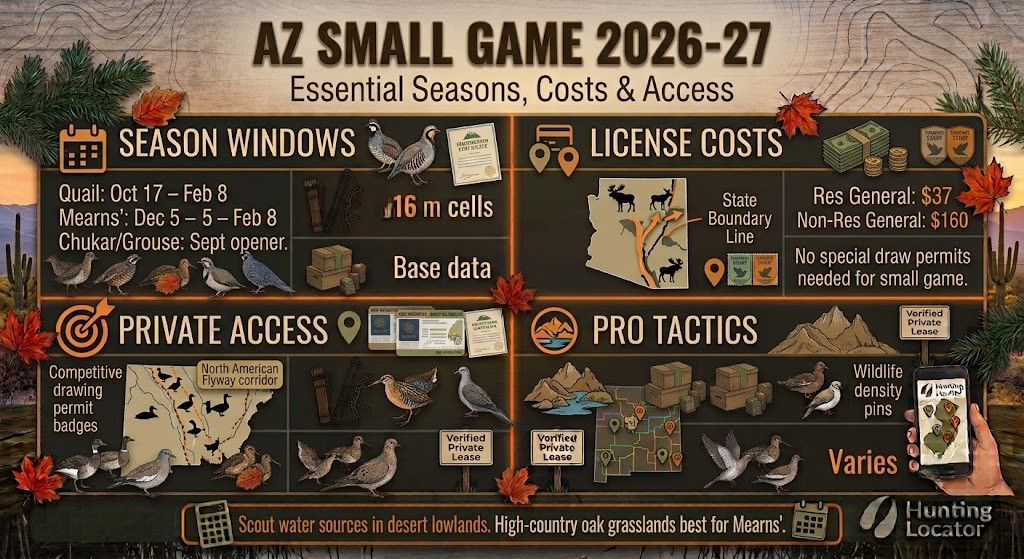
Quick Overview: Arizona Small Game Season Dates 2026–2027
The Arizona Game and Fish Department sets season dates, bag limits, and legal methods for all small game species in the state. The table below summarizes the 2026–2027 seasons for every major species covered in this guide.
| Species | Season Type | Start Date | End Date | Daily Bag Limit | Notes |
|---|---|---|---|---|---|
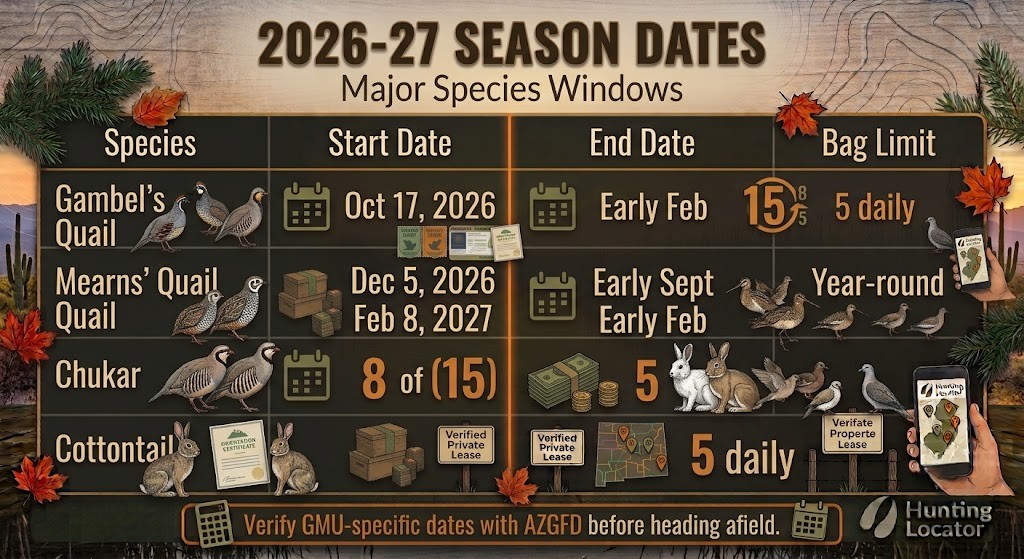
| Gambel’s Quail | General | Oct 17, 2026 | Feb 8, 2027 | 15 quail aggregate | Part of 15-quail aggregate with Scaled & CA quail |
| Scaled Quail | General | Oct 17, 2026 | Feb 8, 2027 | 15 quail aggregate | Part of 15-quail aggregate |
| California Quail | General | Oct 17, 2026 | Feb 8, 2027 | 15 quail aggregate | Part of 15-quail aggregate |
| Mearns’ Quail | General | Dec 5, 2026 | Feb 8, 2027 | Max 8 within aggregate | Later opener; no more than 8 Mearns’ daily |
| Tree Squirrels (Abert’s, etc.) | General | Oct 1, 2026 | Late-Jan 2027 | Verify with AZGFD | Confirm unit-specific limits |
| Chukar Partridge | General | Early-Sep 2026 | Early-Feb 2027 | 5 per day | Rugged, rocky terrain species |
| Dusky Grouse | General | Early-Sep 2026 | Early-Nov 2026 | 3 per day | Short fall window—plan early |
| Cottontail Rabbit | General | Year-round (typical) | — | 5 per day / 15 possession | One of Arizona’s most accessible small game species |
| Coyote (General 1 – All Units) | General | Year-round | Year-round | No limit | Statewide open season |
| Coyote (General 2 – Select Units) | General | Aug 22, 2026 | May 31, 2027 | No limit | Check which units are open |
Always verify current dates and limits with AZGFD before your hunt—regulations are subject to commission order changes.
License, Permit & Education Requirements at a Glance
Full details are in the license section below, but here’s a quick reference:
- General hunting license required: Anyone age 10 or older must have a valid Arizona hunting license to hunt small game, resident or non-resident.
- No special small-game permit needed: A general license covers quail, squirrel, rabbit, chukar, and grouse—no draw tag required.
- Hunter education: Required only for hunters ages 10–13. Adults are not required to complete it, though it’s worth doing for anyone new to the sport.
- Youth under 10: Children under 10 may hunt small game without a license when accompanied by a licensed adult (18+); a maximum of two unlicensed children per licensed adult applies.
- Migratory bird note: Doves, ducks, and geese require an Arizona State Migratory Bird Stamp—quail, squirrel, and rabbit do not.
- Apprentice license option: Resident licensed hunters can obtain a free Apprentice Hunting License, valid for two consecutive days, to take a new hunter afield before they commit to a full license.
Arizona Quail Hunting Seasons
Arizona offers four huntable quail species—Gambel’s, Scaled, Mearns’, and California quail, covering terrain from desert flats to high-elevation oak grasslands. Per AZGFD, the 2026–2027 seasons are structured as follows.
Before getting into species-specific dates, understand how the aggregate bag limit works. The daily bag limit is 15 quail in aggregate, of which no more than 8 may be Mearns’ quail. The possession limit is 45 quail in aggregate after opening day, with no more than 24 Mearns’ quail in that total. Gambel’s, Scaled, California, and Mearns’ quail all count toward the same daily total.
Gambel’s, Scaled & California Quail Season
The general quail season for Gambel’s, Scaled, and California quail opens Friday, October 17, 2026 and runs through Sunday, February 8, 2027—nearly four months across Arizona’s desert lowlands and grasslands.
All three species share the 15-quail aggregate daily limit, so hunters working multiple species in a day should track their combined total as they go. Scaled quail favor open grassland and semi-arid flats; California quail are more common in brushy canyon country; Gambel’s dominate the desert lowlands. All three fall under the same statewide season framework, require no draw permits, and are accessible to hunters of any experience level.
Mearns’ Quail Season
Mearns’ quail—also called Montezuma quail—have their own season structure. The Mearns’ season opens December 5, 2026 and runs through February 8, 2027, with the later opener intended to protect the species through its breeding period.
No more than 8 Mearns’ quail may be taken in a single day, and the 45-quail possession limit may include up to 24 Mearns’ quail, with the 8-per-day rule still applying. These birds are found in the higher-elevation oak-grassland terrain of southern Arizona’s sky island mountain ranges—a physically demanding hunt that requires better conditioning and a different approach to locating birds than lowland desert quail. Season dates can also differ by Game Management Unit, so confirm GMU-specific rules with AZGFD before you go.
Arizona Tree Squirrel Season
The general tree squirrel season—covering Abert’s squirrel and related species—runs from October 2026 through late January 2027, overlapping with quail season for hunters who want to mix species on a trip into forested terrain.
Bag limits and unit-specific rules can vary significantly across Arizona’s Game Management Units, so confirm current limits directly with AZGFD’s official regulations before heading out.
Arizona Upland Bird Seasons: Chukar & Dusky Grouse
Chukar partridge and dusky grouse both open considerably earlier than the desert quail season, giving hunters action before October. The two species have distinct terrain requirements and season structures.
Chukar Partridge
Chukar season runs from early September 2026 through early February 2027, with a daily bag limit of 5 chukar per day—one of the longer small game seasons in the state.
Chukar habitat in Arizona is rugged: steep, rocky canyon walls with loose footing and birds that hold the elevation advantage. Effective chukar hunters work from above and push birds downhill rather than chasing them up. The extended season gives you time to learn the terrain and refine your approach, though the country itself will set the pace.
Dusky Grouse
Dusky grouse season runs from early September 2026 through early November 2026 with a daily bag limit of 3 dusky grouse per day. That two-month window closes fast, so planning ahead matters.
These birds inhabit higher-elevation conifer and mixed forest zones, making a dusky grouse hunt a natural early-season complement before dropping down to desert quail country later in the fall.
Arizona Predator Hunting: Coyote
Arizona structures coyote hunting across two general frameworks:
- General 1 (All Units): Coyote hunting is available year-round, statewide, with no closed season.
- General 2 (Select Units): A structured window runs from August 22, 2026 through May 31, 2027 in designated units.
Be sure to check the units that are open during General 2 hunting dates before heading out. The two-tier structure means some units carry additional regulation layers during the General 2 period, so confirm your specific GMU with AZGFD before you hunt. Coyotes are not subject to a bag limit (verify current rules with AZGFD), making this one of the more flexible hunting opportunities in the state—useful for hunters who want to stay active between big game seasons or manage predator populations on leased land.
Arizona Small Game Licenses and Permits
The Arizona Game and Fish Department administers all hunting licenses in the state. For small game hunters, the licensing structure is simple—no draw tags, no species-specific permits for most species. A valid general hunting license covers you.
Arizona Hunting Licenses
| License Type | Resident Cost | Non-Resident Cost | Notes |
|---|---|---|---|
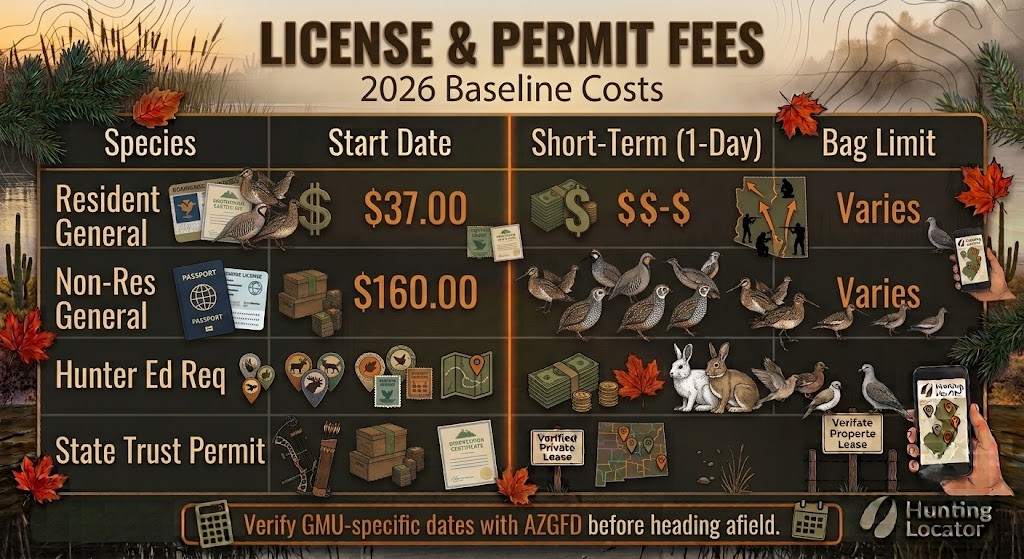
| General Hunting License | $37 | $160 | Annual; required for hunters age 10+ |
| Combination Hunt & Fish | $57 | $160 | Good value for hunters who also fish |
| Youth Combination (Ages 10–17) | $5 | — | Reduced fee for resident youth |
| Short-Term Combo (1 Day) | $15/day | $20/day | Suitable for visiting or trial hunters |
Resident license costs range from $5 for a youth license to $57 for a combination hunt and fish license. Non-residents should budget $160 for their annual combination license, valid for 365 days from the date of purchase.
To qualify as a resident, you must have resided solely in Arizona for at least six months prior to your application date. If you’ve recently relocated, confirm your residency status before purchasing a resident-priced license.
Licenses can be purchased online through the AZGFD portal, at all AZGFD offices, and through licensed dealers statewide. The online portal at license.azgfd.com allows new customers to create an account or check out as a guest—an account makes renewal and license management easier in future seasons.
Arizona Hunting Permits
For small game hunters, no special permit or draw tag is required beyond your general hunting license for quail, rabbit, squirrel, chukar, or grouse. A few additional items worth knowing:
- Migratory Bird Stamp: Required for doves, ducks, geese, coots, and snipe—not required for quail, squirrel, or rabbit. Waterfowl hunters also need a Federal Duck Stamp and HIP participation.
- Apprentice License: Resident licensed hunters can obtain a free Apprentice Hunting License valid for two consecutive days to take a new hunter afield. The apprentice license covers small game, upland game birds, fur-bearing animals, predatory animals, and nongame species—a practical pathway for introducing someone to the sport before they commit to a full license.
- Big game permits: If you plan to pursue big game alongside your small game season, draw applications and permit-tag fees apply separately. Non-residents should budget an additional $15 per species application plus tag fees ranging from $315 for deer to $665 for elk if they draw.
- Hunter Education: Required for hunters ages 10–13. Hunters 14 and older are not required to complete a course, but it’s worth doing for anyone new to the sport.
Arizona Small Game: Where to Hunt
Arizona has a substantial mix of public and private hunting access, from BLM flats and national forest to private ranch leases. The right approach depends on your target species, preferred experience, and budget.
Best Public Lands for Small Game Hunting
Arizona’s public land system covers millions of acres across desert, grassland, and mountain terrain. Different public land types—BLM, State Trust Land, and National Monuments—each carry their own additional access rules beyond the general hunting license, so confirm land-specific requirements before you hunt.
Some consistently productive public land options for Arizona small game hunters include:
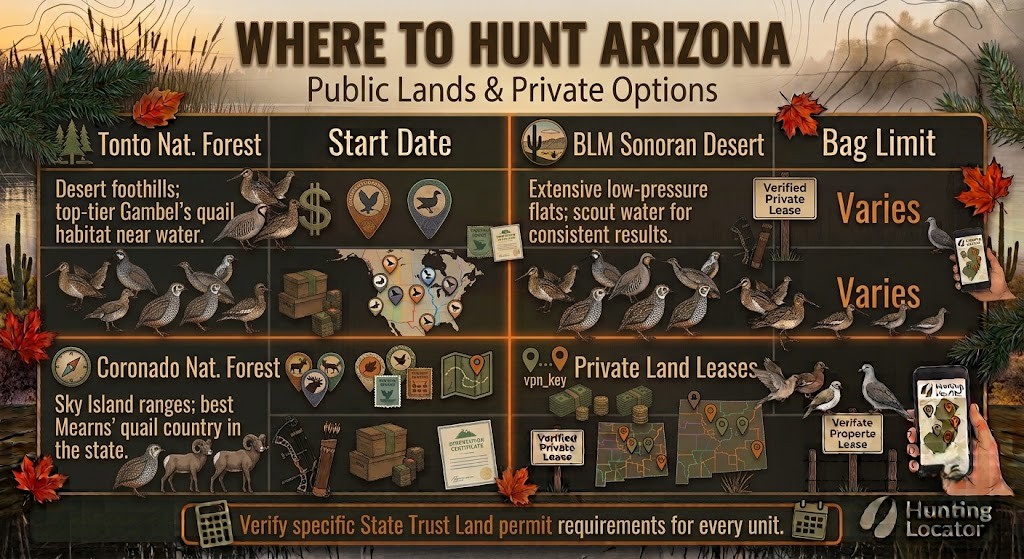
- Tonto National Forest: The desert foothills of the Tonto are well-regarded for Gambel’s quail, particularly near water sources and palo verde washes where coveys concentrate—especially after October rains trigger green-up.
- BLM Land in Southern Arizona: Expansive BLM acreage throughout the Sonoran Desert provides accessible terrain for both Gambel’s and Scaled quail without heavy pressure from easily accessible roads and trailheads. Scouting before opener pays off.
- Coronado National Forest: The sky island ranges within the Coronado—including the Huachuca, Santa Rita, and Chiricahua mountains—provide the higher-elevation oak-grassland habitat where Mearns’ quail are found, making this a top destination for December and January hunts.
- Apache-Sitgreaves National Forest: Northern Arizona’s forested terrain supports tree squirrel populations, including Abert’s squirrel, alongside early-fall opportunities for dusky grouse.
- State Trust Land: Arizona’s State Trust Land network adds additional huntable acres but requires a separate Recreation Permit in addition to your hunting license. The permit is low-cost and easy to obtain—don’t skip it.
Summer monsoon rainfall is a primary ecological driver of quail abundance in the fall. A strong monsoon season generally produces more birds; a dry summer means tighter coveys and harder hunting. Monsoon reports in July and August are worth tracking before you commit to areas for the October opener.
Guided Hunts
For non-resident hunters—and residents who want a curated experience—Arizona’s guided quail hunt market is well-developed. Arizona’s small game hunting, particularly Gambel’s and Mearns’ quail, is described as world-class in productive years. Here’s what to evaluate when booking a guided Arizona small game hunt:
- Species specialization: Gambel’s quail operations in the Sonoran Desert have a different logistical profile than Mearns’ quail guides working the sky island ranges. Make sure the outfitter’s territory matches where your target birds live.
- Dogs and bird work: Most quality Arizona quail operations work pointing dogs. Ask about the breed, number, and experience level of the dogs before booking—dog work has a significant effect on how productive a day in the field will be.
- Season timing: The Mearns’ season doesn’t open until December 5, 2026. Booking for late December or January gives the season time to settle and birds to pattern more predictably.
- What’s included: Full-service packages typically include guides, dogs, bird processing, and field transportation. Confirm whether lodging, meals, and licenses are included before finalizing any booking.
- Booking lead time: Quality outfitters fill their best dates early. Arizona non-resident licenses are valid for 365 days from purchase, so buy your license well in advance. Book your guide six to nine months ahead for peak dates.
Private Land Hunting with Hunting Locator
Public land hunting in Arizona can be productive, but private land typically offers less pressure, better habitat management, and exclusive access. For hunters focused on Arizona quail, cottontail, or squirrel, private land access is worth considering.
Leasing private land is the most flexible model. A seasonal hunting lease gives you the rights to hunt a specific property for a defined period without the long-term commitment of ownership. Lease agreements typically cover access rights, permitted species, rules of conduct, and hunter counts. Rates in Arizona vary considerably based on acreage, location, habitat quality, and target species—desert quail leases and sky island Mearns’ properties represent different price points.
Buying private land is the deeper commitment. Owning your own hunting property means no lease renewals, no access restrictions from other hunters, and the ability to manage habitat over the long term. For hunters with the resources to invest, land ownership in productive Arizona quail country can pay off across many seasons.
Whether you’re looking to lease for a season or find land worth owning, Hunting Locator connects hunters with Arizona landowners offering seasonal leases and land-sale opportunities. Browse verified listings across the state—from Sonoran Desert quail properties to sky island ranches—on a platform built specifically for hunters. Find Arizona hunting access on Hunting Locator.
Arizona Small Game Hunting Tips
- Scout for water first: In the desert, water sources and palo verde washes concentrate quail coveys throughout the day. A reliable stock tank, seasonal seep, or post-rain wash is worth finding before opening day.
- Hunt the edges of the day: Desert quail are most active in the first two hours after sunrise and the last hour before sunset. Midday birds go tight in shade cover. Glass open flats and listen for the “chi-CA-go” call of Gambel’s to locate coveys before walking the country.
- Let the monsoon guide your expectations: Summer monsoon rainfall is the primary driver of quail abundance for the fall season. Strong monsoon years with good grass coverage typically produce the best coveys. Track monsoon reports in July and August and adjust your target areas accordingly.
- Track your aggregate limit in real time: The 15-quail daily aggregate covers Gambel’s, Scaled, California, and Mearns’ quail combined. Keep a running count across all species throughout the day. Mearns’ quail count toward both the aggregate and their own 8-bird daily cap.
- Match your gear to the terrain: Chukar and Mearns’ quail hunting both involve steep, physically demanding country. Lightweight, breathable upland boots with ankle support matter here. Bring more water than you think you need. Physical conditioning before a Mearns’ hunt in high-elevation sky island terrain pays off in both success and safety.
- Run pointing dogs effectively: Pointing breeds—setters, pointers, and Brittanys in particular—are well-suited to Arizona quail hunting. Coveys sit tight in cover, and a well-trained dog finds birds you’d walk past. Keep dogs watered and watch their pads in rocky chukar terrain.
- Confirm public land rules for every parcel: Different public lands carry different access rules beyond the general hunting license. State Trust Land requires a separate recreation permit. Some units may have additional restrictions. Check regulations for every parcel you plan to hunt.
- Time your Mearns’ hunt for mid-season: With the Mearns’ season opening December 5, hunting often improves through December into January as birds pattern more predictably on established territories in the right oak-grassland elevation band.
- Use small game’s no-draw advantage: Arizona’s small game requires no draw permits—buy a license and go. That flexibility is worth using: multiple shorter trips throughout the season tend to outperform a single all-or-nothing outing.
More Resources from Hunting Locator
- Arizona Hunting Leases — Browse verified private land leases across Arizona, from Sonoran Desert quail properties to mountain ranches. Connect directly with landowners.
- Arizona Hunting Seasons Overview — A full calendar of Arizona hunting seasons, including big game, upland birds, and migratory species.
- Arizona Small Game Hunting Season — Detailed coverage of Arizona’s small game regulations, including rabbits, squirrels, and upland birds.
- Arizona Upland Game Hunting Season — Focused coverage of Arizona’s upland bird seasons, including quail, chukar, and grouse with tips for accessing prime habitat.
- Arizona Dove Hunting Season — Season dates, licensing, and the best public and private spots for the September dove opener.
- Arizona Elk Hunting — Draw process, unit strategies, and land access options for Arizona elk.
- Arizona Deer Hunting — Arizona’s deer seasons, permits, and where to find Coues deer in the south and mule deer in the high country.
- Arizona Javelina Hunting Season — Draw system, season structure, and best hunting areas for javelina.
- Arizona Bear Hunting Season — Season structure, licenses, and access options for Arizona black bear across multiple units.
- Arizona Pronghorn Hunting Season — Draw process, unit selection, and land access for Arizona pronghorn.
- Arizona Mountain Lion Hunting Season — Licensing, pursuit methods, and access for lion hunting in Arizona.
- Arizona Bighorn Sheep Hunting Season — The draw process and what to expect from an Arizona bighorn application.
- Arizona Bison Hunting Season — How Arizona’s bison hunts work and how to pursue them.
- Hunting Locator Store — Upland vests, boots, dog supplies, and field accessories for Arizona small game hunting.
Frequently Asked Questions
When does Arizona quail season open in 2026?
The statewide general quail season for Gambel’s, Scaled, and California quail opens Friday, October 17, 2026 and runs through Sunday, February 8, 2027. Mearns’ quail have a later opener—December 5, 2026—and also close on February 8, 2027. All dates are set by AZGFD and subject to commission order changes; verify before you hunt.
What is the daily bag limit for quail in Arizona?
The daily bag limit is 15 quail in aggregate across all quail species. Of those 15, no more than 8 may be Mearns’ quail. The possession limit after opening day is 45 quail in aggregate, with no more than 24 being Mearns’ quail. Gambel’s, Scaled, California, and Mearns’ quail all count toward the same daily total.
How much does a non-resident Arizona hunting license cost?
A non-resident annual Combination Hunt and Fish license costs $160 and is valid for 365 days from the date of purchase. Non-residents who want a shorter commitment can purchase a short-term combo license at $20 per day. No special small-game permit or draw tag is required for quail, rabbit, or other small game beyond the base license.
Do I need hunter education to hunt small game in Arizona?
Hunter education is required only for hunters ages 10 through 13 in Arizona. Hunters 14 and older are not required to complete a course before purchasing a license, though it’s worth doing for anyone new to the sport. Children under 10 may hunt small game without a license when accompanied by a licensed adult (18+), with a maximum of two unlicensed children per licensed adult.
Can I hunt small game on public land in Arizona without additional permits?
A general hunting license covers small game hunting on most public land in Arizona, but different land types—BLM, State Trust Land, and National Monuments—each carry their own additional access rules. State Trust Land requires a separate recreation permit. Confirm land-specific requirements before hunting any public parcel, and check unit-specific regulations through AZGFD’s regulations portal.
What’s the best way to find private land to hunt small game in Arizona?
Hunting Locator connects hunters directly with Arizona landowners offering seasonal leases and land-sale opportunities. Browse verified listings across the state, filter by species and region, and contact landowners without the guesswork—a practical starting point for securing private land access for the 2026–2027 season.
The Final Shot
The 2026–2027 Arizona small game season covers a lot of ground: Gambel’s quail in the desert lowlands, Mearns’ in the sky islands, chukar in rocky canyon country, squirrels in the northern forests, and coyote opportunities year-round. Season dates are set, licensing is straightforward, and access options range from vast public land to managed private ranches.
Get your license in order, confirm your GMU regulations and water sources before opener, and secure your access—public or private through Hunting Locator—well before October 17.


