This Montana antelope guide consolidates season dates, license costs, the draw application process, and land access options for residents and non-residents. Where FWP leaves off on private land access, Hunting Locator picks up.
What’s covered:
- 2026 season dates by method — archery and general rifle — plus bag limits and permit structure
- A full breakdown of licenses, permits, and the draw application process with current costs for residents and non-residents
- Where to hunt in 2026: public land options, guided hunt considerations, and how to secure private land access through Hunting Locator
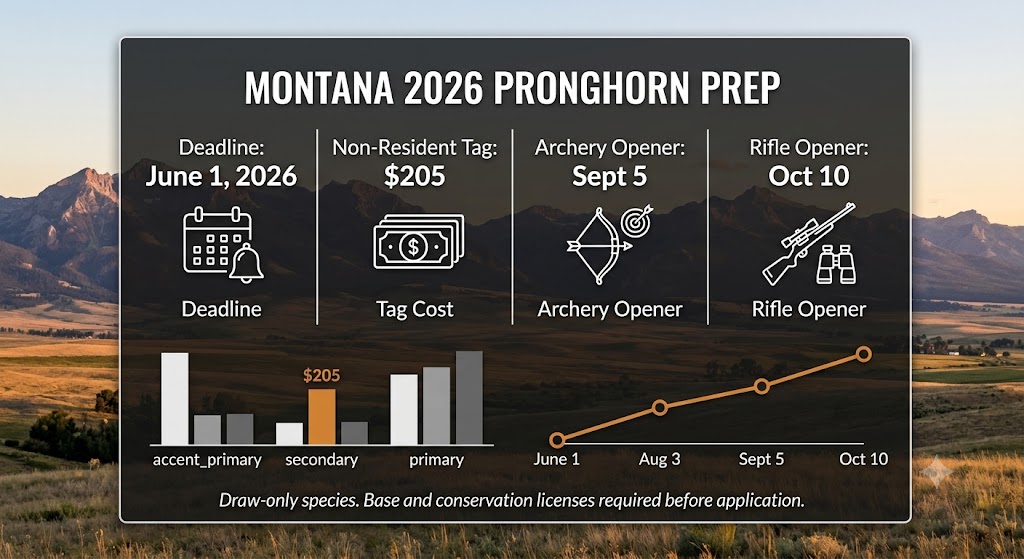
Quick Overview: Montana Antelope Season 2026 at a Glance
The table below summarizes the 2026 Montana pronghorn season from archery opener through the last rifle day, followed by a checklist of what you’ll need before you can legally hunt.
| Season Type | Dates (2026) | Bag Limit | Notes |
|---|---|---|---|
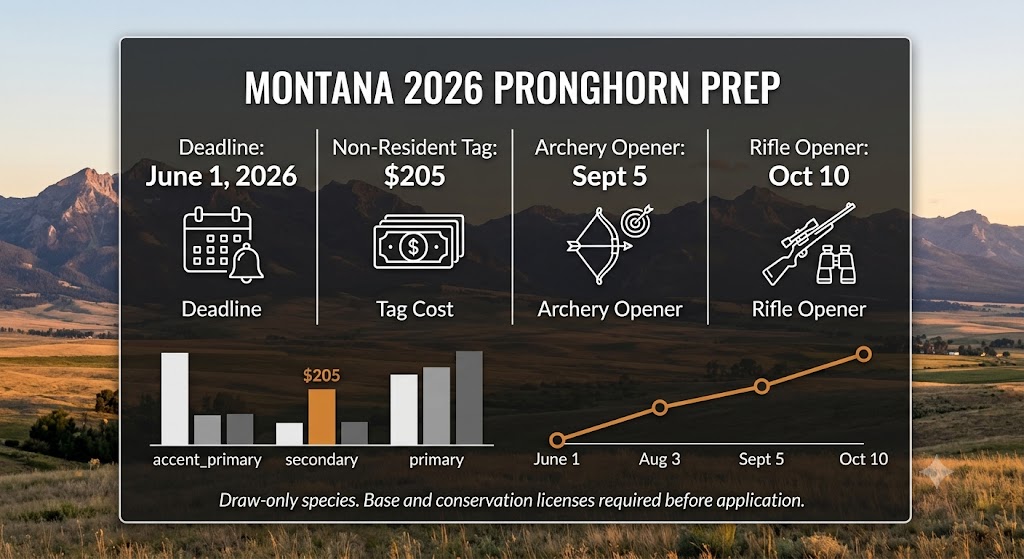
| Archery Season | September 5 – October 9 | One antelope (buck or doe, per district draw) | Requires an additional $10 archery stamp |
| General (Rifle) Season | October 10 – November 8 | One antelope (buck or doe, per district draw) | Limited to specific drawn districts |
| 900-Series Archery-Only Permit | August 15 – November 8 | One antelope per license | Covers Regions 4–7; hunters may apply for archery OR general, not both |
All dates per Montana FWP official antelope regulations.
Before you can hunt, you’ll need several licenses and must meet one eligibility requirement. Full detail is in the Licenses section below — here’s the short version:
- Base hunting license — required before purchasing any tag
- Conservation license — a required companion license that funds wildlife management statewide
- Antelope tag — allocated through a draw; $205 for non-residents, $20–$30 for residents
- Archery stamp — an additional $10 if you plan to hunt during the archery season
- Hunter education — mandatory for anyone born on or after January 1, 1985, before any license can be purchased
Montana Antelope Hunting Seasons
Montana splits its pronghorn season by hunting method — archery and general rifle — with specific dates set each year by Montana Fish, Wildlife & Parks. All hunting is tied to drawn districts, meaning your bag limit (buck or doe) and legal hunting area are determined by the specific permit you draw.
Archery Antelope Season (September 5 – October 9)
The archery season opens September 5 and runs through October 9, giving bowhunters five weeks before rifle hunters arrive. Holders of statewide 900-series archery-only permits get a longer window — August 15 through November 8 — covering parts of five Montana regions.
One cost that catches beginners off guard: you’ll need to purchase an additional $10 archery stamp before hunting the archery season, regardless of whether you drew a rifle tag or an archery-specific permit.
The archery season is worth serious consideration for first-time pronghorn hunters. Draw odds for the 900-20 archery permit ran 31% with one preference point, 58% with two, 82% with three, and 91% with four points in 2025 — substantially better than many rifle district odds. The season also covers the pronghorn rut, with peak breeding typically falling around September 21, when bucks are less cautious and more responsive to decoys.
General (Rifle) Season (October 10 – November 8)
The general rifle season opens October 10 and closes November 8, 2026. All rifle season hunts follow this same October 10 – November 8 window — variation between districts comes not in dates but in which animals and antler configurations are legal based on your drawn tag.
Experienced hunters consistently recommend arriving two or three days before the October 10 opener to glass the area and locate a target buck. Hunting pressure pushes bucks onto private land shortly after opening day, and hunters who arrive early with a specific animal already located have a measurably better chance of filling a tag on day one.
Understanding Districts & the 2026 Permit Structure
Your bag limit — buck or doe — depends entirely on the specific district you draw, so understanding Montana’s district system matters before you apply. The 700-series districts, particularly 007-20 and 007-21 in Region 7, are consistently the most popular and productive, accounting for roughly half of all non-resident application demand statewide.
For 2026, Montana made a change to its archery-only tag structure. Hunters now have two statewide archery-only permit options: the 399-20, valid for all of Region 3, and the 900-20, valid for Regions 4, 5, 6, and 7. One critical rule: hunters may apply for either an archery-only tag or a general tag in a single year — not both. Choosing which path to take before the application deadline is one of the more consequential planning decisions you’ll face. Review district boundaries using Montana FWP’s interactive GIS antelope district map.
Montana Antelope Licenses and Permits
Montana’s licensing structure is layered rather than complicated. There’s a meaningful difference between a base license, a conservation license, a species tag, and an archery stamp — and missing the draw deadline costs you an entire season. This section walks through the complete license stack in purchase order, then explains how the draw application process works for 2026.
Montana Hunting Licenses
Each layer of Montana’s licensing stack is a prerequisite for the next:
- Base hunting license — the foundational license every hunter must hold before buying any tag or permit in Montana
- Conservation license — a required companion license purchased alongside the base license; it funds Montana’s wildlife management programs and is mandatory for all hunters
- Antelope tag — the species-specific license obtained through the draw; gives you legal authority to hunt pronghorn in a specific district
- Archery stamp — an additional $10 license required only if you plan to hunt during the archery season, whether you hold a rifle tag or an archery-specific permit
The purchase order matters. Follow this sequence:
- Complete hunter education (if required)
- Purchase your base hunting license
- Purchase your conservation license
- Apply for your antelope tag through the draw
- Purchase your archery stamp (if bowhunting)
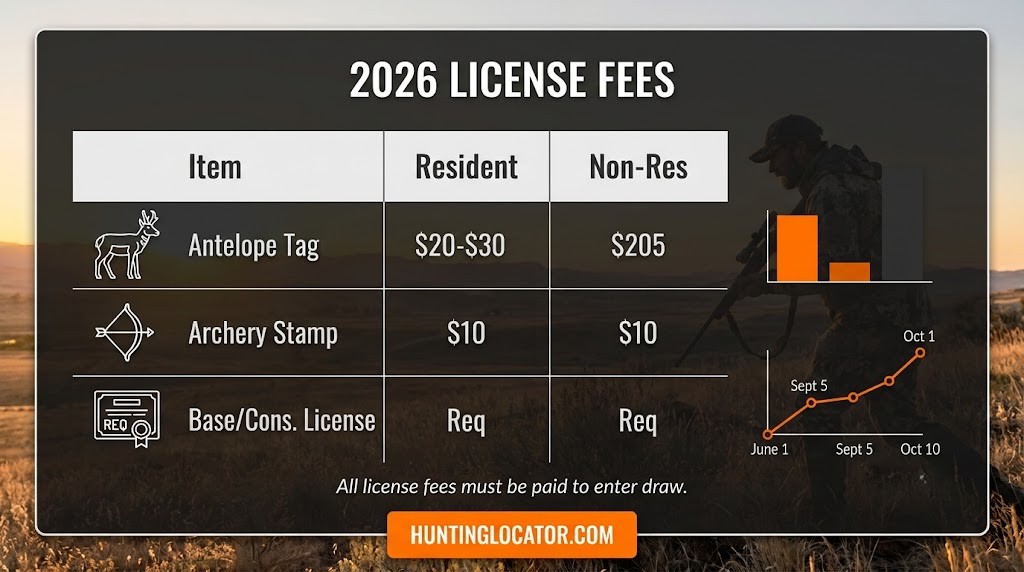
Current costs for residents and non-residents:
| License / Fee | Resident | Non-Resident | Notes |
|---|---|---|---|
| Antelope Tag | $20 – $30 | $205 | Non-resident figure includes a $5 application fee |
| Base & Conservation Licenses | Required | Required (~$10 base + $10 conservation for non-residents) | Must be purchased before applying for a tag |
| Archery Stamp | $10 | $10 | Required only if hunting during the archery season |
Fees per the Montana FWP official fee schedule and confirmed authoritative data.
If you were born on or after January 1, 1985, you must complete a hunter education course before purchasing any Montana hunting license. There are no exceptions. Complete the course, secure your certification, then work through the license stack. Montana offers both in-person and online hunter education options — check the FWP website for current availability.
Montana Hunting Permits & the Draw Application Process
Antelope tags in Montana are not sold over the counter. They’re allocated through a draw (lottery) application, meaning your 2026 tag depends on submitting an application before the deadline and on the preference points you’ve accumulated. Missing the window means waiting another full year.
Here’s the application process:
- Complete hunter education if you were born on or after January 1, 1985. No certification, no license.
- Purchase your base and conservation licenses. These are prerequisites before you can submit a draw application.
- Choose your district and tag type. Decide between an archery-only permit (399-20 or 900-20) or a general any-weapon tag — the 2026 rule stands: you may apply for one or the other in a single year, not both. Also decide whether to apply for an either-sex tag or an antelope B (doe-only) license.
- Apply online or at any Montana FWP office before the deadline. The 2026 application deadline is June 1, 2026, at 11:45 p.m. MT. Applications open in early March.
- Purchase a preference point with your application. Montana fronts a preference point at the time of application, so applying without banking a point is a missed opportunity. Even if you don’t draw, you’ll carry that point into next year.
- Check draw results. The 900-20 and B License draw results are announced June 12, 2026; rifle antelope draw results are released in early August.
- Purchase your archery stamp (if applicable) before opening day.
A few notes on strategy: residents will see good draw odds across roughly 75% of Montana’s available antelope districts at the preference point level. For non-residents targeting the 900-20 archery permit, 2025 odds ran 31% with one point and climbed to 91% with four — which makes a reasonable case for building points before targeting a competitive district. And some of Montana’s largest bucks come from the easiest-to-draw hunts, so accumulating points for a “premium” district isn’t always the most productive approach.
Montana Antelope: Where to Hunt
Finding the right place to hunt is often the hardest part — especially for non-residents who can’t scout in person before the season opens. Montana offers public access programs, guided outfitter options, and private land opportunities, each with different tradeoffs in cost, competition, and quality.
Best Public Lands for Montana Antelope
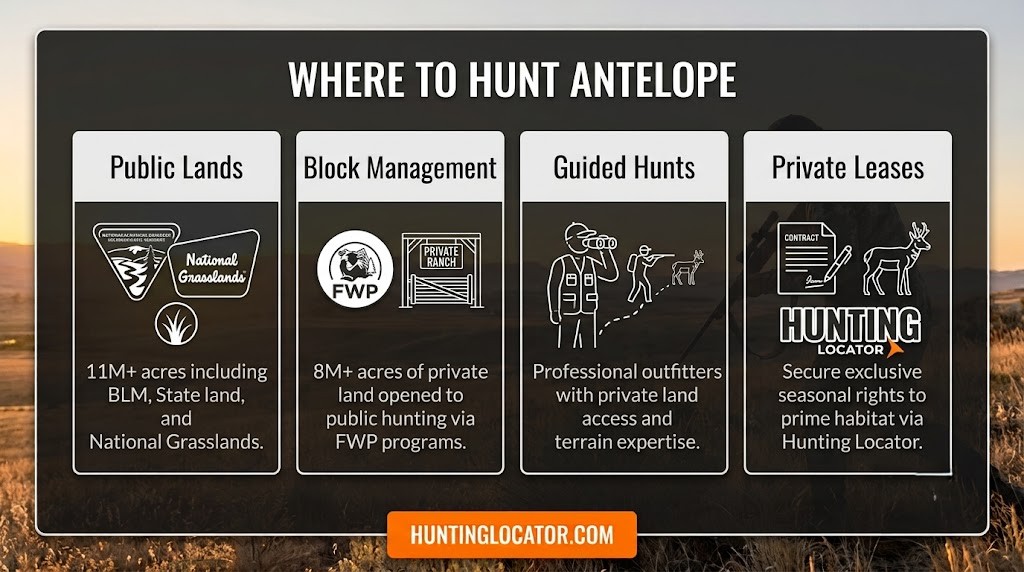
Montana’s pronghorn range covers over 11 million acres of public land, with the most productive country concentrated in eastern Montana’s plains and prairie regions. Knowing which access types to pursue — and how to combine them — matters more than raw acreage.
- BLM (Bureau of Land Management) land — Eastern Montana has large blocks of BLM land interspersed with private holdings, open to public hunting without a fee. These areas include some of the most productive pronghorn country in the state. Use onX Hunt or the FWP Hunt Planner to identify legal parcels within your drawn district before you arrive.
- Block Management Areas (BMA) — Montana’s Block Management program opens private land to public hunting at no cost through agreements between FWP and participating landowners. Montana has over 8 million acres of Block Management land available statewide, though antelope-specific BMA availability varies by district and year. Maps are available through FWP and updated annually.
- State land — Montana’s Department of Natural Resources and Conservation (DNRC) administers state trust lands generally open to public hunting. Check DNRC maps alongside FWP district boundaries to identify accessible parcels in your target area.
- National Grasslands — Portions of the Custer Gallatin National Forest’s national grasslands in southeastern Montana offer open-country pronghorn habitat with public access and typically less pressure than BLM land near major highways.
- 700-Series Districts in Region 7 — The 007-20 and 007-21 districts consistently produce the highest antelope harvest numbers in the state and are worth prioritizing when mapping your public land strategy near Jordan, Glasgow, and Miles City.
Guided Antelope Hunts in Montana
Hiring a guide isn’t the right call for every hunter, but for first-timers, non-residents unfamiliar with the terrain, or anyone working with a once-in-several-years tag, an outfitter can shift the odds meaningfully. Montana outfitters typically use spot-and-stalk techniques, covering significant ground daily to locate shootable bucks — and local knowledge of specific drainages and landowner relationships isn’t something satellite imagery replaces.
A guided hunt makes the most sense when:
- You drew a rifle tag in a competitive district and want to maximize the opportunity
- You’re a first-time pronghorn hunter who wants to learn glassing, stalking, and shot placement in the field
- You can’t make an advance scouting trip and need pre-season information on animal locations and access
- You want access to private land the outfitter has secured through existing landowner relationships
Draw odds for rifle antelope in competitive districts can run around 25% for non-residents in their first year, so if a guided hunt is part of your plan, establish that outfitter relationship early and confirm their access situation before you apply. A good guide will also help ensure you’re applied on time and for the correct area.
Private Land Hunting with Hunting Locator
Public land is plentiful in Montana, but a significant amount of prime antelope country is on private ground. Landowner relationships or private land access can make or break your hunt, and increased hunting pressure pushes bucks off public and BMA ground and onto private land shortly after the rifle season opener — which means the quality of your access matters as much as the quality of your tag.
There are two main paths to private land access: leasing and buying.
Hunting leases are the most practical option for most hunters. A lease gives you exclusive or shared access rights to a private landowner’s property for a defined season, typically paid annually. Costs vary based on acreage, location, and hunting quality. For non-residents especially, starting planning at least a year in advance is strongly recommended — quality leases in productive antelope districts don’t stay available long.
Buying hunting land is the longer-term investment. Owning Montana property means permanent, exclusive access with no annual renewal, the ability to manage habitat for pronghorn, and the option to pass that access to the next generation.
Whether you’re looking to lease for a season or buy Montana hunting ground, Hunting Locator’s Montana lease listings connect you directly with landowners ready to work with qualified hunters.
Hunting Locator lists verified lease and land-for-sale opportunities directly from landowners across Montana. Filter by location, acreage, and game type to find access that fits your 2026 pronghorn season. Explore Montana hunting leases and land on Hunting Locator.
Antelope Hunting Tips for Montana Success
Pronghorn are built for open country in ways that make them genuinely different from most big game. They have exceptional eyesight and use Montana’s open landscape to their full advantage. A few targeted adjustments to your approach will improve your chances considerably.
- Glass first, move second. Spend more time glassing from high vantage points than you spend stalking. Locate your target animal, identify escape routes, and plan your approach before moving.
- Use terrain on stalks. The open prairie looks featureless from a distance, but subtle ridges, coulees, and low buttes can conceal a moving hunter. Low buttes, cottonwood draws, and undulating hills are the primary cover features in productive antelope country — learn to read them before your approach.
- Hunt water sources. Pronghorn need water daily and typically stay within four miles of a water source. Identifying stock ponds, creek draws, and reservoirs within your district anchors your glassing strategy and helps predict movement throughout the day.
- Time the rut. Peak pronghorn breeding in Montana typically falls around September 21, squarely within the archery season. During the rut, bucks are less cautious and a decoy is particularly effective for drawing a buck into bow range.
- Arrive early for rifle season. Show up two or three days before the October 10 opener to scout and locate a target buck. Knowing where your animal is before opening morning gives you a meaningful advantage before pressure moves bucks onto private ground.
- Bring quality optics and a rangefinder. A rangefinder and quality binoculars are among the most important tools for open-country pronghorn hunting. Shots are often longer than expected, and guessing distance by eye isn’t a risk worth taking.
- Care for your meat immediately. Early archery temperatures can be warm. Field dress immediately after harvest, then age the meat 3–7 days at 34–40°F. Antelope meat is lean and dries quickly — vacuum seal any portion transported across state lines.
- Equip yourself right. Visit the Hunting Locator store for optics, field gear, and pronghorn-specific equipment for the 2026 season.
More Resources from Hunting Locator
- Montana Hunting Overview — A broad reference covering regulations, seasons, and access across species
- Montana Antelope Hunting Season — Additional pronghorn-specific tips, district insights, and planning resources
- Montana Elk Hunting Season — Planning resource for a combo antelope and elk trip
- Montana Deer Hunting Season — Whitetail and mule deer overlap with antelope country in eastern Montana
- Montana Bighorn Sheep Hunting Season — Montana bighorn draws are among the most coveted in the West
- Montana Bison Hunting Season — Regulations and access requirements before you apply
- Montana Black Bear Hunting Season — Spring and fall bear seasons across diverse habitat
- Montana Moose Hunting Season — Draw process and best habitat areas for one of Montana’s most coveted tags
- Montana Mountain Goat Hunting Season — Draw odds and gear considerations for high-alpine pursuits
- Montana Mountain Lion Hunting Season — Season structure, regulations, and access strategies
- Montana Bobcat Hunting Season — Regulations, season dates, and tips
- Montana Turkey Hunting Season — Spring and fall turkey hunting statewide
- Montana Game Bird Hunting Season — Sharptail grouse, pheasant, and Hungarian partridge across eastern Montana
- Montana Waterfowl Hunting Season — Prairie potholes, river corridors, and reservoir systems
- Montana Wolf Hunting Season — Current regulations and season structure
- Montana Hunting Leases — Private land lease listings across Montana, directly from landowners
Frequently Asked Questions
When does Montana antelope season open in 2026?
Montana’s archery antelope season opens September 5, 2026, and runs through October 9. The general rifle season opens October 10 and closes November 8. Hunters holding a 900-series archery-only permit have an extended window from August 15 through November 8. All dates are per Montana FWP official antelope regulations.
How much does a Montana antelope tag cost in 2026?
Non-residents pay $205 for an antelope tag, which includes a $5 nonrefundable application fee. Residents pay $20–$30. All hunters also need a base hunting license and a conservation license before they can apply. If you plan to hunt during the archery season, add $10 for the required archery stamp.
What is the application deadline for the 2026 Montana antelope draw?
The application deadline is June 1, 2026, at 11:45 p.m. Mountain Time. Applications open in early March and can be submitted online or at any Montana FWP office. Missing this deadline means waiting until the 2027 application window.
Can I apply for both an archery tag and a rifle tag in the same year?
No. For 2026, hunters may apply for either an archery-only tag or a general (rifle) tag in a single year — not both. You can, however, apply for one of the either-sex licenses and also apply for an antelope B (doe-only) license in the same year.
What are the draw odds for Montana antelope tags?
Draw odds vary significantly by district and tag type. For the 900-20 archery-only permit in 2025, non-resident draw odds were 31% with one preference point, 58% with two, 82% with three, and 91% with four points. Montana fronts a preference point with your application, so there’s no reason to apply without banking a point in the same transaction. For residents, draw odds are favorable across roughly 75% of the state’s antelope districts at the preference point level.
Do I need hunter education to hunt antelope in Montana?
If you were born on or after January 1, 1985, you must complete a hunter education course before purchasing any Montana hunting license. This requirement applies to residents and non-residents equally. Complete your certification before attempting to purchase your base license or apply for a tag.
Final Notes
Montana’s 2026 pronghorn season is in good shape — antelope numbers are stable to increasing across most of the state, the permit structure rewards hunters who apply early and bank preference points, and over 11 million acres of public land gives do-it-yourself hunters real options. The hunters who make the most of it will have their licensing handled before the June 1 deadline, their district selected with points already accumulated, and their land access arranged before opening week pressure does its work.
That last piece is where Hunting Locator is useful. Whether you want to lease proven private ground for a single season or explore owning Montana hunting land for the long term, the listings are live and the landowners are ready. Find your 2026 Montana antelope hunting access on Hunting Locator.


