This guide covers the 2026 Arizona pronghorn season in full — season dates, license and tag costs, the draw process, and where to hunt — whether you’re a longtime resident applicant or a non-resident planning your first Western hunt. Every date, fee, and regulation below reflects the Arizona Game and Fish Department’s (AZGFD) official structure for the year.
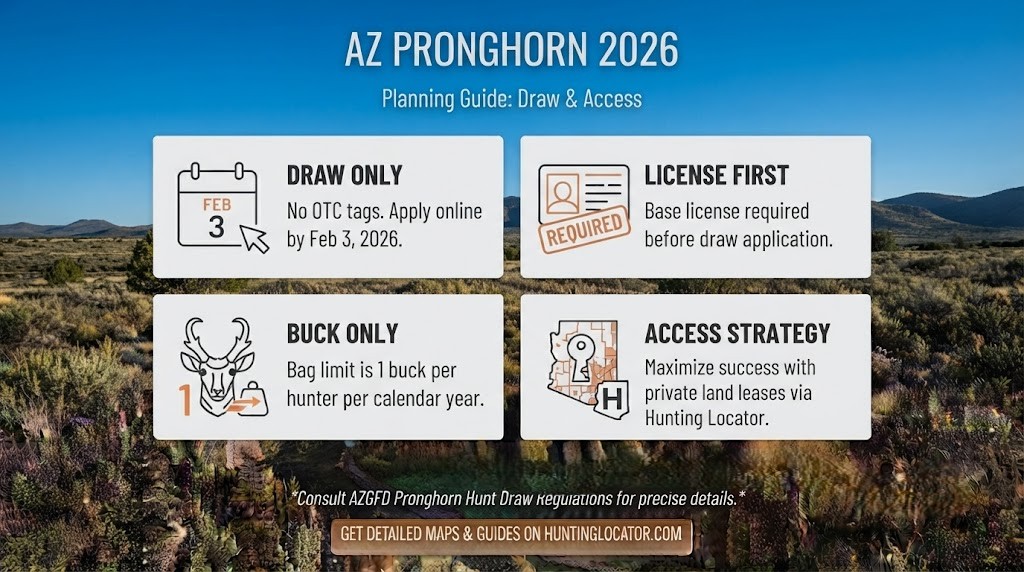
One thing to understand before anything else: Arizona pronghorn is 100% draw-only. There’s no landowner tag program and no way around the lottery. Knowing that up front is what separates a smooth 2026 season from a frustrating one.
This guide covers:
- Exact 2026 season dates by hunting method — archery, general firearms, muzzleloader, and youth — along with bag limits
- License, tag, and application fee breakdowns for residents and non-residents, plus a walkthrough of the draw process
- Where to hunt — public land, private leases through Hunting Locator, and guided options — plus field tips and gear recommendations
Quick Overview: 2026 Arizona Pronghorn Season at a Glance
Arizona’s 2026 pronghorn seasons run from late August through mid-October. Every tag is draw-only, unit-specific, and buck-only, and the bag limit across all methods is one pronghorn per hunter, per year, with no exceptions. For a broader look at how pronghorn fits into the state’s calendar, see all Arizona hunting seasons to line up your application timeline against other species.
| Season Type | Start Date | End Date | Bag Limit |
|---|---|---|---|
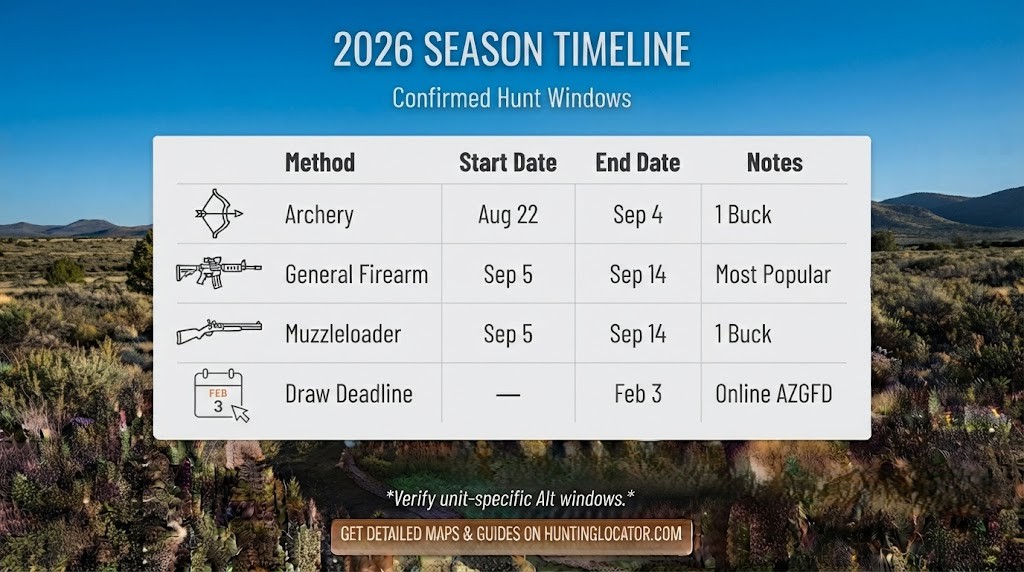
| Archery | Aug 22, 2026 | Sep 4, 2026 | 1 |
| Archery (Alt) | Aug 22, 2026 | Sep 11, 2026 | 1 |
| General Firearms | Sep 5, 2026 | Sep 14, 2026 | 1 |
| General Firearms (Alt) | Sep 12, 2026 | Sep 18, 2026 | 1 |
| Muzzleloader | Sep 5, 2026 | Sep 14, 2026 | 1 |
| Muzzleloader (Alt) | Oct 3, 2026 | Oct 12, 2026 | 1 |
| Youth | 3 Oct 2026 | Oct 12, 2026 | 1 |
Before you can hunt any of these seasons, AZGFD requires:
- A valid Arizona hunting license or combination license — required just to apply for the draw
- A drawn, unit-specific, buck-only pronghorn tag — no tag, no hunt, regardless of license status
- An online application submitted through the official AZGFD draw system by Feb. 3, 2026, at 11:59 p.m. Arizona time
- Hunter education certification for any hunter under 14, completed before the season begins
The sections below cover each of these in detail.
2026 Arizona Pronghorn Hunting Seasons
Arizona structures its pronghorn hunts by weapon type, and most methods offer both a primary season and an “Alt” (alternate) window to spread hunting pressure across the fall. Every hunt is buck-only, with a one-tag, one-animal bag limit. For 2026, the muzzleloader opportunity has consolidated mostly into September, while rifle hunters get more available windows — worth knowing as you pick an application strategy.
One clarification: you’ll often hear pronghorn called “antelope” in casual conversation and even in Arizona’s own hunt materials. The terms get used interchangeably, though pronghorn are technically a distinct species. More on that in the FAQ below.
Archery Season
Archery is the earliest opportunity at Arizona pronghorn, running Aug 22 – Sep 4, 2026 for the standard season, with an Alt archery hunt extending Aug 22 – Sep 11, 2026. It’s widely considered the most demanding method — pronghorn’s exceptional eyesight and the open terrain they favor make close-range bow shots a real test of patience and stalking skill. Expect warm, late-summer conditions during this window, so plan gear and pacing accordingly.
General Firearms Season
The general firearms season runs Sep 5 – Sep 14, 2026 (with an Alt firearms hunt from Sep 12 – Sep 18, 2026) and is Arizona’s most popular and highest-opportunity pronghorn season. Long-range shooting is common in the state’s wide-open country, and spot-and-stalk is the primary method hunters use to close the distance before taking a shot. This window typically offers the broadest stretch of good weather and animal activity, which is worth factoring in when choosing which season to apply for.
Muzzleloader & Youth Seasons
Muzzleloader hunters have two options for 2026: the standard season runs Sep 5 – Sep 14, 2026, alongside an Alt muzzleloader hunt from Oct 3 – Oct 12, 2026. These hunts appeal to hunters looking for the added challenge of a primitive weapon rather than a scoped rifle at long range.
The youth hunt, running Oct 3 – Oct 12, 2026, gives junior-eligible hunters a dedicated opportunity to pursue pronghorn. It also comes with cooler October weather compared to the late-August and early-September openers, which makes it a reasonable entry point for introducing a new hunter to the species.
Arizona Pronghorn Licenses, Permits & the Draw
Hunting Arizona pronghorn comes down to two things: a valid hunting license to apply, and a drawn tag to hunt. There’s no shortcut — 100% of pronghorn tags come through the draw, and Arizona doesn’t run any kind of landowner tag program. Every requirement below is set and enforced by AZGFD.
Arizona Hunting Licenses
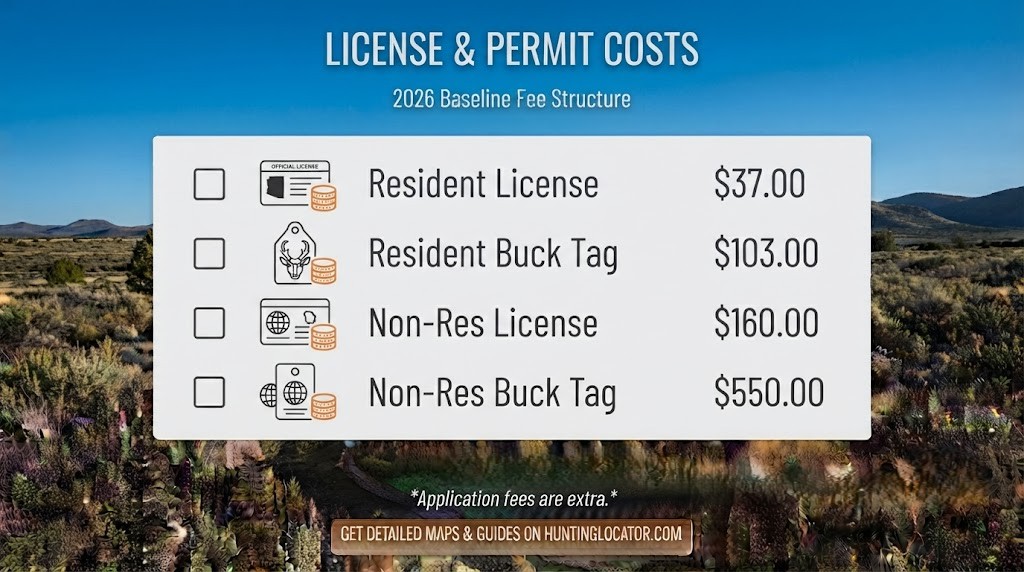
Before you can apply for a pronghorn tag, you need a valid hunting license. Here’s what that costs for the 2026 season:
| License Type | Resident | Non-Resident |
|---|---|---|
| Hunting License (to apply) | $37 | $160 (Combination Hunt/Fish) |
That $160 non-resident fee covers a combination hunt/fish license and functions as your entry ticket into the draw — it doesn’t guarantee a tag. It’s the mandatory first step every applicant, resident or not, has to clear before moving on to the actual pronghorn application.
Arizona Pronghorn Tags & Application Fees
Once you’re licensed, you pay a separate, non-refundable application fee to enter the draw for a specific hunt code. If you’re drawn, a second fee — the tag fee — comes due.
| Fee Type | Resident | Non-Resident |
|---|---|---|
| Application Fee (non-refundable, per species) | $13 | $15 |
| Tag Fee (only if drawn) | $103 | $550 |
The part that trips people up: you pay the application fee just to enter the draw, and the tag fee only if your name is actually drawn. If you’re not selected, you owe nothing further — no tag fee, no penalty, just the application fee you already paid.
For non-residents budgeting a 2026 Arizona pronghorn hunt, a simple worked estimate looks like this: $160 license + $15 application fee + $550 tag fee if drawn. Arizona limits non-resident opportunity to keep quality high, so this is a premium, competitive hunt by design — budget accordingly and go in with realistic expectations.
How the Arizona Pronghorn Draw Works
Applying for an Arizona pronghorn tag follows a clear sequence:
- Purchase your valid Arizona hunting or combination license — required before you can apply for any tag.
- Choose your unit-specific, buck-only hunt code(s) — you’ll rank a first and second choice, so pick strategically.
- Apply online through the official AZGFD draw system at azgfd.gov before Feb. 3, 2026, at 11:59 p.m. Arizona time.
- Pay the per-species application fee — $13 for residents, $15 for non-residents.
- Await your draw results, typically released in mid-spring. Pay the tag fee only if you’re drawn, and tags are issued ahead of the season opener.
Behind the scenes, Arizona’s draw system runs on a few key mechanics worth understanding:
- Bonus points increase your entries in the draw, and Arizona “squares” every applicant’s bonus points before running the lottery.
- A portion of tags — 20% — is allocated randomly, regardless of points, so even zero-point applicants have a genuine shot.
- Non-residents are capped at up to 10% of tags for any given hunt code — a cap, not a guarantee.
If you’re building a draw strategy, treat your first choice as your aspirational unit and your second choice as a realistic backup you’d actually be happy to hunt. Review historical trends for units you’re considering, and go in understanding that pronghorn is often a long-horizon, multi-year points project rather than a one-and-done application.
One more requirement worth flagging: hunters under 14 must complete a Department-approved hunter education course before the hunt, per AZGFD.
For the complete, official rundown — including exact eligibility language and deadline confirmation — check the official AZGFD draw information directly before you submit your application.
Where to Hunt Arizona Pronghorn
Once you understand the draw, the next question is where you’ll actually hunt if your name comes up. Arizona offers plenty of public land for pronghorn, plus opportunities to secure private access that can round out your hunt planning.
Best Public Lands for Pronghorn
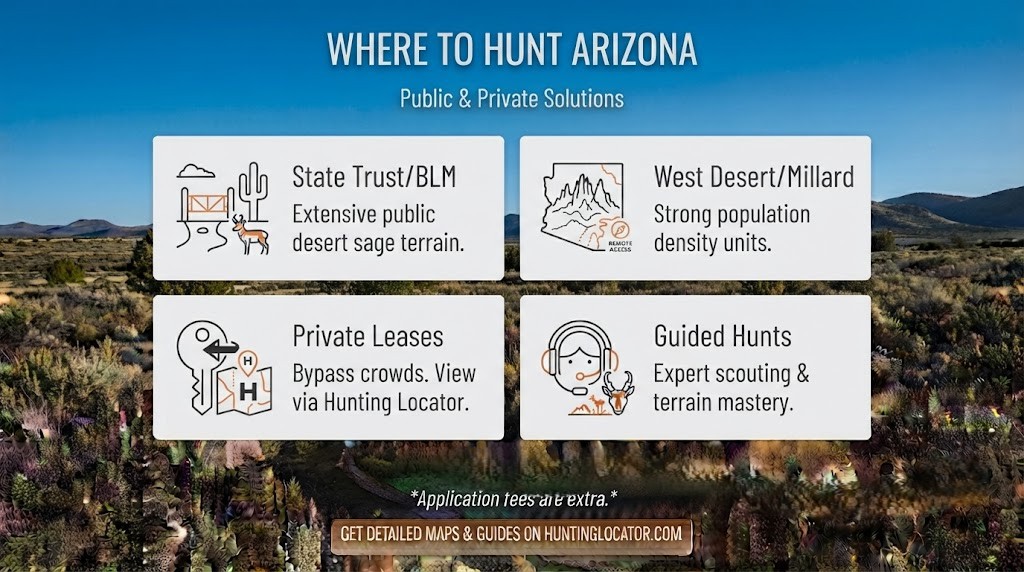
A large share of Arizona is public land, including State Trust Land accessible with a valid hunting license, and most of the state’s pronghorn population lives on public ground — which makes DIY hunts genuinely viable for residents and non-residents alike. A few things worth knowing as you plan:
- State Trust Land — accessible with a valid Arizona hunting license, and a major piece of the state’s huntable ground
- BLM land — vast, open country that matches classic pronghorn habitat
- National forest and grassland units — always check unit-specific boundaries before you head out
- Scout access points, water sources, and boundary lines ahead of time so you’re not wasting daylight during your hunt
Private Land Hunting with Hunting Locator
Many hunters pair a public-land tag with private ground for lodging, base-camp staging, scouting-adjacent access, or building a long-term relationship in a unit they plan to return to year after year. Private land access doesn’t replace the draw, but it can make your hunt smoother and open doors to future seasons.
Arizona pronghorn is draw-only, and there is no landowner tag program in this state — leasing private land will not get you a tag or bypass the lottery. What it will do is give you access, lodging, and staging ground near the country you’re hunting, plus a foothold for other Arizona species down the road.
That’s where Hunting Locator comes in. We connect hunters directly with Arizona landowners who lease or sell hunting land, so you’re not starting from scratch every time you need ground to work with. Whether you’re looking for a season-long lease near your unit or considering buying property for the long haul, our platform puts real landowner connections in front of you — no guesswork, no cold calls.
Ready to lock in access before the season fills up? Browse Arizona hunting leases and start connecting with landowners near your target units. Quality access goes fast, so it pays to start early.
Guided Pronghorn Hunts
If you’re weighing whether to go it alone or bring in a guide, it helps to know what each option actually offers. A guided pronghorn hunt typically includes:
- Local knowledge of the unit — guides know the terrain, water sources, and where bucks tend to hold
- Scouting and glassing support — someone else putting in the pre-season legwork on your behalf
- Logistics handled — lodging, access routes, and field prep taken care of
- Higher cost, higher convenience — you’re paying for time saved and a smoother experience
Guided hunts tend to suit non-resident hunters who want a turnkey experience without the logistics of scouting a new state from scratch. DIY hunting costs less but demands more self-reliance — you’re doing your own scouting, navigating access, and making every call in the field. Either way, a guide doesn’t bypass the draw: you still need a drawn tag in hand before any guide can take you into the field.
Arizona Pronghorn Hunting Tips & Gear
Success on an Arizona pronghorn hunt comes down to a handful of fundamentals, most of them built around spotting animals early and closing the distance with patience. What consistently makes the difference in the field:
- Glass Before You Move: Pronghorn have extraordinary eyesight and can pick up movement across vast open ground. Locate animals with quality optics before you commit to closing the distance.
- Master Spot-and-Stalk: This is the primary method across Arizona’s open terrain — use folds in the land and patience to work your way into range without spooking the herd.
- Prepare for Long Shots: Rifle shots at extended range are common in this kind of open country. Practice at distance ahead of time, know your effective range, and never take a shot beyond your ability or at a running animal.
- Range Everything: Distance is deceiving on open prairie. A reliable rangefinder prevents misjudged shots and missed opportunities.
- Dress in Layers: Arizona days can swing from cool mornings to hot afternoons. Thin, removable layers keep you comfortable and mobile without weighing you down.
- Hunt All Day: Pronghorn stay active throughout the day, so you don’t need to limit your hunting to dawn and dusk hours.
- Handle Meat Fast: In the heat, skin, quarter, and cool the animal as quickly as possible — pronghorn is excellent table fare when it’s handled properly and promptly.
Getting the right gear together makes a real difference on a hunt built around glassing and long-range shots. You’ll want quality binoculars, a solid spotting scope, a dependable rangefinder, a flat-shooting rifle paired with a good riflescope and bipod, and layered clothing that adapts to Arizona’s temperature swings. When you’re ready, gear up at our store for the optics, rangefinders, and long-range equipment built for this kind of open-country hunting.
More Resources from Hunting Locator
Keep planning with these Hunting Locator resources — guides and tools to round out your 2026 Arizona season.
Pronghorn Deep Dives & Planning
- Arizona pronghorn hunting deep dive — a companion guide covering additional pronghorn-specific strategy and unit insight
- All Arizona hunting seasons — the master hub for every species’ season dates in one place
- Arizona hunting leases — browse current private land leasing opportunities across the state
- Hunting Locator gear store — shop optics, rangefinders, and rifles built for open-country hunting
Other Arizona Big Game
- Arizona elk hunting guide — season dates and draw info for Arizona’s other premier big-game species
- Arizona deer hunting guide — coues and mule deer season breakdowns
- Arizona bighorn sheep season — one of the state’s most exclusive draw hunts
- Arizona bison hunting guide — a rare Arizona hunting opportunity
- Arizona bear hunting season — dates and unit info for black bear hunters
- Arizona mountain lion hunting — year-round pursuit opportunities and regulations
Arizona Small Game & Bird Hunting
- Arizona javelina hunting season — a popular winter hunt option
- Arizona upland game hunting — quail and other upland bird seasons
- Arizona small game hunting — rabbit, squirrel, and other small game info
- Arizona dove hunting season — one of the state’s most popular early-season hunts
Frequently Asked Questions
What is the bag limit for pronghorn in Arizona?
The bag limit is one pronghorn per year, and every tag is buck-only. All tags are unit-specific and issued exclusively through the draw, per AZGFD regulations — there’s no over-the-counter or general season option for this species.
How much does a non-resident Arizona antelope tag cost?
The non-resident pronghorn tag fee is $550, but you only pay it if you’re drawn. Before that, budget for a $160 combination hunting license and a $15 per-species application fee — roughly $725 total if your name comes up in the draw.
What is the deadline to apply for the 2026 Arizona pronghorn draw?
The deadline is Feb. 3, 2026, at 11:59 p.m. Arizona time, applied for online through the AZGFD draw system at azgfd.gov. You must hold a valid Arizona hunting or combination license before you’re able to submit your application.
What’s the difference between pronghorn and antelope?
Pronghorn are commonly called “antelope” in everyday conversation, but they’re actually a distinct North American species, not a true antelope. In Arizona’s hunting regulations and among hunters generally, the two terms are used interchangeably without any practical difference.
Can I lease private land to hunt pronghorn in Arizona?
Yes, you can lease private land for access, lodging, and staging, but Arizona has no landowner tag program, so a lease never grants or bypasses the draw. You still need a drawn tag to hunt. Hunting Locator connects hunters directly with Arizona landowners offering leases for exactly this kind of supplemental access.
How do bonus points work in the Arizona pronghorn draw?
Arizona “squares” your bonus points before running the draw, which weights your odds based on accumulated points. However, 20% of all tags are allocated randomly regardless of points, meaning hunters with few or zero points still have a genuine chance to draw.
The Final Shot
Planning a 2026 Arizona pronghorn hunt comes down to three things: knowing your exact season dates, understanding the draw-only reality and its costs, and lining up the right access before opening day arrives. With the Feb. 3, 2026 deadline on the calendar and resident and non-resident fees laid out clearly, you have what you need to submit a solid application this year.
Your next move is straightforward: buy your license, pick your units, apply before February 3, and start lining up access and gear well ahead of the season. Everything in this guide reflects the official 2026 season structure and AZGFD’s draw process.
When it’s time to secure your ground, Hunting Locator connects hunters directly with Arizona landowners for private access. Browse Arizona hunting leases and gear up at our store as you get ready for opening day.


